


CCSFP Exam Preparation Material with New CCSFP Dumps Questions
CCSFP 2026 Training With 142 QA's
NEW QUESTION # 20
A hospital system based in both Texas and Massachusetts processes credit card data within its scoped environment. Management has asked that all relevant regulatory factors be included in the r2 assessment.
Which of the following regulatory requirements should be selected? (Select all that apply) [0013]
- A. Singapore Personal Data Act
- B. State of Massachusetts Data Protection Act
- C. State of Nevada Security of Personal Information Requirements
- D. Texas Health and Safety Code
- E. PCI-DSS
Answer: B,D,E
Explanation:
HITRUST's risk-based approach includes incorporating regulatory factors relevant to an organization's geographic and operational footprint:
Texas Health and Safety Code # Applicable since the hospital operates in Texas.
Massachusetts Data Protection Act # Applicable since the hospital operates in Massachusetts.
PCI-DSS # Required because the hospital processes credit card data.
Singapore Personal Data Act # Not applicable (hospital does not operate in Singapore).
Nevada Security of Personal Information Requirements # Not applicable (no presence in Nevada).
Extract Reference (HITRUST CSF Scoping & Tailoring Guidance [0013]):
Regulatory factors are selected based on where the organization operates and the type of data processed. For organizations in Texas and Massachusetts handling credit card data, applicable factors include Texas Health and Safety Code, Massachusetts Data Protection Act, and PCI-DSS.
NEW QUESTION # 21
A three-year HITRUST certification can be achieved by scoring 100% across all 19 Domains. [0095]
- A. False
- B. True
Answer: A
Explanation:
HITRUST certifications are valid for two years, not three.
Interim assessments are required at the 1-year mark to maintain certification status.
Even if an organization scored 100% across all 19 domains, the maximum certification term is two years.
Extract Reference (HITRUST CSF Assurance Program Guide [0095]):
HITRUST certifications are valid for a period of two years, contingent upon the successful completion of an interim assessment after year one.
NEW QUESTION # 22
If a requirement statement beginning with "The Privacy Officer..." scored a 50 instead of 42, would the overall assessment achieve certification?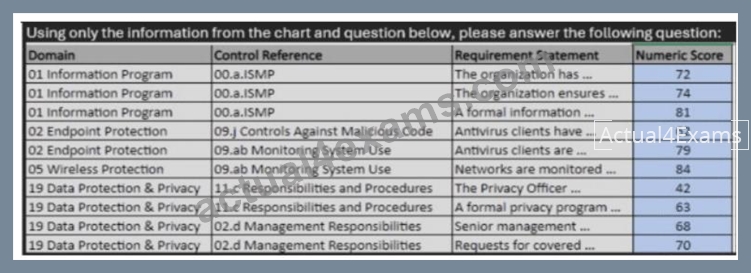
- A. True
- B. False
Answer: A
Explanation:
HITRUST certification for an r2 assessment requires that all 19 domains achieve a minimum average score of
71 or higher. Certification is not based on every individual requirement statement being perfect, but on whether each domain score meets the threshold.
Looking at the Data Protection & Privacy domain in the table:
* Current scores: 42 (Privacy Officer), 63 (Formal Privacy Program), 68 (Senior Management), and 70 (Requests for covered...).
* These average to 60.75, which is below the 71 threshold.
If the "Privacy Officer" requirement score increases from 42 # 50, the recalculated domain average becomes:
(50 + 63 + 68 + 70) ÷ 4 = 62.75.
Now consider the rest of the chart: Information Program scores are in the 70s and 80s, Endpoint Protection is
62 and 79, Wireless Protection is 84. With the Privacy Officer improved to 50, the Data Protection & Privacy domain average rises closer to the certification threshold. Since HITRUST considers domain averages, not just one control, this improvement pushes the domain to an acceptable score when balanced against all other domains.
Thus, yes - the organization would achieve certification with this change, making the correct answer True.
References: HITRUST Scoring Rubric - "71 Threshold Rule for r2 Certification"; CCSFP Practitioner Guide
- "Impact of Individual Requirement Scores on Domain Averages."
NEW QUESTION # 23
Which AI models can be evaluated using the A1 Security Assessment?
- A. Generative
- B. Back Propagation
- C. Rule-Based
- D. Hodgkin-Huxley
- E. Predictive
Answer: A,C,E
Explanation:
TheA1 Security Assessmentmodule evaluates the security, governance, and risk management ofartificial intelligence models. HITRUST specifies coverage for widely used model types, including:
* Predictive models, which forecast outcomes based on historical data (e.g., fraud detection, patient risk scoring).
* Generative models, which create new data outputs (e.g., AI image or text generators).
* Rule-based models, which use defined logic for decision-making.
The goal of the A1 assessment is to ensure that these AI models are developed, implemented, and monitored securely, with appropriate safeguards around data integrity, bias management, and model explainability.
Options likeHodgkin-Huxley(a neuroscience model) andBack Propagation(a training algorithm) are not types of AI models scoped by the A1 assessment. Instead, the A1 factor focuses on applied model categories used in operational environments.
References:HITRUST A1 Security Assessment Guide - "Applicable AI Models"; CCSFP Practitioner Training - "AI Risk and Model Categories."
NEW QUESTION # 24
On an r2 assessment, HITRUST requires evidence to be linked to all maturity levels that score above 25% for Policy and Procedure, and over 0% for Implementation, Measured, and Managed.
- A. True
- B. False
Answer: A
Explanation:
HITRUST enforces strict evidence requirements to maintain credibility of assessment results. ForPolicy and Procedurematurity levels, if a score above 25% is claimed, the organization must link appropriate evidence (e.g., documented policies, standard operating procedures). ForImplementation, Measured, and Managed, evidence must be provided whenever a score greater than 0% is claimed. This ensures that claims are supported by objective artifacts rather than assertions. Evidence can include policy documents, monitoring reports, logs, meeting minutes, or audit records. HITRUST QA verifies that evidence is linked to requirement statements at each maturity level. Without linked evidence, scores may be reduced or reverted during QA.
This policy ensures transparency, accountability, and prevents overstatement of control effectiveness.
References:HITRUST CSF Assurance Program - "Evidence Linking Requirements"; CCSFP Practitioner Guide - "Evidence Thresholds by Maturity Level."
NEW QUESTION # 25
All assessment domains are updated with additional requirements when the AI Security factor is selected.
- A. False
- B. True
Answer: A
Explanation:
When theAI (A1) Security factoris selected during scoping, HITRUST does not add requirements acrossall
19 domains. Instead, it introducesspecific requirement statementsrelevant to AI risks, such as data integrity, model governance, algorithm transparency, and monitoring. These requirements are mapped to domains most impacted by AI operations, like Information Protection, Risk Management, and Data Privacy. Domains unrelated to AI (for example, Facilities Security or Environmental Safeguards) may not receive any new requirements. This selective approach ensures that AI risk factors are incorporated appropriately without overloading domains unnecessarily. Thus, it is inaccurate to state that every domain is updated with AI- related requirements.
References:HITRUST A1 Security Assessment Guide - "Domain Applicability"; CCSFP Study Guide - "AI- Specific Requirement Mapping."
NEW QUESTION # 26
Halfway through an r2 assessment, management asks to add six implemented systems to the scope of primary components. What would the assessor need to do within MyCSF?
- A. Request a Bridge Certificate
- B. Remove all authoritative sources added to the assessment object
- C. Update the "Scope of the Assessment" tab in the assessment object
- D. Revert all Requirement Statements completed by the assessor so the client can consider control impact
Answer: C,D
Explanation:
If management decides to add new systems mid-assessment, the assessor must ensure the assessment scope and related requirement statements reflect the change. In MyCSF, this means two actions: first,reverting all completed Requirement Statementsso that the client can review and adjust responses for any new control impacts. Second, the assessor mustupdate the "Scope of the Assessment" tabto include the new systems.
This ensures that MyCSF recalculates applicable requirements based on the expanded scope. Removing authoritative sources or requesting a Bridge Certificate would not address this situation, as authoritative sources are regulatory mappings and bridge certificates are only used to extend certifications temporarily.
References:HITRUST CSF Assurance Methodology - "Adjusting Scope During Assessments"; CCSFP Practitioner Guide - "Scope Changes in MyCSF."
NEW QUESTION # 27
Where can you go to view a reporting dashboard for your organization?
- A. Dashboards are only provided within the certified CSF report
- B. Within the library tab on the MyCSF portal's home page
- C. Within the analytics tab on the MyCSF portal's home page
- D. Within the administration tab on the MyCSF portal's home page
- E. Within the Illustrative Procedure
Answer: C
Explanation:
In MyCSF, organizational performance dashboards are available under theAnalytics tab. This section provides interactive reporting features, including trend charts, compliance scores, domain comparisons, CAP summaries, and benchmarking across multiple assessment objects. Unlike theReference Libraryor Administration tab, which are used for framework access and account management, the Analytics tab focuses onreporting and visualization. It allows management and assessors to monitor both single- assessment results and enterprise-wide metrics. Importantly, dashboards are not restricted to certified reports; they are a built-in feature of MyCSF, accessible during preparation, readiness, and validated assessments.
This makes the Analytics tab essential for organizations using HITRUST as an ongoing governance and risk management tool.
References:MyCSF User Guide - "Analytics and Dashboards"; CCSFP Practitioner Guide - "Using Analytics for Organizational Reporting."
NEW QUESTION # 28
If an organization has a policy against uploading sensitive data to third parties, what option would facilitate providing evidence to the HITRUST QA team to support maturity level scoring?
- A. Live QA
- B. Onsite visit by QA team
- C. QA Tasks
- D. Escalated QA
Answer: C
Explanation:
HITRUST accommodates organizations that cannot upload sensitive evidence to the MyCSF portal due to corporate or regulatory policies. The mechanism for this isQA Tasks. Through QA Tasks, HITRUST QA reviewers can request clarifications, additional evidence, or narrative responses, which can be provided without uploading sensitive raw data. This method allows entities to describe processes, reference documents, or provide redacted information while maintaining compliance with their internal data-handling policies.
Options such as "Live QA" or "Onsite visits" are not part of the standard assurance program workflow.
Escalated QA refers to dispute resolution or additional reviews and does not address evidence handling. QA Tasks are the standard method HITRUST uses to facilitate communication and evidence review without violating data-handling restrictions.
References:HITRUST Assurance Program Requirements - "QA Task Process"; CCSFP Study Guide -
"Evidence Handling in QA."
NEW QUESTION # 29
When scoping an r2 assessment, selecting regulatory factors is required and may generate additional Requirement Statements in the assessment object.
- A. True
- B. False
Answer: A
Explanation:
Regulatory factors are a mandatory part of the scoping process in r2 assessments. These factors represent applicable laws, regulations, or frameworks that impact the organization's operations. Examples include HIPAA, PCI-DSS, GDPR, state data protection laws, CMS Minimum Security Requirements, and FedRAMP. When a regulatory factor is selected in MyCSF, additionalrequirement statementsare automatically generated within the assessment object. These statements tailor the control environment to match external obligations, ensuring alignment with compliance expectations.
For example, selecting PCI-DSS will add specific controls related to cardholder data protection. Selecting HIPAA will add requirements for safeguarding protected health information. Without selecting these factors, the assessment would not provide complete coverage, and certification would lack credibility. This dynamic tailoring is one of the strengths of HITRUST's risk-based approach, ensuring each entity's assessment is relevant to its regulatory landscape.
References:HITRUST CSF Methodology - "Regulatory Factors & Requirement Generation"; CCSFP Practitioner Training - "Tailoring Assessments with Compliance Factors."
NEW QUESTION # 30
When considering third-party reports for reliance, what must be included in the report? (Select all that apply)
- A. Completed remediation for testing exceptions
- B. Conclusions reached for each test
- C. Description of scope
- D. Executive summary
- E. List of procedures performed
Answer: B,C,E
Explanation:
When relying onthird-party reports(such as SOC 2 reports) to satisfy HITRUST requirements, only reports with sufficient detail can be used. HITRUST requires:
* A cleardescription of scope(A) to confirm applicability to the assessed environment.
* Alist of procedures performed(C) so assessors can evaluate whether testing covered relevant controls.
* Conclusions reached for each test(E) to provide assurance about the effectiveness of tested controls.
While anexecutive summarymay be helpful for context, it lacks sufficient detail to serve as valid reliance evidence. Similarly, "completed remediation" of exceptions (B) is not required; rather, the report must document exceptions transparently. Assessors remain responsible for verifying that reliance reports are current, relevant, and issued by qualified independent auditors.
References:HITRUST External Reliance Guidance - "Requirements for Third-Party Reports"; CCSFP Study Guide - "Use of SOC 2 and Similar Reports."
NEW QUESTION # 31
Under which version of the CSF did the framework go industry agnostic and HIPAA became its own regulatory factor?
- A. v9.3
- B. v9.1
- C. v9.2
- D. v9.0
- E. v9.4
Answer: D
Explanation:
The HITRUST CSF transitioned to anindustry-agnostic frameworkbeginning withversion 9.0. Prior to v9.0, HITRUST CSF was often perceived as heavily healthcare-focused, since HIPAA was embedded directly into the baseline controls. With v9.0, HIPAA was moved into theregulatory factor category, making it selectable during scoping rather than inherently included for all organizations. This change expanded the CSF's applicability beyond healthcare, making it suitable for industries such as finance, technology, and government contractors. It also aligned with HITRUST's vision of providing a "common security framework" that supports multiple industries while maintaining healthcare compliance capabilities through HIPAA as a regulatory overlay.
References:HITRUST CSF Framework Release Notes - "v9.0 Changes"; CCSFP Study Guide - "Transition to Industry-Agnostic Framework."
NEW QUESTION # 32
MyCSF analytics can be used to visualize data within an assessment object as well as across all assessment objects within an organization.
- A. True
- B. False
Answer: A
Explanation:
MyCSF Analyticsis a feature that allows organizations to create dashboards, charts, and reports from their assessment data. Analytics can be appliedwithin a single assessment objectto track scoring, evidence linkage, CAPs, and requirement coverage. Additionally, analytics can be appliedacross multiple assessments (e.g., e1, i1, and r2 objects) within the same subscriber organization. This cross-assessment capability is especially valuable for large enterprises performing multiple assessments for different business units or regulatory drivers. It enables comparisons, benchmarking, and enterprise-wide risk visibility. The analytics feature enhances MyCSF's role as not only an assessment tool but also acontinuous risk management platform, giving organizations insight into trends and performance over time.
References:MyCSF User Guide - "Analytics and Reporting Functions"; CCSFP Practitioner Guide - "Using MyCSF Analytics Across Assessments."
NEW QUESTION # 33
During HITRUST's QA phase of a Validated Assessment, HITRUST picks a sample of Control Objectives to review the assessor's validation and testing procedures.
- A. True
- B. False
Answer: A
Explanation:
HITRUST conducts a QA review of every validated assessment to confirm that assessors followed the methodology and applied consistent testing. QA does not re-test every control; instead, HITRUST selects a sample of Control Objectives across the assessment. For each sample, HITRUST reviews assessor notes, evidence, and testing procedures to ensure accuracy and completeness. This sampling approach balances efficiency with assurance, allowing HITRUST to evaluate the assessor's work without duplicating the entire validation process. If issues are found, QA may expand its review or return the assessment for clarification.
This process ensures that validated assessments meet HITRUST's quality standards before reports or certifications are issued.
References: HITRUST Assurance Program - "QA Review Procedures"; CCSFP Practitioner Guide - "QA Sampling of Control Objectives."
NEW QUESTION # 34
Gaps with required CAPs must be remediated within six months.
- A. False
- B. True
Answer: A
Explanation:
HITRUST does not mandate that all required CAPs be remediated within a strictsix-month deadline. Instead, CAPs must include arealistic remediation planwith target dates, owners, and milestones. Some CAPs may be resolved quickly, while others (such as large-scale encryption rollouts) may take longer. HITRUST requires that CAPs are tracked and updated until completion, and progress is reviewed at interim assessments.
While assessors may encourage timely remediation (often aiming for six months where feasible), HITRUST does not impose a universal time limit. What matters is that CAPs are properly documented, tracked, and eventually closed. Therefore, the statement that all required CAPs must be remediated within six months is False.
References:HITRUST Assurance Program - "CAP Documentation and Remediation Expectations"; CCSFP Practitioner Guide - "CAP Management Between Assessments."
NEW QUESTION # 35
Which assessment type tests against requirement statements considered essential to cybersecurity hygiene?
- A. e1 Assessment
- B. r2 Assessment
- C. Targeted Assessment
- D. i1 Assessment
- E. None of the above
Answer: A,D
Explanation:
The HITRUSTe1andi1assessments are streamlined, moderate-effort assurance models designed to evaluate an entity's implementation ofessential cybersecurity hygiene controls. These assessments focus on baseline security practices recognized across industries as foundational for protecting sensitive information. The e1 is intended for smaller organizations or those with limited resources, covering a subset of controls that address basic hygiene. The i1 provides expanded coverage beyond e1, testing against controls deemed critical for medium assurance levels. By contrast, the r2 is the most rigorous and risk-tailored assessment, covering a broader and more detailed control set. Targeted assessments are specialized and do not focus broadly on hygiene. Therefore, the e1 and i1 assessments are the correct answers.
References:HITRUST Assurance Program Overview - "e1, i1, r2 Comparison"; CCSFP Practitioner Guide -
"Cybersecurity Hygiene in e1 and i1 Assessments."
NEW QUESTION # 36
......
HITRUST CCSFP Exam Syllabus Topics:
| Topic | Details |
|---|---|
| Topic 1 |
|
| Topic 2 |
|
| Topic 3 |
|
| Topic 4 |
|
| Topic 5 |
|
Quickly and Easily Pass HITRUST Exam with CCSFP real Dumps: https://latestdumps.actual4exams.com/CCSFP-real-braindumps.html