


D-ISM-FN-01 Self-Study Guide for Becoming an Dell Information Storage and Management Foundations v2 Exam Expert
D-ISM-FN-01 Study Guide Realistic Verified D-ISM-FN-01 Dumps
NEW QUESTION # 10
Match each OSD (Object Storage Device) feature with its description: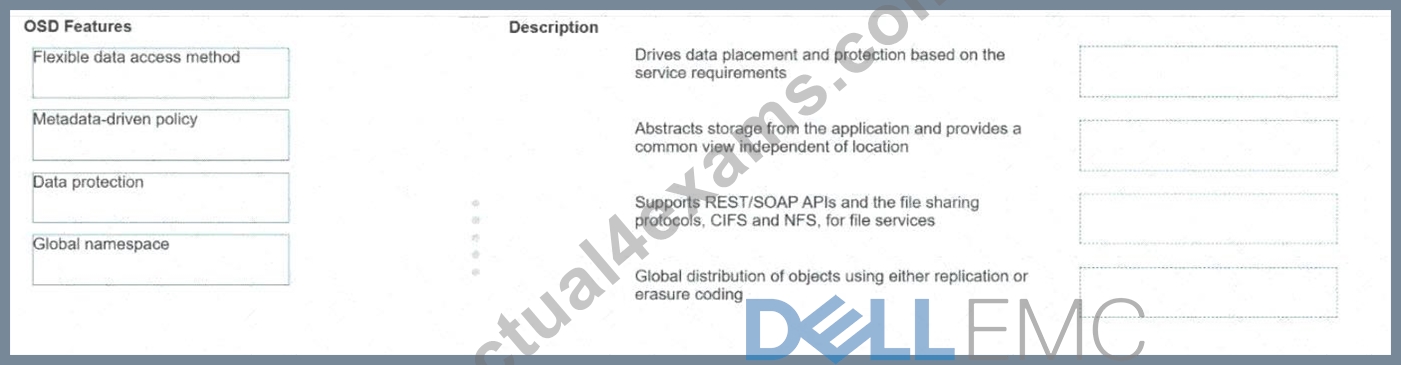
Answer:
Explanation: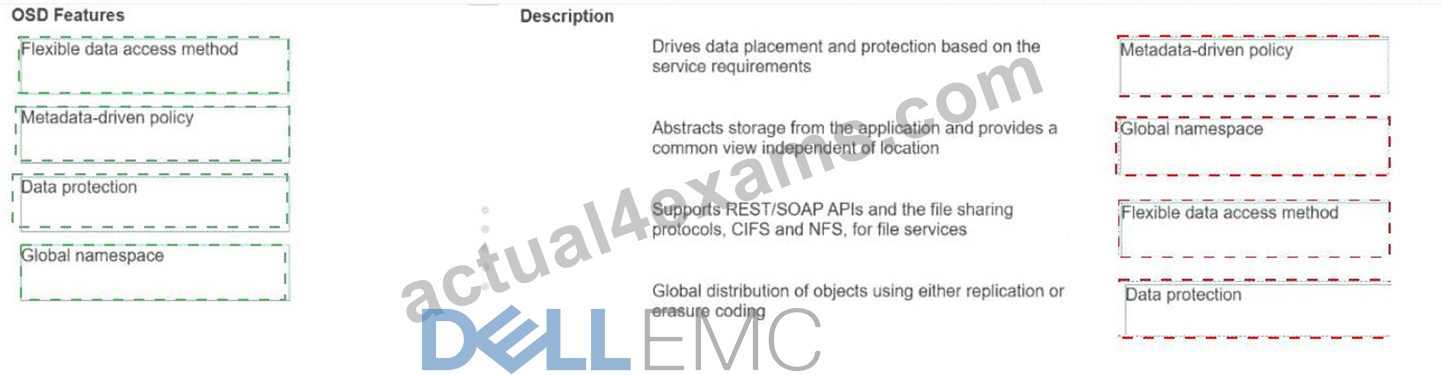
Explanation:
A screenshot of a computer AI-generated content may be incorrect.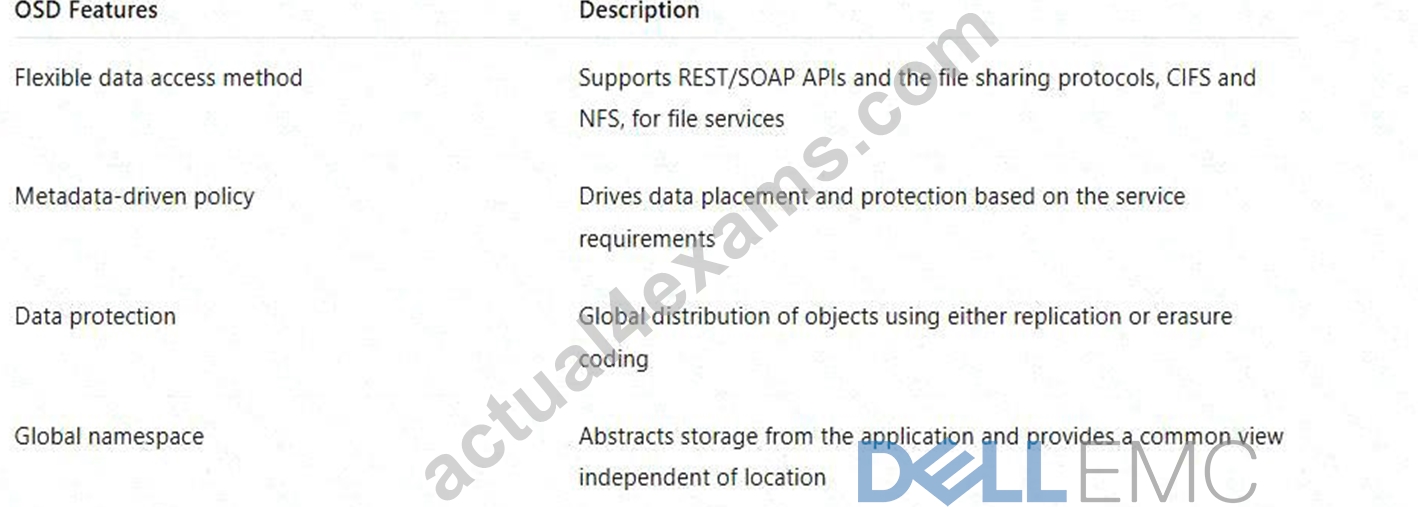
#Flexible data access method:Object storage can offer multiple ways to access and interact with stored data, such as REST/SOAP APIs (for object-based access) and file-sharing protocols (CIFS, NFS) for file-level access.
#Metadata-driven policy:Object storage uses rich metadata to define how objects are placed, protected, and managed, driven by policies that respond to service-level requirements.
#Data protection:Object storage systems implement data protection at a global scale through replication or erasure coding to ensure data durability and availability.
#Global namespace:Object storage abstracts physical locations, providing a single namespace (a unified view) so that applications can seamlessly access data regardless of where it physically resides.
Reference:Dell Information Storage and Management Foundations 2023 Study Guide, Section: Object-Based Storage - Key Features.
NEW QUESTION # 11
Question:
What is an advantage of deploying intelligent storage systems in the data center?
- A. Reduces the complexity of managing information by creating silos of storage
- B. Enables efficient and optimized storage and management of information
- C. Reduces the amount of data to replicate, migrate, and back up
- D. Migrates data from a data center to the cloud at no cost
Answer: B
Explanation:
Intelligent storage systems incorporate advanced features like automated tiering, deduplication, and compression. These features enable efficient storage utilization and optimized management by automating data placement and reducing manual intervention.
* Option A: While intelligent systems may facilitate cloud integration, they do not guarantee cost-free migration.
* Option B: Data reduction features help, but the primary advantage is broader efficiency and optimization.
* Option C: Creating silos increases complexity; intelligent systems aim to unify and simplify storage management.
Reference:Dell Information Storage and Management Foundations 2023 Study Guide, Section: Intelligent Storage Systems.
NEW QUESTION # 12
Question:
What is a read miss in cache operations?
- A. Deleting data from the cache
- B. Fetching data that is not in cache
- C. Fetching requested data that is already in cache
- D. Writing data to the cache
Answer: B
Explanation:
Aread missoccurs when the data requested by the host isnotavailable in the cache. As a result, the storage system must fetch the data from the slower disk storage (back-end), leading to higher latency.
* Cache hit:Data is already in cache # faster response.
* Cache miss (read miss):Data not in cache # fetched from the disk.
Reference:Dell Information Storage and Management Foundations 2023 Study Guide, Section: Cache Operations and Intelligent Storage Systems.
NEW QUESTION # 13
Question:
Which layer of the OSI model does a router primarily operate at?
- A. Layer 3
- B. Layer 7
- C. Layer 4
- D. Layer 2
Answer: A
Explanation:
Routers are networking devices that determine the optimal path for data packets to travel across networks.
They primarily operate at Layer 3 of the OSI model, known as the Network Layer. This layer is responsible for logical addressing and routing, enabling data to move between different networks.
* Layer 2 (Data Link Layer):Handles physical addressing and is the primary domain of switches.
* Layer 3 (Network Layer):Manages logical addressing (IP addresses) and routing; the main operational layer for routers.
* Layer 4 (Transport Layer):Ensures reliable data transfer but is not the primary layer for routers.
* Layer 7 (Application Layer):Interfaces with end-user applications; not relevant to routing functions.
Reference:Dell Information Storage and Management Foundations 2023 Study Guide, Section: Storage Networking Technologies.
NEW QUESTION # 14
Question:
An Ethernet switch has eight ports, and all ports must be operational for 24 hours from Monday through Friday. However, failures of Port 6 occur within the week as follows:
* Tuesday: 6 AM to 8 AM
* Thursday: 5 PM to 10 PM
* Friday: 7 AM to 9 AMWhat is the MTBF (Mean Time Between Failures) of Port 6?
- A. 37 hours
- B. 32 hours
- C. 30 hours
- D. 40 hours
Answer: D
Explanation:
To calculate the MTBF, we need to determine the total operational time and the number of failures.
* Total operational time (Monday to Friday):5 days × 24 hours = 120 hours
* Number of failures:3 (Tuesday, Thursday, Friday)
MTBF = Total operational time / Number of failures
MTBF = 120 hours / 3 = 40 hours
Reference:Dell Information Storage and Management Foundations 2023 Study Guide, Section: Information Availability Measurements.
NEW QUESTION # 15
Question:
What is the main advantage of a write-through operation in cache write I/O operations?
- A. Low risk of data loss
- B. Enhanced data security
- C. No impact to host I/O performance
- D. Reduced write-response time
Answer: B
Explanation:
Inwrite-through caching, data is written simultaneously to both the cache and the underlying disk. This ensures data integrity because the write is not acknowledged until it's safely written to the disk.
* Write-backcaching offers reduced latency but increases risk of data loss if cache is lost.
* Write-throughtrades speed for security, offeringenhanced data securityand reducing the risk of data loss during power failures.
Reference:Dell Information Storage and Management Foundations 2023 Study Guide, Section: Intelligent Storage System Cache Operations.
NEW QUESTION # 16
Question:
What is the main advantage of 5G technology over previous generations of mobile networks?
- A. Lower cost
- B. Reduced distance
- C. Increased speed and capacity
- D. Increased bandwidth
Answer: C
Explanation:
5Grepresents the fifth generation of mobile networks and offers several significant advantages over 4G, 3G, and earlier generations:
* Increased speed:5G delivers data speeds up to 100 times faster than 4G LTE.
* Enhanced capacity:Supports more devices per square kilometer, crucial for IoT and smart cities.
* Low latency:Reduces delay in data transmission, enabling real-time applications like remote surgeries or autonomous vehicles.
* Increased bandwidth(Option B) is part of the overall increased capacity.
* Reduced distance(Option C) is incorrect; 5G uses shorter wavelengths, meaning shorter range.
* Lower cost(Option D) is not a key advantage of 5G technology itself.
Reference:Dell Information Storage and Management Foundations 2023 Study Guide, Section: 5G Technologies in Modern Data Centers.
NEW QUESTION # 17
Question:
A company needs to ensure high availability for its applications and minimize downtime in case of a disk failure. The current storage configuration is a RAID 0 array with SSDs. Which RAID level is most cost effective and would provide the necessary data protection without significant performance degradation?
- A. Implement a RAID 1 array with SSDs for disk mirroring
- B. Upgrade to a RAID 6 array with SSDs for dual parity protection
- C. Migrate to a RAID 5 array with SSDs for parity-based protection
- D. Maintain the existing RAID 0 configuration with SSDs
Answer: C
Explanation:
RAID 5provides acost-effective balancebetween:
Data protection(single parity, can tolerate one disk failure).
Performance(especially read-heavy environments).
Cost(uses fewer drives than RAID 1 or 6 for the same capacity).
* RAID 1 (B): Best for read-heavy workloads but doubles the storage needed (mirroring).
* RAID 0 (C): No protection against disk failure.
* RAID 6 (D): More protection (dual parity), but more write penalty and more disks needed.
Reference:Dell Information Storage and Management Foundations 2023 Study Guide, Section: RAID Levels.
NEW QUESTION # 18
Question: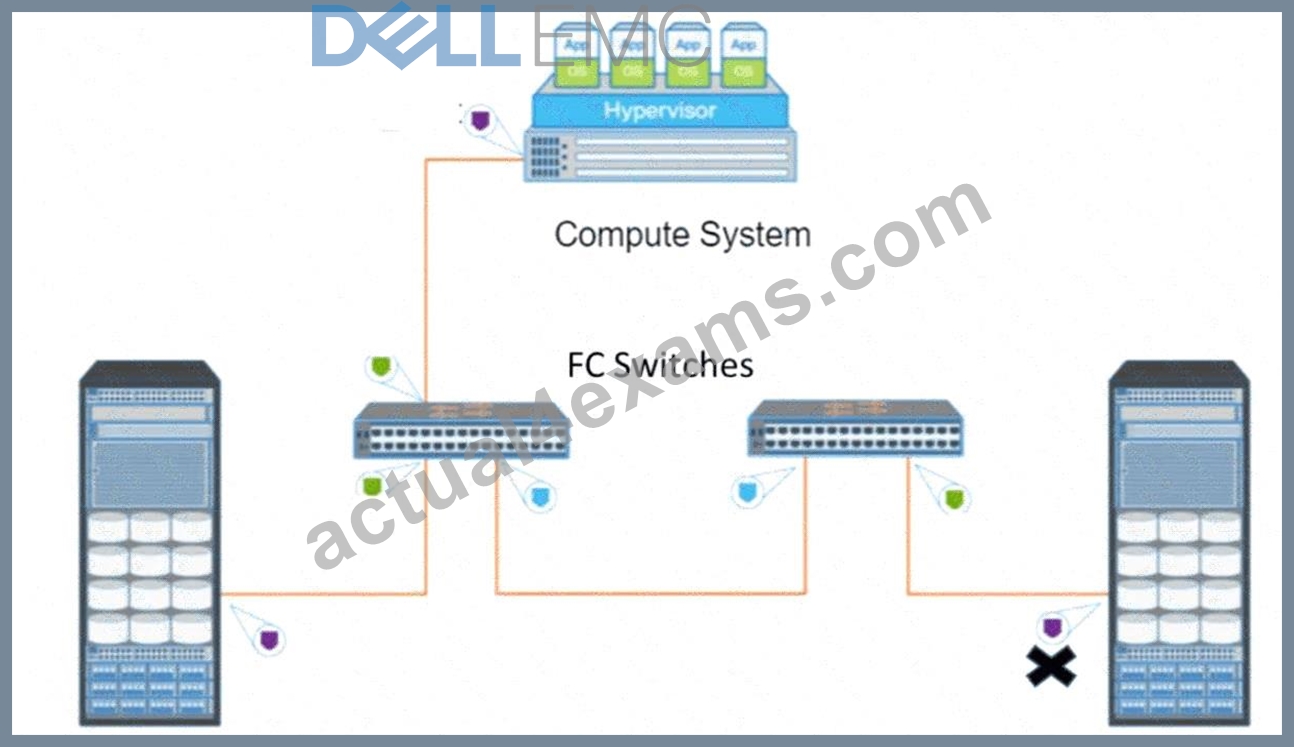
Refer to the Exhibit (Port marked "X"): What type of FC port does the "X" represent?
- A. NL port
- B. N port
- C. E_port
- D. F_port
Answer: C
Explanation:
The exhibit shows a Fibre Channel (FC) switch connected to another FC switch. The port "X" is used for inter- switch link (ISL) connectivity, which is characteristic of anE_port (Expansion Port).
* F_port (Fabric port):Connects an N_port (host or storage device) to a switch.
* N_port (Node port):End device port in FC networks (like HBA in hosts or storage).
* NL_port (Node Loop port):Used for Arbitrated Loop topologies.
* E_port:Connects two FC switches together for ISL, which is exactly what's shown in the exhibit.
Reference:Dell Information Storage and Management Foundations 2023 Study Guide, Section: FC SAN Components and Topologies.
NEW QUESTION # 19
Question:
What is the main advantage of Network Attached Storage (NAS) systems over general-purpose servers?
- A. Supports FC protocols to access files over FC-SAN
- B. Reduces the size of the object ID
- C. Increases data transfer speed
- D. Centralizes and optimizes file sharing operations
Answer: D
Explanation:
NAS systemsare purpose-built to handle file sharing and provide:
* Centralized file accessfor multiple clients.
* Optimized file sharingthrough dedicated hardware and software.
* Efficient managementwith file-level protocols (NFS, CIFS/SMB).
* FC protocols(Option B) are for block storage, not NAS.
* Object ID(Option C) relates to object storage, not NAS.
* Speed (Option D): While NAS can offer good speed, its main advantage is shared file access.
Reference:Dell Information Storage and Management Foundations 2023 Study Guide, Section: NAS Architecture and Benefits.
NEW QUESTION # 20
Question:
Refer to the Exhibit:
Identify the following FC Frame fields:
- A. 1: CRC, 2: Frame header, 3: Data field
- B. 1: Frame header, 2: CRC, 3: Data field
- C. 1: CRC, 2: Data field, 3: Frame header
- D. 1: Frame header, 2: Data field, 3: CRC
Answer: D
Explanation:
Full Detailed Explanation with Step by Step Solutions:
A standardFibre Channel (FC) frameconsists of several fields in a specific order. The typical sequence for an FC data frame is:
1##Frame header:Contains control and addressing information.
2##Data field:Carries the actual payload (up to 2112 bytes).
3##CRC (Cyclic Redundancy Check):Ensures data integrity of the frame.
The diagram in the exhibit shows exactly this ordering:
* SOF (Start of Frame)- marks the beginning of the frame.
* 1 (Frame header)- the control and addressing info.
* 2 (Data field)- the main data payload.
* 3 (CRC)- for error checking.
* EOF (End of Frame)- marks the end of the frame.
Reference:Dell Information Storage and Management Foundations 2023 Study Guide, Section: FC Frame Structure and Fields.
NEW QUESTION # 21
Question:
An IT team needs to connect a compute system to a switch in their SAN. What is the port type?
- A. N_port
- B. F_port
- C. E_Port
- D. G_port
Answer: B
Explanation:
AnF_port (Fabric port)is used on a Fibre Channel switch to connectN_ports (Node ports)on end devices like servers and storage arrays.
* N_port:On the compute system (HBA).
* F_port:On the switch, accepting N_port connections.
* E_port:For switch-to-switch ISL (Inter-Switch Link) connections.
* G_port:A generic port that can operate as either an F_port or an E_port (not the direct answer in this scenario).
Reference:Dell Information Storage and Management Foundations 2023 Study Guide, Section: FC SAN Ports.
NEW QUESTION # 22
Question:
What is a key benefit for deploying a remote data protection and recovery solution in a data center environment?
- A. Reduces the cost of protecting data
- B. Avoids security risks that expose business data
- C. Reduces required maintenance time for IT resources
- D. Maximizes application and information availability
Answer: D
Explanation:
Remote data protection and recovery solutions, like replication and cloud-based backup, are primarily designed to ensuremaximum application and information availability. They protect data in the event of:
* Local failures(disk, server, or site outages)
* Natural disasters(floods, fires)
* Ransomware attacks
By having off-site copies and failover options, businesses maintain continuous access to critical data.
Reference:Dell Information Storage and Management Foundations 2023 Study Guide, Section: Information Availability Techniques.
NEW QUESTION # 23
Question:
Which layer of the OSI reference model provides logical end-to-end connections, sequencing, and integrity?
- A. Session
- B. Presentation
- C. Transport
- D. Data Link
Answer: C
Explanation:
TheTransport layer (Layer 4)of the OSI model ensures reliable data transfer between systems by providing:
End-to-end connections- manages communication sessions
Sequencing- orders data packets
Integrity- error detection and correction
* Session (Layer 5): Manages sessions and controls dialogues between systems.
* Data Link (Layer 2): Deals with local network frame delivery.
* Presentation (Layer 6): Translates data formats (like encryption, compression).
Reference:Dell Information Storage and Management Foundations 2023 Study Guide, Section: Network Technologies.
NEW QUESTION # 24
Question:
A backup array was able to achieve a 30:1 reduction by finding multiple copies of the same data. Which method was used in this scenario?
- A. Data encryption
- B. Data replication
- C. Data deduplication
- D. Data compression
Answer: C
Explanation:
Data deduplication is a technique that eliminates redundant copies of data, storing only unique instances.
When multiple copies of the same data are found, deduplication replaces them with references to a single stored copy, significantly reducing storage requirements.
* Data replication:Involves copying data to another location for redundancy, not reducing storage size.
* Data encryption:Secures data but doesn't affect storage size.
* Data compression:Reduces data size by encoding information more efficiently but doesn't eliminate duplicates.
Reference:Dell Information Storage and Management Foundations 2023 Study Guide, Section: Data Deduplication and Data Archiving Solutions Architecture.
NEW QUESTION # 25
Question:
A company is looking for a continuous data protection solution that can provide any point-in-time recovery.
Which Dell solution is most suitable for this requirement?
- A. Dell TimeFinder SnapVX
- B. Dell Cloud Tier
- C. Dell SRDF
- D. Dell RecoverPoint
Answer: D
Explanation:
Dell RecoverPoint is a continuous data protection (CDP) solution that uses journaling to provideany point-in- time recoveryof data. It continuously captures and replicates data changes, storing them in a journal to enable precise recovery to any required point in the past.
* Dell SRDF (Symmetrix Remote Data Facility):Provides synchronous/asynchronous replication, not CDP.
* Dell TimeFinder SnapVX:Creates point-in-time snapshots but doesn't offer continuous journaling.
* Dell Cloud Tier:Used for archiving older data to the cloud.
Reference:Dell Information Storage and Management Foundations 2023 Study Guide, Section: Replication and CDP.
NEW QUESTION # 26
Question:
A storage system uses SSDs as a secondary cache tier in front of traditional hard drives. What is the primary goal of this configuration?
- A. To simplify data backup
- B. To reduce power consumption
- C. To improve read performance
- D. To increase storage capacity
Answer: C
Explanation:
Using SSDs as asecondary cache(sometimes called a "flash cache") helps:
Improve read performanceby storing frequently accessed data in the faster SSDs.
Reduce latency for read requests because SSDs are much faster than traditional spinning hard drives (HDDs).
* Power consumption (A): SSDs do use less power, but the primary goal here is performance.
* Data backup (C): SSD cache doesn't impact backup operations.
* Storage capacity (D): This is not the main focus; the SSDs act as a cache layer only.
Reference:Dell Information Storage and Management Foundations 2023 Study Guide, Section: Storage System Caching Architectures.
NEW QUESTION # 27
......
Valid D-ISM-FN-01 Exam Dumps Ensure you a HIGH SCORE: https://latestdumps.actual4exams.com/D-ISM-FN-01-real-braindumps.html