


[Dec-2025] Latest Fortinet EMEA-Advanced-Support exam dumps and online Test Engine
Fortinet EMEA-Advanced-Support: Selling Fortinet NSE Products and Solutions
NEW QUESTION # 21
How many layers does the OSI Model contain?
- A. 0
- B. 1
- C. 2
- D. 3
Answer: D
Explanation:
The OSI (Open Systems Interconnection) model consists of seven layers: Physical, Data Link, Network, Transport, Session, Presentation, and Application. This framework is used in Fortinet documentation to explain protocol operations. Options A, C, and D are incorrect as they do not match the standard OSI model.
Exact extract: "The OSI model defines seven layers for network communication: 1. Physical, 2. Data Link, 3.
Network, 4. Transport, 5. Session, 6. Presentation, 7. Application."
NEW QUESTION # 22
In VMware vSphere, the term VMotion refers to
- A. The process used to describe the movement of hard drive platters on a virtual machine
- B. A zero downtime live migration of workloads from one server to another
- C. The patented technology available to migrate a server from Hyper-V to VMware
- D. The streaming of high definition video on a virtual machine
Answer: B
Explanation:
VMotion in VMware vSphere enables live migration of running virtual machines from one physical server to another with zero downtime, ensuring continuous operation. Fortinet's FortiGate-VM supports such environments. Options A, C, and D are incorrect as they do not describe VMotion; C refers to a different migration scenario, and D is unrelated to virtualization. Exact extract: "VMotion allows the live migration of a running virtual machine from one physical server to another with no downtime... This ensures workloads continue running during server maintenance or load balancing."
NEW QUESTION # 23
TCP protocol can be used for data delivery via multicast
- A. No
- B. Yes
Answer: A
Explanation:
TCP is a unicast, connection-oriented protocol that ensures reliable data delivery between two endpoints using sequence numbers and acknowledgments. Multicast, which sends data to multiple recipients, is supported by UDP, not TCP, due to TCP's requirement for a direct connection. Fortinet devices handle multicast traffic via UDP-based protocols like IGMP or PIM. Exact extract: "TCP is a unicast protocol that establishes a reliable connection between two devices... Multicast traffic, such as streaming or group communications, relies on UDP, as TCP does not support multicast delivery."
NEW QUESTION # 24
What is the default FortiGate behavior when a packet matches no firewall policy?
- A. The packet is dropped
- B. The packet is logged and allowed
- C. The packet is forwarded to the default gateway
- D. The packet is sent to the IPS engine
Answer: A
Explanation:
FortiGate operates on a default-deny principle; if a packet does not match any firewall policy, it is dropped to ensure security. No forwarding (A), IPS processing (C), or automatic allowing (D) occurs without a matching policy. Exact extract: "FortiGate uses a default-deny approach; packets that do not match any configured firewall policy are dropped to prevent unauthorized traffic."
NEW QUESTION # 25
Which of the following is a benefit of using FortiGate's Security Fabric?
- A. It increases the speed of IPsec VPN tunnels
- B. It reduces the need for firewall policies
- C. It enables centralized management of multiple Fortinet devices
- D. It automatically configures VLANs on FortiSwitches
Answer: C
Explanation:
The Fortinet Security Fabric provides a centralized management platform for multiple Fortinet devices (e.g., FortiGate, FortiSwitch, FortiAP), enabling coordinated security policies, telemetry sharing, and simplified administration. It does not directly speed up VPNs (B), reduce firewall policies (C), or auto-configure VLANs (D). Exact extract: "The Fortinet Security Fabric enables centralized management and visibility across Fortinet devices, allowing coordinated security policies and telemetry sharing for enhanced protection."
NEW QUESTION # 26
Hybrid cloud means that
- A. Cloud provider provides both 32-bit and 64-bit virtual machines
- B. Some of the customer's systems are virtualized in the public cloud and some are in the local datacenter
- C. One customer uses VMs with multiple different operating systems in the same cloud account
- D. The cloud provider uses AMD, Intel and possibly also other CPU vendors
Answer: B
Explanation:
A hybrid cloud combines on-premises infrastructure (local datacenter) with public cloud resources, allowing workloads to operate across both environments for flexibility and scalability. Fortinet solutions like FortiGate- VM support hybrid cloud deployments. Option A refers to hardware diversity, C to OS variety, and D to architecture types, none of which define hybrid cloud. Exact extract: "Hybrid cloud is the combination of public cloud services with an on-premises private cloud or datacenter... This allows customers to run some systems in the public cloud and others in their local datacenter, managed seamlessly."
NEW QUESTION # 27
Which of the following are classful addresses? (Select all that apply below)
- A. 10.225.30.0/16
- B. 172.16.0.0/24
- C. 10.225.30.0/8
- D. 172.16.0.0/16
Answer: C,D
Explanation:
Classful addressing follows the original IP address classes: Class A (/8), Class B (/16), and Class C (/24).
Option A (10.225.30.0/8) is a Class A address, and C (172.16.0.0/16) is a Class B address. Option B (10.225.30.0/16) and D (172.16.0.0/24) use non-standard masks for their respective ranges, making them classless (CIDR). The original document incorrectly lists only A. Fortinet routing supports both classful and classless addressing. Exact extract: "Classful addressing uses fixed subnet masks: Class A (/8), Class B (/16), and Class C (/24)... Addresses like 10.0.0.0/8 and 172.16.0.0/16 are classful, while non-standard masks indicate classless addressing."
NEW QUESTION # 28
Firewall is performing stateful inspection for TCP traffic between Client 10.0.0.21 and Server 172.16.1.200.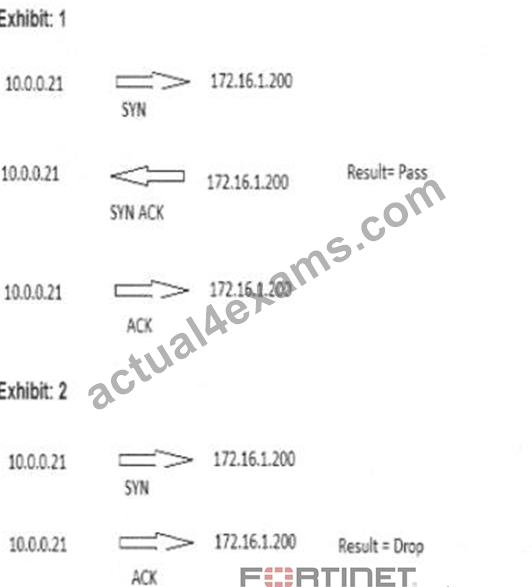
- A. Traffic should be allowed
- B. Traffic is Asymmetric and not allowed by the Firewall
- C. Three way handshake was not completed
- D. The ACK was not supposed to be sent to client 10.0.0.21
Answer: C
Explanation:
Stateful inspection requires a complete TCP three-way handshake (SYN, SYN-ACK, ACK) to establish a session in the firewall's state table. If the handshake is incomplete (e.g., missing ACK), the session is not established, and traffic is dropped. The question implies a stateful firewall scenario where traffic is blocked, likely due to an incomplete handshake. Asymmetric traffic (B) or incorrect ACK (A) are not indicated without further context, and C is incorrect if the handshake fails. Exact extract: "Stateful inspection ensures that a TCP three-way handshake is completed before allowing traffic... If the handshake is not completed, FortiGate drops the packets as invalid."
NEW QUESTION # 29
Which of the below technology(ies) could reduce CPU load and memory utilization used by an IPS engine?
- A. Using IPS sensors and IPS filter to determine which traffic should be examined for which signatures, instead of examine network traffic for all signatures
- B. Using multiple engines, aligned with load balancing technologies like Turbo that uses round robin algorithms to dispatch traffic up to specific IPS engine
- C. All of the above
- D. IPS does not compare traffic to each signature individually. Instead it compiles them into a decision tree
- E. Using regular instead of extended database, to reduce memory footprint
Answer: A,D,E
Explanation:
IPS efficiency is improved by: A) Compiling signatures into a decision tree to reduce comparison overhead; B) Using IPS sensors/filters to selectively apply signatures to relevant traffic, reducing unnecessary processing; D) Using a regular database instead of an extended one to lower memory usage. Option C's
"Turbo" and round-robin load balancing is not a standard Fortinet IPS feature. Option E is incorrect as C is not valid. Exact extract: "IPS efficiency is improved by compiling signatures into decision trees to minimize CPU usage... IPS sensors and filters allow selective signature application to reduce processing... Using the regular signature database instead of extended reduces memory footprint."
NEW QUESTION # 30
What happens when a router receives a packet for forwarding with a TTL value of 1?
- A. The packet is only forwarded through the router to a locally attached network
- B. The TTL is decreased to 0, the packet is dropped and an ICMP message is sent to the transmitting IP
- C. It decreases the value to 0 and then forwards it
- D. It increments it and passes it on to the next router
Answer: B
Explanation:
When a router, such as a FortiGate, receives a packet with a TTL (Time to Live) of 1, it decrements the TTL to 0, drops the packet, and sends an ICMP Time Exceeded message to the source IP. This prevents infinite loops in routing. Option A is incorrect as TTL is decremented, not incremented; B and D are incorrect as the packet is not forwarded when TTL reaches 0. Exact extract: "When a packet's TTL reaches 1, the router decrements it to 0, drops the packet, and sends an ICMP Time Exceeded message to the source IP address to prevent routing loops."
NEW QUESTION # 31
Which FortiGate feature supports load balancing across multiple WAN links?
- A. SD-WAN
- B. Link Aggregation
- C. Virtual Routing
- D. Multi-Path Routing
Answer: A
Explanation:
FortiGate's SD-WAN feature enables load balancing and intelligent traffic steering across multiple WAN links based on criteria like bandwidth, latency, or application. Link Aggregation (B) bonds interfaces, Virtual Routing (C) is VRF, and Multi-Path Routing (D) is not a standard term. Exact extract: "SD-WAN enables load balancing and traffic steering across multiple WAN links, optimizing performance and reliability based on configured rules and metrics."
NEW QUESTION # 32
Which of these BGP paths will be the preferred one ?
- A. Prefer the path with the highest Local Preference value
- B. Prefer the path with the shortest AS Path
- C. Prefer External path (learned via EBGP) over Internal path (IBGP)
- D. Prefer the path with the lowest Multi-Exit Discriminator (MED)
Answer: A
Explanation:
BGP path selection follows a specific order of attributes to determine the best path. The process prefers the path with the highest local preference first, as it is one of the earliest steps in the decision process. Local preference is used within an AS to influence outbound traffic. Only if local preferences are equal does it move to the next criteria, such as shortest AS path. The AS path length is considered after local preference, MED after that, and eBGP over iBGP even later. Therefore, among the options, the highest local preference (D) is the most preferred criterion. The original document's answer B is incorrect based on standard BGP selection rules implemented in Fortinet. Exact extract: This article describes the BGP route selection process. Scope FortiGate. Solution Consider only routes with no AS loops and a valid next hop. BGP makes routing decisions based on path, network policies and rulesets ... select the route with the lowest router ID as the best path. Network. Type. To achieve this, multiple route selection techniques can be used. Some are protocol- agnostic (for example, weight) and others are protocol-specific (for example ...).
NEW QUESTION # 33
What is the purpose of the FortiGate 'diagnose debug flow' command?
- A. To troubleshoot routing table issues
- B. To show the packet flow through firewall policies
- C. To display real-time packet captures
- D. To monitor system performance metrics
Answer: B
Explanation:
The 'diagnose debug flow' command in FortiGate is used to troubleshoot how packets are processed through firewall policies, showing details like policy matching, NAT, and session handling. It helps identify why packets are allowed or dropped. Option A refers to packet sniffing, B to routing diagnostics, and D to performance monitoring, none of which are the primary function. Exact extract: "The diagnose debug flow command displays the packet flow through FortiGate, including policy matching, NAT, and session details, useful for troubleshooting traffic issues."
NEW QUESTION # 34
In a FortiGate high availability (HA) cluster, what happens if the primary unit fails?
- A. Traffic is rerouted through an external gateway
- B. The cluster is disabled, and traffic stops
- C. The cluster switches to active-passive mode
- D. A secondary unit takes over as the primary unit
Answer: D
Explanation:
In a FortiGate HA cluster (active-active or active-passive), if the primary unit fails, a secondary unit automatically takes over as the primary, ensuring continuity of traffic with minimal disruption. Option A is incorrect as traffic continues, C is incorrect as the mode doesn't change post-failure, and D is unrelated. Exact extract: "In a FortiGate HA cluster, if the primary unit fails, a secondary unit is elected as the new primary, taking over all roles to maintain traffic flow and session continuity."
NEW QUESTION # 35
Which protocol is used by FortiGate to synchronize session tables in an HA cluster?
- A. FGCP
- B. VRRP
- C. BGP
- D. OSPF
Answer: A
Explanation:
The FortiGate Cluster Protocol (FGCP) is used to synchronize session tables, configuration, and state information between HA cluster members to ensure seamless failover. VRRP (B) is for router redundancy, OSPF (C) and BGP (D) are routing protocols, not used for HA synchronization. Exact extract: "FGCP synchronizes session tables, configurations, and state information between FortiGate HA cluster members to ensure continuity during failover."
NEW QUESTION # 36
Which of the following are request methods in HTTP?
- A. RETR
- B. HEAD
- C. LIST
- D. GET
Answer: B,D
Explanation:
HTTP defines standard request methods, including GET (retrieve a resource) and HEAD (retrieve headers only). LIST and RETR are not standard HTTP methods; RETR is used in FTP, and LIST is not a recognized method in either protocol. The original document incorrectly lists only A, omitting C. Exact extract: "HTTP supports several request methods, including GET, HEAD, POST, PUT, DELETE, etc... GET retrieves a resource, while HEAD retrieves only the headers without the body content."
NEW QUESTION # 37
......
New 2025 EMEA-Advanced-Support Test Tutorial (Updated 52 Questions): https://latestdumps.actual4exams.com/EMEA-Advanced-Support-real-braindumps.html