


L5M5 Braindumps Real Exam Updated on Apr 17, 2026 with 91 Questions
Latest L5M5 PDF Dumps & Real Tests Free Updated Today
NEW QUESTION # 30
All of the following are advantages of low-cost country sourcing EXCEPT which one?
- A. Access to new and better process technologies
- B. Lower wage rates allow lower manufacturing costs
- C. Intellectual property is easily protected
- D. A wider array of potential suppliers are available
Answer: C
Explanation:
Choice B - LCCS carries the risk of engaging with unethical suppliers, raising concerns about the protection of intellectual property. Consequently, this serves as the answer.
Incorrect answer:
Choice A - This is an advantage of LCCS as LCCS opens up opportunities to engage potential suppliers globally.
Choice C - Companies use LCCS to find more affordable raw materials, labor and manufacturing thereby increasing profits.
Choice D- When considering the profitability of LCCS, a procurement professional will consider the development in technologies have made it easier for their business to communicate with and source from suppliers in low cost countries. This means business can source more affordable products.
Reference:
LO-1.4; Page 106-107; Profit maximization and low-cost sourcing
NEW QUESTION # 31
The Modern Slavery Act (2015) ensures supply chains are free from forced and child labour. Which of the following is a limitation of the Act?
- A. It is optional to comply with
- B. It only applies to companies with a large turnover
- C. There are no repercussions for non-compliance
- D. It doesn't apply if supply chains are outside the UK
Answer: B
Explanation:
Comprehensive and Detailed Explanation From Exact Extract of Documents:
The Modern Slavery Act (2015) requires companies with a turnover above £36 million to publish a slavery and human trafficking statement. The L5M5 study guide (p.45) highlights this as a limitation because it excludes smaller businesses, even though they may also operate complex supply chains. The Act applies regardless of where supply chains are located (so A is incorrect), and compliance is mandatory (C is incorrect). Non-compliance can lead to civil proceedings (so D is incorrect). Procurement professionals must be aware of this threshold and ensure compliance in larger organisations.
Reference: Managing Ethical Procurement and Supply (L5M5) Study Guide, p.45
NEW QUESTION # 32
Which of the following is not a fraud risk in a procurement function?
- A. Phantom suppliers
- B. Duplicating payments
- C. Bid rigging
- D. Accepting presents
Answer: D
Explanation:
Comprehensive and Detailed Explanation From Exact Extract of Documents:
Fraud risks in procurement typically include practices such as bid rigging (collusion to manipulate tenders), phantom suppliers (fake companies created to siphon money), and deliberate duplicate payments (processing false or repeated invoices). However, accepting presents is classified as bribery, not fraud. The L5M5 study guide (old p.139, new p.50) explains that fraud involves intentional deception for personal gain, while bribery relates to improper inducements or gifts. Procurement professionals must distinguish between fraud and bribery because both undermine ethical procurement but require different controls. For example, fraud prevention requires audit trails and segregation of duties, while anti-bribery policies require clear rules on gifts and hospitality.
Reference: Managing Ethical Procurement and Supply (L5M5) Study Guide, old p.139, new p.50
NEW QUESTION # 33
A seafood company in Country Z sources fish from a supplier employing migrant workers. An investigation reveals that the workers were charged excessive recruitment fees, leading to severe debt. Upon arrival, their passports were confiscated, and they were forced to work on fishing vessels for months without fair pay or rest. Those who attempted to leave or report the abuse faced threats of violence. Which labor rights violation best describes this situation?
- A. Child labor
- B. Forced labor
- C. Sexual exploitation
- D. Discrimination
Answer: B
Explanation:
Option C- This scenario involves forced labor because:
Workers were subjected to coercion through confiscation of passports and threats of violence.
They were trapped in abusive working conditions due to debts and lack of freedom to leave. The key elements of forced labor include deception during recruitment, coercion, and lack of consent, all of which are evident in this situation.
Incorrect answer:
Option A- The scenario does not mention minors being employed.
Opton B- No evidence of unequal treatment based on characteristics like gender, race, or religion is mentioned.
Option D- The scenario does not involve sexual abuse or coercion.
Reference:
LO-3.1; Page 250-251; Standards set by the United Nations (UN) and the International Labor Organization (ILO)
NEW QUESTION # 34
The main aim of the ILO is to promote rights at work and improve social protection. Is this TRUE?
- A. Yes - the ILO is an agency of the UN which deals with labour problems
- B. No - the ILO was formed in 1975 to encourage globalisation
- C. No - the purpose of the ILO is to increase international trade
- D. Yes - the ILO sets trade rules between nations
Answer: A
Explanation:
Comprehensive and Detailed Explanation From Exact Extract of Documents:
The International Labour Organisation (ILO) is a specialised UN agency founded in 1919 to promote labour rights and improve social protection. The L5M5 study guide (p.87) confirms that the ILO's mission includes eliminating child labour, eradicating forced labour, and promoting fair wages and safe workplaces. It does not set trade rules (that is the WTO), nor was it created to drive globalisation. For procurement professionals, understanding the ILO is critical when assessing supplier practices against international labour standards, especially in global supply chains.
Reference: Managing Ethical Procurement and Supply (L5M5) Study Guide, p.87
NEW QUESTION # 35
Nicolas is the Head of Procurement at Penny Dolittle Manufacturing Company. He is introducing an ESG agenda to the company's procurement strategy, especially regarding sustainability. Nicolas believes an advantage of this is that it will drive innovation. Is he correct?
- A. Yes - reporting on sustainability can drive change and innovation
- B. Yes - reporting on sustainability is mandatory and always leads to innovation
- C. No - reporting on sustainability will increase costs
- D. No - reporting on sustainability will only increase reputation
Answer: A
Explanation:
Comprehensive and Detailed Explanation From Exact Extract of Documents:
The L5M5 study guide (p.182) states that sustainability reporting and the adoption of ESG (Environmental, Social, Governance) principles can stimulate organisational change and innovation. By measuring and reporting on sustainability, companies often seek new technologies, processes, and supply models to improve performance and meet ESG commitments. Reporting is not mandatory in all cases, so option B is incorrect. While sustainability may improve reputation and sometimes costs, these are not the key focus of this question. CIPS guidance stresses that sustainability reporting can drive innovation-procurement can encourage suppliers to develop new sustainable practices, products, and approaches.
Reference: Managing Ethical Procurement and Supply (L5M5) Study Guide, p.182
NEW QUESTION # 36
Which of the following are principles of the Wine and Agricultural Ethical Trade Association (WIETA)? Select THREE
- A. Prohibition of forced labour
- B. Working hours shall not be excessive
- C. A working environment free from risk
- D. Automatic sick pay
- E. Regular employment to be provided
Answer: A,B,E
Explanation:
Comprehensive and Detailed Explanation From Exact Extract of Documents:
The Wine and Agricultural Ethical Trade Association (WIETA) is an organisation promoting fair trade and ethical practices in South Africa's wine industry. The L5M5 study guide (p.262) outlines WIETA's principles, which align with ILO standards. These include prohibition of forced labour, ensuring working hours are not excessive, and providing regular employment rather than temporary or exploitative contracts. Options D and E are not accurate-no workplace can be entirely free of risk, and sick pay is determined by national legislation, not WIETA. Procurement professionals working with agricultural sectors should be aware of such sector-specific ethical trade associations.
Reference: Managing Ethical Procurement and Supply (L5M5) Study Guide, p.262
NEW QUESTION # 37
When developing an ESG policy, which of the following steps should be taken first?
- A. Consult with stakeholders
- B. Identify the need
- C. Draft the policy
- D. Gather Information
Answer: B
Explanation:
Steps to take to develop an ESG policy:
1) Identify the need
2) Identify who will take lead responsibility
3) Gather information
4) Draft the policy
5) Consult with stakeholders
6) Approve the policy
7) Procedures
8) Implement the policy
9) Monitor
So the correct answer is D.
Reference:
LO-1.1; Page 32-33; The development of ESG focused procurement and supply policies in securing ethical and sustainable procurement and supply arrangements
NEW QUESTION # 38
In what circumstances is Expert Determination the most suitable method for resolving contract disputes?
- A. personality disputes
- B. international contracts
- C. high value contracts
- D. technical disputes
Answer: D
Explanation:
Choice C- This is the correct answer. Expert Determination is particularly suited for disputes that require specialized technical knowledge, such as issues related to engineering, construction, or IT systems. An independent expert with relevant expertise can assess and resolve the dispute effectively.
Incorrect answer:
Choice A-Expert Determination is not specifically suited to international contracts. While it could be used in such cases, it is more about the nature of the dispute (technical issues) rather than the geographic scope of the contract.
Choice B- The value of the contract does not determine the suitability of Expert Determination. Other methods like arbitration or litigation are often more common for resolving high-value disputes.
Choice D- Expert Determination is not designed to handle personality conflicts or disputes rooted in interpersonal disagreements. Mediation or other relationship-focused methods are more appropriate in such cases.
Reference:
LO-2.4; Page 236; Escalating non-compliance and making exit arrangements
NEW QUESTION # 39
Which of the following strategies is primarily designed to lower business costs while also considering social and environmental impacts?
- A. Cutting Workforce Salaries
- B. Outsourcing
- C. Value Engineering
- D. Increasing Product Prices
Answer: C
Explanation:
Choice B- Value engineering is a structured approach to improving the value of products or services by analyzing their functions. It aims to reduce costs without sacrificing quality, thereby enhancing overall efficiency. It reviews and amends new products like reworking or developing new processes so that fewer raw materials are used or wasted in production of goods. This method encourages innovation and sustainability, often leading to more environmentally friendly processes and materials, and can also foster positive social outcomes by improving product design and usability.
Incorrect answer:
Choice A- Outsourcing involves contracting third-party companies to handle certain business functions or processes. While it can reduce costs by utilizing cheaper labor or specialized services, it often does not address social or environmental impacts. In some cases, outsourcing can lead to negative consequences, such as job losses in the local economy or reliance on suppliers with poor labor practices.
Choice C- Increasing product prices is a straightforward way to improve profit margins, but it does not reduce costs. In fact, this strategy can alienate customers, especially in competitive markets. Additionally, it may not have any direct impact on social or environmental considerations, and could potentially lead to decreased accessibility for consumers.
Choice D- Cutting salaries is a short-term cost-saving measure that can severely impact employee morale, loyalty, and productivity. While it may reduce costs temporarily, it often leads to higher turnover rates and loss of skilled workers. This strategy can have negative social impacts on the workforce and may ultimately harm the company's reputation and long-term sustainability.
Reference:
LO-1.1; Page 28-29; The risks and rewards of adopting ESG considerations in securing ethical and sustainable procurement and supply arrangements
NEW QUESTION # 40
Which of the following actions could create a conflict between profitability and social value among stakeholders?
- A. Engaging in corporate social responsibility initiatives
- B. Implementing environmentally sustainable practices
- C. Cutting costs by reducing employee wages
- D. Offering competitive prices to customers
Answer: C
Explanation:
Choice B- Cutting costs by reducing employee wages is the action that could lead to a conflict between profitability and social value. While it might improve short-term profits, it can negatively affect employee morale, retention, and overall company reputation, leading to long-term challenges.
Incorrect answer:
Choice A- This action typically enhances social value by promoting environmental responsibility. While it may involve higher upfront costs, in the long run, it can lead to savings, increased customer loyalty, and a stronger brand reputation. Thus, it usually aligns profitability with social value rather than conflicting with it.
Choice C- Engaging in CSR initiatives often enhances a company's reputation and fosters goodwill within the community. While it may require financial investment and could impact short-term profits, it generally aligns with social value and can lead to long-term benefits, such as customer loyalty and brand strength.
Choice D- Offering competitive prices may initially seem like a strategy focused solely on profitability. However, it can also enhance social value by making products more accessible to a broader audience. If done without compromising quality or ethical standards, this option usually does not create a conflict but can benefit both profitability and social value.
Reference:
LO-1.4; Page 137; Comprehensive stakeholder consultations and engagement
NEW QUESTION # 41
A manufacturing company experienced frequent breakdowns of a critical machine due to improper maintenance. To resolve this, management is investigating the root cause and implementing measures to prevent future occurrences. What type of plan is the management prioritizing?
- A. Preventative Action Plan
- B. Root Cause
- C. Risk mitigation plan
- D. Corrective Action Plan
Answer: A
Explanation:
Choice B- This is the correct answer because the focus is on implementing measures to prevent future breakdowns and ensure the issue does not recur.
Incorrect answer:
Choice A- This would apply if the management's focus was on fixing the immediate issue (e.g., repairing the broken machine). Since the emphasis is on prevention, this is incorrect.
Choice C- While identifying the root cause is a part of the process, the plan described involves taking preventive action beyond just identifying the cause.
Choice D- This is incorrect because risk mitigation focuses on reducing potential risks, often before they occur. In this case, the issue has already occurred, and the goal is prevention, not general risk management.
Reference:
LO-2.4; Page 229-230; Creating corrective action plans and supplier development programmes
NEW QUESTION # 42
One criticism of the UN Global Compact is that some organisations join without making real ethical improvements, using it for legitimacy instead. What is this known as?
- A. Bribery
- B. Blue washing
- C. Corruption
- D. Greenwashing
Answer: B
Explanation:
Comprehensive and Detailed Explanation From Exact Extract of Documents:
The L5M5 study guide (p.258) explains that blue washing refers to organisations associating with the UN Global Compact to appear legitimate while failing to implement its principles. The term comes from the blue colour of the UN flag. In contrast, greenwashing (A) is when companies exaggerate their environmental credentials. Blue washing is a reputational risk because it undermines genuine CSR initiatives and public trust. Procurement professionals must ensure that CSR commitments are backed by verifiable actions rather than symbolic gestures.
Reference: Managing Ethical Procurement and Supply (L5M5) Study Guide, p.258
NEW QUESTION # 43
Ms. Nabila plans to create a CSR plan by involving all internal and external stakeholders of the company. Which TWO key components should she prioritize for the CSR plan?
- A. Refinement
- B. Philanthropic responsibility
- C. Financial Analysis
- D. Introduction
- E. CSR Strategy
Answer: A,E
Explanation:
Key components of a CSR plan
* CSR assessment
* CSR strategy
* CSR commitment to stakeholder engagement
* Implementation plan and activities
* Verification and evaluation of results
* Refinement
Reference:
LO-1.1; Page 8; Analyze the application of ethical and ESG (Environmental, Social and Governance) factors in supple chains
NEW QUESTION # 44
SA8000 measures an organisation's social accountability. Which of the following is a disadvantage of this standard?
- A. It is industry specific
- B. It is only applicable to larger organisations
- C. It is not recognised in some countries
- D. It requires a management system which can be costly to implement
Answer: D
Explanation:
Comprehensive and Detailed Explanation From Exact Extract of Documents:
SA8000 is an internationally recognised certification standard for social accountability. It requires organisations to adopt management systems to monitor compliance with social standards, including child labour elimination, safe working conditions, and fair wages. According to the L5M5 study guide (p.264), one disadvantage is the cost of implementing and maintaining the management system, which can be resource-intensive for smaller organisations. SA8000 is not industry-specific, is recognised globally, and is applicable to both large and small organisations. However, the investment in audits, training, and compliance documentation can be significant, making this a barrier for some companies.
Reference: Managing Ethical Procurement and Supply (L5M5) Study Guide, p.264
NEW QUESTION # 45
Under the Equalities Act 2010, which of the following is not a protected characteristic?
- A. Weight
- B. Pregnancy
- C. Age
- D. Disability
Answer: A
Explanation:
Comprehensive and Detailed Explanation From Exact Extract of Documents:
The Equalities Act 2010 provides legal protection against discrimination in the UK. The L5M5 study guide (p.35) lists the protected characteristics, which include disability, pregnancy and maternity, age, race, sex, sexual orientation, gender reassignment, marriage/civil partnership, and religion/belief. Weight is not included as a protected characteristic. For procurement, understanding equality legislation is vital to ensuring suppliers uphold fair treatment of employees and do not discriminate unlawfully. Organisations must embed these protections into contracts and supplier codes of conduct.
Reference: Managing Ethical Procurement and Supply (L5M5) Study Guide, p.35
NEW QUESTION # 46
Contracts contain different types of clauses. What is the name given to a clause that, if breached, allows damages but not termination of a contract?
- A. Representation
- B. Warranty
- C. Condition
- D. Innominate term
Answer: B
Explanation:
Comprehensive and Detailed Explanation From Exact Extract of Documents:
The L5M5 study guide (p.190) explains that a warranty is a contractual term where breach allows the injured party to claim damages, but the contract continues. By contrast, conditions are fundamental terms-breach may allow termination and damages. Representations are statements made in negotiation, not binding terms, and innominate terms may be treated as conditions or warranties depending on the breach. Understanding the difference is crucial for procurement professionals when drafting and managing contracts, as it affects remedies and supplier relationships.
Reference: Managing Ethical Procurement and Supply (L5M5) Study Guide, p.190
NEW QUESTION # 47
Which of the following strategies can procurement professionals use to effectively manage language and cultural barriers in global sourcing?
1. Improving foreign language skills
2. Think and act with an open mind
3. Insisting that English is the only business language used
4. Ensuring proper documentation for all the imports to comply with regulations
- A. 4 and 1
- B. 2 and 3
- C. 1 and 2
- D. 2 and 4
Answer: C
Explanation:
Managing language and cultural barriers
O View culture within the language
O Choose location carefully
O Know and communicate business goals
O Check and monitor relationships
O Communicate well
O Improve foreign language skills
O Think and act with an open mind
O Have patience
O Be respectful
The correct answer is Option A.
Reference:
LO-1.3; Page 82-84; Language and culture
NEW QUESTION # 48
When a major garments factory faces adverse publicity due to alleged child labor, which of the following recognized techniques would be most effective in identifying the root cause of the issue?
- A. Whole life costs
- B. Value engineering
- C. Six sigma
- D. Supply chain mapping
Answer: D
Explanation:
Choice C - Supply chain mapping is a technique that enables a comprehensive analysis of the entire supply chain involved in the production and distribution of garment products. It helps identify the origin of the issue and how it spread. Therefore, it is the correct answer.
Incorrect answer:
Choice A - WLC is used to assess the total cost of an asset over its whole life, taking account of its initial cost and the cost of operation, maintenance, upgrade and disposal. It does not help in identifying the child labor issue.
Choice B - Value engineering is a method used to improve the value of a product or process, not primarily focused on issue identification.
Choice D- Six sigma is a methodology aimed at process improvement and reducing defects, not specifically tailored for issue identification.
Reference:
LO-2.1; Page 145; Mapping supply chains to achieve supply chain transparency
NEW QUESTION # 49
Which organisation is responsible for the creation of the 2030 Sustainable Development Agenda?
- A. ISO
- B. UN
- C. NATO
- D. ILO
Answer: B
Explanation:
Comprehensive and Detailed Explanation From Exact Extract of Documents:
The United Nations (UN) launched the 2030 Sustainable Development Agenda, which includes the 17 Sustainable Development Goals (SDGs). The L5M5 study guide (p.4) emphasises that these goals cover social, environmental, and economic priorities, including poverty reduction, climate action, decent work, and responsible consumption. NATO, ISO, and ILO play important roles in governance, standards, and labour rights but are not responsible for the SDGs. For procurement professionals, the SDGs provide a global framework to align ethical supply practices with wider sustainability objectives.
Reference: Managing Ethical Procurement and Supply (L5M5) Study Guide, p.4
NEW QUESTION # 50
ABC Group, the country's largest textile company, is considering partnering with a Fair Trade-certified supplier to support sustainability and ethical practices. However, they are concerned about potential challenges in working with a Fair Trade organization. Which TWO of the following challenges might ABC Group face in this partnership?
- A. The Fair Trade certification process may require complex audits, and if there is a longer period between audits, activities could change and will no longer be compliant
- B. Fair Trade standards may require investments in audits supported by self-assessment reports and office reviews adding costs to the business
- C. Improved stakeholder perception of the brand, which can lead to reputational benefits
- D. The product prices from Fair Trade suppliers are often significantly lower than conventional suppliers, making it hard to remain competitive
- E. There are no real challenges, as all Fair Trade products are guaranteed to be competitive and cost-efficient
Answer: A,B
Explanation:
Choice A- Obtaining Fair Trade certification often involves a thorough and detailed audit process, which demonstrates a company's positon at a period of time. If there is a longer period between audits, there is a chance that activities and processes could change within business and they will no longer be compliant with a fair trade organisation.
Choice C- This is correct. Fair Trade standards accreditation come at a cost and four yearly independent audits supported by self assessment reports and office reviews take time and resources.
Incorrect answer:
Choice B- This is incorrect. While Fair Trade products aim to provide ethical and sustainable options, they can come with challenges such as higher costs and longer certification processes.
Choice D- This is incorrect. Fair Trade products typically come with higher prices due to ethical production costs and fair wages. These prices are often higher, not lower, than those from conventional suppliers.
Choice E- This is a benefit of associating with a fair trade organisation and not a challenge.
Reference:
LO-3.3; Page 297-298; The World Fair Trade Organization (WFTO) and its principles and Charter of Fair Trade and implications for procurement and supply
NEW QUESTION # 51
If a company has SA8000 certification, what does this measure?
- A. Risk management
- B. Environment
- C. Social accountability
- D. Quality conformance
Answer: C
Explanation:
Comprehensive and Detailed Explanation From Exact Extract of Documents:
SA8000 is a globally recognised certification standard for Social Accountability. The L5M5 study guide (p.264) confirms that it measures compliance with ethical labour practices such as child labour elimination, safe working conditions, fair wages, and working hours. It does not cover quality (A), environmental management (B), or risk management (C). For procurement professionals, SA8000 provides assurance that suppliers operate ethically, helping organisations meet CSR/ESG commitments across supply chains.
Reference: Managing Ethical Procurement and Supply (L5M5) Study Guide, p.264
NEW QUESTION # 52
NIMBUS TeK, a leading call center employing cost-effective English-speaking workers in countries like India, Pakistan, and the Philippines, has gained a competitive advantage through global sourcing. Which of the following are effective global sourcing practices that the call center has implemented? Select any TWO.
- A. Managing relationship with supplier before selection
- B. Service Level Agreement
- C. Key Performance Indicator
- D. Detailed research of the market and potential suppliers
Answer: B,D
Explanation: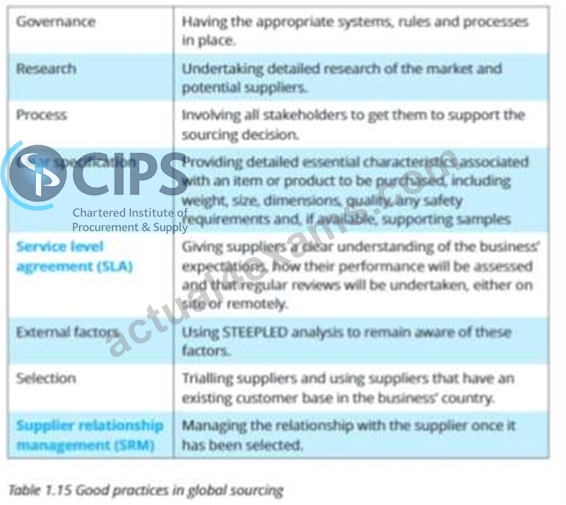
Choice B- Option B is the correct answer as it is a part of RESEARCH under good practices. Choice D- Giving suppliers a clear understanding of the business expectations is a good practice in global sourcing. Therefore is also an answer. Incorrect answer: Choice A- Supplier relationship management is essential but once the supplier has been selected. Choice C- Key Performance Indicator is not a part of good practices in global sourcing. Reference: LO-1.2; Page 70; Competitive advantage through global sourcing
NEW QUESTION # 53
......
L5M5 Dumps With 100% Verified Q&As - Pass Guarantee or Full Refund: https://latestdumps.actual4exams.com/L5M5-real-braindumps.html