


New 2026 Latest Questions L5M6 Dumps - Use Updated CIPS Exam
Latest L5M6 Exam Dumps CIPS Exam from Training Expert Actual4Exams
CIPS L5M6 Exam Syllabus Topics:
| Topic | Details |
|---|---|
| Topic 1 |
|
| Topic 2 |
|
| Topic 3 |
|
NEW QUESTION # 14
Category Management and Strategic Sourcing are terms which are interchangeable. Is this statement TRUE?
- A. No - Category Management is a tactical form of sourcing
- B. No - Category Management is a process most effectively applied when using a recognised framework and supporting tools
- C. Yes - they are synonyms and used interchangeably within most organisations
- D. Yes - Strategic Sourcing is a type of Category Management
Answer: B
Explanation:
Although some organisations mistakenly use Category Management and Strategic Sourcing interchangeably, they are not the same. Strategic Sourcing is a philosophy or approach to procurement, while Category Management is a structured process, applied most effectively through recognised frameworks like Kraljic or Kearney's 7-step model. Category Management is strategic, not tactical, and focuses on long- term value creation, supply market management, and alignment with organisational objectives. A direct quote from L5M6 states: "Category Management is a process and is applied most effectively when using a recognised framework and supporting tools." This clarity ensures that organisations do not reduce Category Management to short-term sourcing exercises. Instead, it emphasises cross-functional collaboration, innovation, and market analysis to achieve sustainable value.
Reference: CIPS L5M6 Study Guide, p.49
NEW QUESTION # 15
Salim is using the CIPS Procurement and Supply Cycle to run a tender for a new item. He needs to complete a Make vs Buy assessment. Under which stage of the cycle should this be done?
- A. Develop strategy/plan
- B. Market/commodity and options
- C. Market engagement
- D. Develop a high-level specification
Answer: B
Explanation:
The correct stage is Market/commodity and options [including make vs buy assessment], which is Stage 2 of the CIPS Procurement and Supply Cycle. This stage focuses on analysing the external market, internal requirements, and identifying whether to make a product in-house or source it externally.
A Make vs Buy assessment helps determine whether the organisation has the capacity, skills, and resources to produce the item internally, or whether outsourcing would deliver greater value. Factors such as cost, risk, quality, lead time, and strategic alignment are evaluated.
Other stages differ:
* High-level specification [Stage 1]: Focuses on defining what is needed, not sourcing decisions.
* Develop strategy/plan [Stage 3]: Comes after options are analysed, where the sourcing path is chosen.
* Market engagement [Stage 4]: Involves engaging suppliers, which cannot happen until the Make vs Buy decision is made.
This makes Stage 2 the most accurate point for such an assessment.
[Ref: CIPS L5M6 Study Guide, pp.35-36 - Procurement Cycle, Make vs Buy analysis]
NEW QUESTION # 16
Which of the following is NOT one of Cialdini's principles of persuasion?
- A. Inducement
- B. Reciprocity
- C. Scarcity
- D. Authority
Answer: A
Explanation:
The correct answer is Inducement, which is not one of Cialdini's principles. The seven principles are:
* Reciprocity - people return favours.
* Commitment/Consistency - people stick with commitments.
* Social Proof/Consensus - people follow others.
* Authority - people respect expertise.
* Liking - people are influenced by those they like.
* Scarcity - people value what is limited.
* Unity - people are influenced by shared identity.
Cialdini's framework is widely applied in procurement negotiations and stakeholder management. For instance, demonstrating scarcity can strengthen a supplier's case for urgency, while using authority enhances credibility during negotiations.
Understanding these principles allows category managers to influence stakeholders and suppliers effectively, building alignment and driving successful outcomes.
[Ref: CIPS L5M6 Study Guide, p.66 - Cialdini's Principles of Persuasion]
NEW QUESTION # 17
The objective of negotiation with a supplier is to ensure the Five Rights of Procurement. Which of the following are part of the Five Rights? Select THREE.
- A. Right price
- B. Right product
- C. Right relationship
- D. Right time
- E. Right supplier
Answer: A,B,D
Explanation:
The Five Rights of Procurement are fundamental principles ensuring procurement delivers value. They are:
* Right product - ensuring goods/services meet requirements.
* Right quality - ensuring standards are appropriate.
* Right time - goods/services are available when needed.
* Right place - ensuring delivery is to the correct location.
* Right price - balancing cost efficiency with value.
Options B, C, and D reflect these principles. "Right supplier" and "right relationship" are not part of the traditional five rights, though they are important in broader supplier management. By aligning negotiations with the Five Rights, procurement professionals secure both operational efficiency and strategic value. These principles also provide benchmarks against which procurement performance can be measured.
Reference: CIPS L5M6 Study Guide, p.58
NEW QUESTION # 18
Tulipa Ltd is a manufacturer of vegan frozen food. It saw significant market growth for three years, but in the last two years market share has remained stable despite no new entrants. Which stage in the lifecycle is the vegan frozen food market?
- A. Decline
- B. Maturity
- C. Growth
- D. Birth
Answer: B
Explanation:
The correct answer is Maturity. In the industry lifecycle model, markets evolve through stages: birth, growth, maturity, and decline. Tulipa Ltd initially saw high growth, reflecting the growth stage, where demand is rising, and market share is expanding. However, for the past two years, share has plateaued, suggesting the market has stabilised, which is a key characteristic of the maturity stage.
At maturity, the market is often saturated, with limited opportunities for expansion. Competition becomes more intense, innovation slows, and firms compete largely on efficiency, branding, or incremental improvements. Unlike decline, the market is still viable and profitable, but growth rates are flat.
The study guide also introduces an intermediate stage called shakeout, occurring between growth and maturity, where weaker competitors exit. Tulipa's situation has passed growth but has not yet entered decline, making maturity the correct classification.
[Ref: CIPS L5M6 Study Guide, p.175 - Industry Lifecycle and Procurement Strategy]
NEW QUESTION # 19
Bellatricks Ltd has four main categories of spend, each headed by a Category Manager. Below is a brief outline of each:
* Category Manager 1: Has a PhD and 15 years' experience. Very competent in developing specifications. Persuasion style built on knowledge, facts, and science.
* Category Manager 2: Meets deadlines, identifies actions, achieves goals. Assertive, self-assured, articulate.
* Category Manager 3: Strong soft skills, relates well to people, builds supplier relationships.
Motivates others by being passionate and creating shared purpose.
* Category Manager 4: Creative thinker, anticipates market changes, produces quick solutions. In negotiations, they see problems from multiple perspectives.
Task:
Complete the table by identifying each Category Manager's competency and style of persuasion when negotiating with suppliers. Each response should only be used once.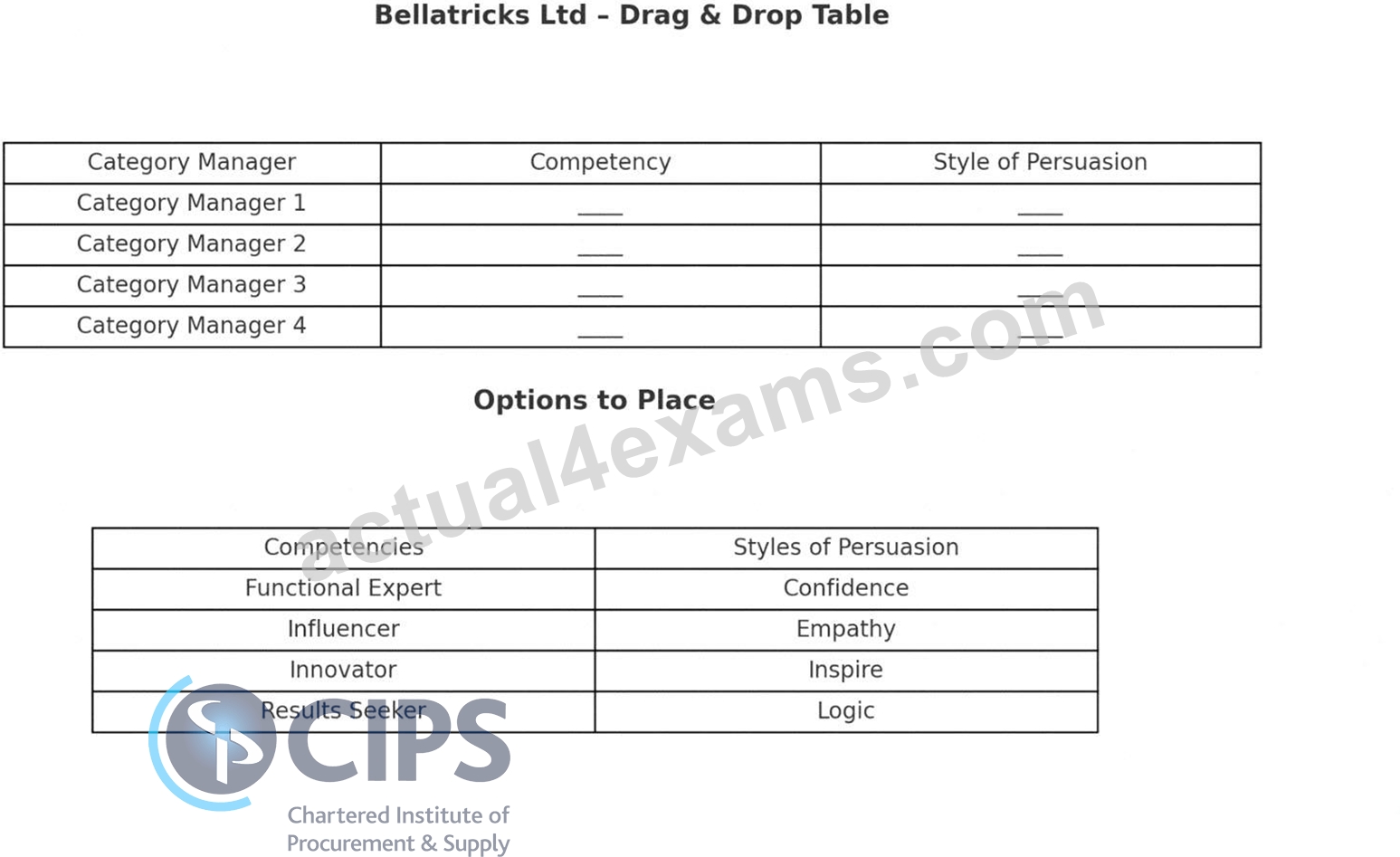
Answer:
Explanation: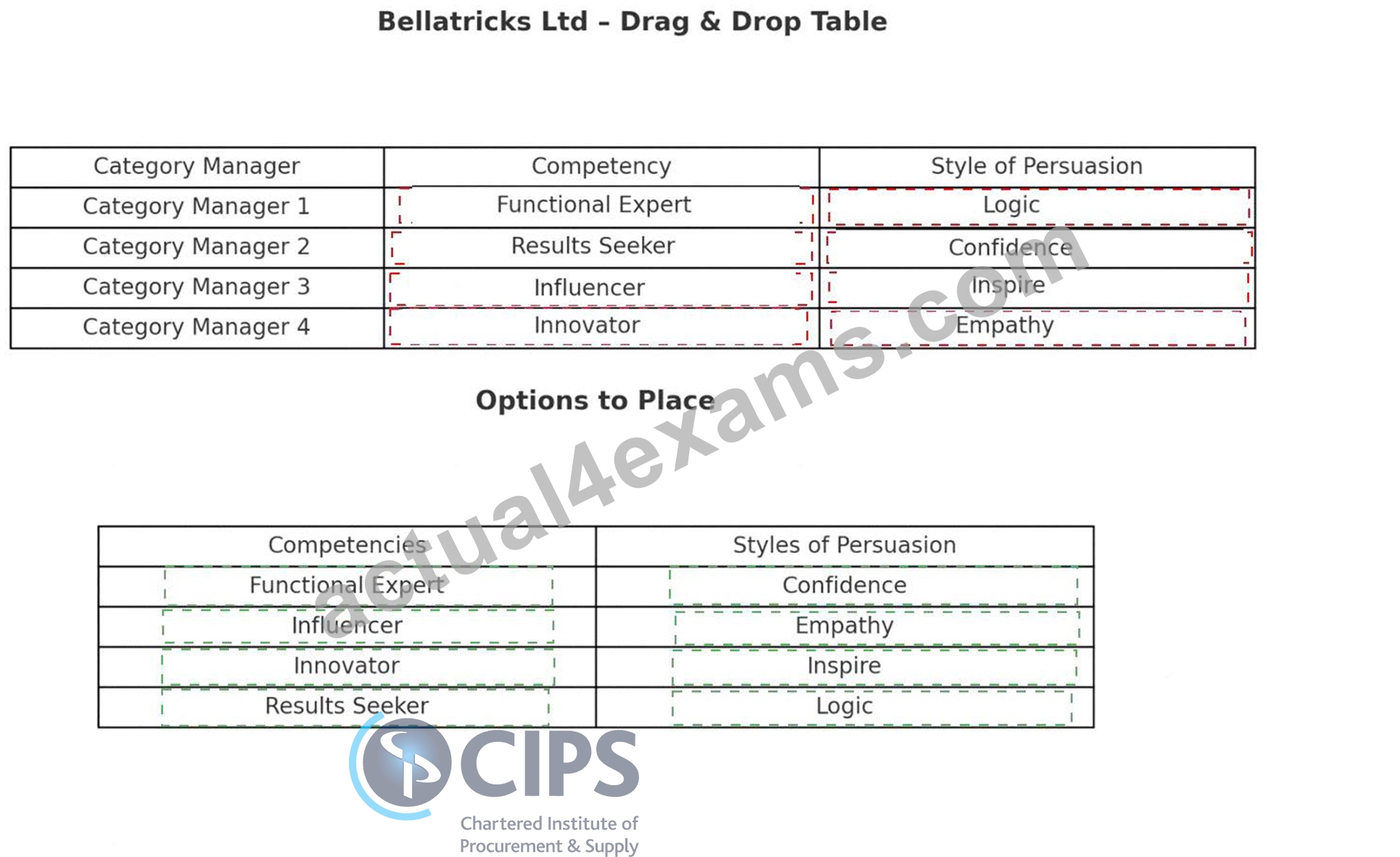
Explanation: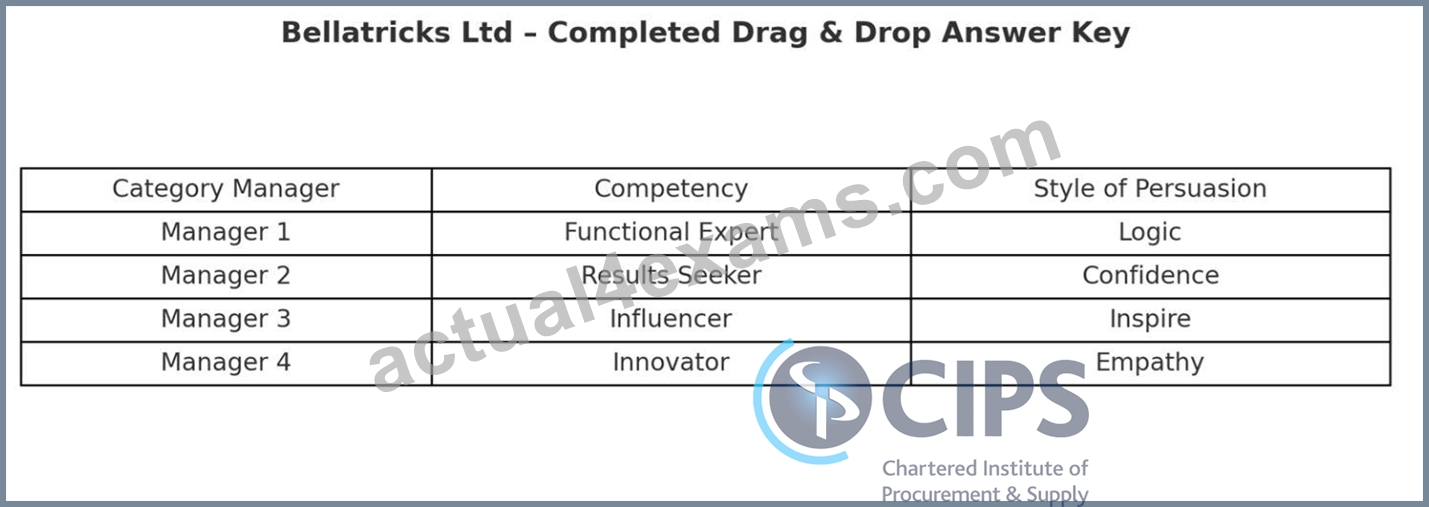
Category Manager 1 # Competency: Functional Expert | Persuasion: Logic
This manager has a PhD, 15 years' experience and is confident developing specifications. That profile maps directly to Functional Expert-deep technical knowledge, standards, and specification ownership. In persuasion terms, the description "strong product knowledge, facts and science" signals a Logic style:
arguments are evidence-led (data, benchmarks, test results, TCO calculations). In supplier negotiations, this type will frame proposals around measurable outcomes and compliance to technical requirements, using structured evaluations and objective criteria. The benefit is credibility and clarity; the risk is over-focusing on technical detail at the expense of relationship nuance. In category work, this style suits complex, specification- driven buys (e.g., engineered components, regulated goods) where accuracy and verification matter most.
Category Manager 2 # Competency: Results Seeker | Persuasion: Confidence
"Meets deadlines, identifies actions, achieves goals; assertive, self-assured, articulate" are classic Results Seeker cues-task focus, milestone discipline, outcome accountability. The persuasion tone is Confidence:
clear asks, firm positions, and decisive proposals. In supplier meetings, this manager will set SMART targets (cost down %, on-time delivery, lead-time reduction), drive cadence (QBRs, action logs), and hold parties to commitments. The upside is momentum and delivery; the watch-out is risking supplier defensiveness if assertiveness isn't balanced with listening. This pairing works well for leverage or non-critical categories where execution speed, price movement and service levels are the primary value drivers.
Category Manager 3 # Competency: Influencer | Persuasion: Inspire
"Strong soft-skills... builds effective relationships... motivates others by being passionate and creating a shared sense of purpose" signals Influencer-credible relationship builder who aligns stakeholders and suppliers. Their persuasion style is Inspire: appeal to shared goals (innovation, sustainability, growth), energise cross-functional teams, and co-create solutions. In supplier negotiations, they'll use vision statements, win-win framing, and recognition to unlock discretionary effort (e.g., co-development, cost-out workshops, service transformation). Strengths include engagement, change adoption and long-term partnership value; risks include under-weighting hard trade-offs if not supported by clear commercial guardrails. This pairing excels in strategic or transformation initiatives where collaboration is the multiplier.
Category Manager 4 # Competency: Innovator | Persuasion: Empathy
"Creative thinker... anticipates rapid changes... produces solutions quickly... sees problems from multiple points of view" matches Innovator-future-oriented, options-generating, comfortable with ambiguity. The persuasion fit is Empathy: actively understanding counterpart drivers (capacity, risk, margin pressures), connecting dots between perspectives, and shaping proposals that address mutual needs. In practice, this manager will run design-thinking workshops, scenario planning, and pilot trials, using supplier insights to re- frame requirements (e.g., modular specs, alternative materials, new service models). The advantage is differentiated value and resilience; the risk is scope drift if ideas aren't prioritised rigorously. This pairing is powerful in volatile markets and for categories needing redesign, sustainability shifts or new tech adoption.
NEW QUESTION # 20
In a marketplace where there is a large number of suppliers, which of the following is true?
- A. Buyer power is strong
- B. There is a low barrier to entry
- C. There is low rivalry
- D. Buyer power is weak
Answer: A
Explanation:
When many suppliers exist, buyers have multiple options, increasing their bargaining power. Suppliers must compete for contracts, shifting power toward the buyer.
[Ref: CIPS L5M6 Study Guide, p.112 - Porter's Five Forces: Buyer Power]
NEW QUESTION # 21
What is a General Ledger?
- A. An IT system that prepares information for financial reporting
- B. An IT system that conducts tenders electronically
- C. A catalogue of products to buy and/or sell
- D. A list of approved suppliers
Answer: A
Explanation:
A General Ledger [GL] is the central accounting record used by businesses to prepare financial reports. It categorises all financial transactions into cost codes, allowing managers to track expenditure, revenue, assets, and liabilities.
For category managers, the General Ledger provides visibility into spend categories. This information supports spend analysis and helps in mapping organisational costs against suppliers, categories, and business functions. It differs from line item detail by offering a higher-level financial view.
Other options are misleading:
* Option A [tenders] relates to e-procurement platforms, not financial records.
* Option C [catalogue] refers to item listings, not ledgers.
* Option D [supplier lists] relates to approved supplier databases.
By using GL data, procurement can ensure alignment with finance, strengthening compliance, budgeting, and strategic sourcing decisions.
[Ref: CIPS L5M6 Study Guide, p.135 - Use of General Ledger in procurement analysis]
NEW QUESTION # 22
The process of designing a product with a trusted supplier in order to eliminate costs that may appear at the delivery stage is known as which cost management strategy?
- A. Cost down
- B. Cost engineering
- C. Cost acceptance
- D. Cost out
Answer: D
Explanation:
The correct term is Cost Out, a proactive cost management approach where the buyer collaborates with the supplier during the design phase to eliminate unnecessary costs before they arise. This ensures efficiency and value creation throughout the product lifecycle. For example, designing packaging to minimise waste or using standardised components to avoid expensive customisation.
This differs from:
* Cost acceptance, where the buyer accepts the supplier's price without analysis.
* Cost engineering, a broader process of optimising costs through design and process evaluation.
* Cost down, which typically involves reducing costs after production by analysing processes, renegotiating contracts, or improving efficiency.
Cost Out is especially relevant for strategic or high-value categories where innovation and collaboration with suppliers can generate long-term savings. It is consistent with category management's emphasis on strategic supplier partnerships.
[Ref: CIPS L5M6 Study Guide, p.80 - Cost Out vs Cost Down strategies]
NEW QUESTION # 23
What can the IACCM help a Category Manager with?
- A. Using the correct sourcing model
- B. Analysing the market
- C. Completing benchmarking
- D. Choosing the correct supplier
Answer: A
Explanation:
The International Association for ContractCommercial Management [IACCM], now known as WorldCC, provides frameworks to help organisations select the most suitable sourcing and contracting models. For category managers, this is particularly valuable when deciding whether a transactional, relational, or investment-based model best fits the organisation's needs.
It does not directly choose suppliers or perform market analysis; rather, it guides decision-makers on the structural relationship with suppliers. For example, IACCM provides tools to decide whether to adopt outcome-based contracts, performance partnerships, or traditional transactional agreements.
Benchmarking may be a separate exercise, but sourcing models determine the governance and risk-sharing approach that underpins supplier relationships.
CIPS encourages procurement professionals to be familiar with IACCM's role, as it reinforces the need for strategic selection of sourcing models rather than a one-size-fits-all approach.
[Ref: CIPS L5M6 Study Guide, p.31 - IACCM and sourcing model selection]
NEW QUESTION # 24
On the BCG Matrix, what is a cash cow?
- A. High market share, low market growth
- B. Low market share, low market growth
- C. High market share, high market growth
- D. Low market share, high market growth
Answer: A
Explanation:
Within the Boston Consulting Group [BCG] Matrix, a Cash Cow represents a product or business unit that holds a high market share in a low-growth market. These products typically generate strong and stable cash flows because they dominate their markets with little new competition. Although growth opportunities are limited, these units require minimal investment and often fund other parts of the business.
For example, a well-established soft drinks brand in a mature market is a classic cash cow. While sales are stable and market share is high, growth potential is low due to saturation. This differs from:
* Stars [high share, high growth] which require significant investment.
* Question Marks [low share, high growth] which may or may not succeed.
* Dogs [low share, low growth] which are often candidates for divestment.
In category management, identifying cash cows helps procurement teams prioritise efficiency and cost management, ensuring these categories remain profitable without heavy strategic input.
[Ref: CIPS L5M6 Study Guide, p.117 - BCG Matrix and procurement strategy]
NEW QUESTION # 25
Randoxx Ltd is a manufacturing company which has four main categories of expenditure:
* Category 1: The market of this category is highly innovative and has rapidly changed over the past five years. There are many suppliers who provide similar products at similar price points.
* Category 2: This category of spend is for highly specialised products and it is important to Randoxx that the products are carbon neutral. Because of this, there is a reduced number of suppliers who provide products to this category and Randoxx has little influence over the price that they pay.
* Category 3: This category of spend is for natural resources which are only found in very few parts of the world. Because of this Randoxx imports all of these items from one country abroad and currency fluctuations have a huge impact on the profit margin of this category spend.
* Category 4: This is a highly technical product which has a patent. It is used in the creation of laptops and phones and it would be impossible to make these with a different product. Due to the growing population Randoxx forecasts that demand for this product will increase.
Task:
Complete the table below by identifying each category's Porter's Force driver and STEEPLE factor challenge. Each response should be used only once.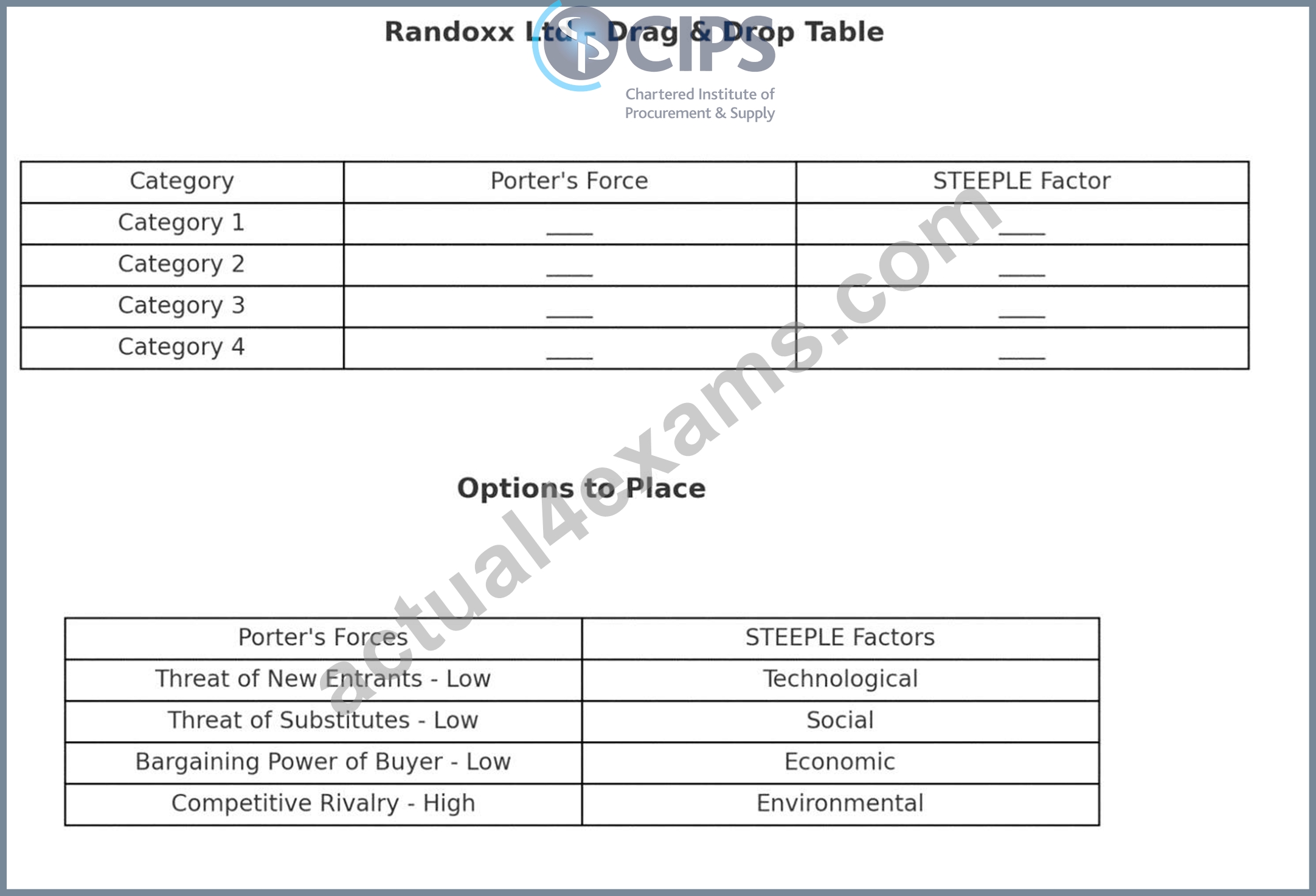
Answer:
Explanation: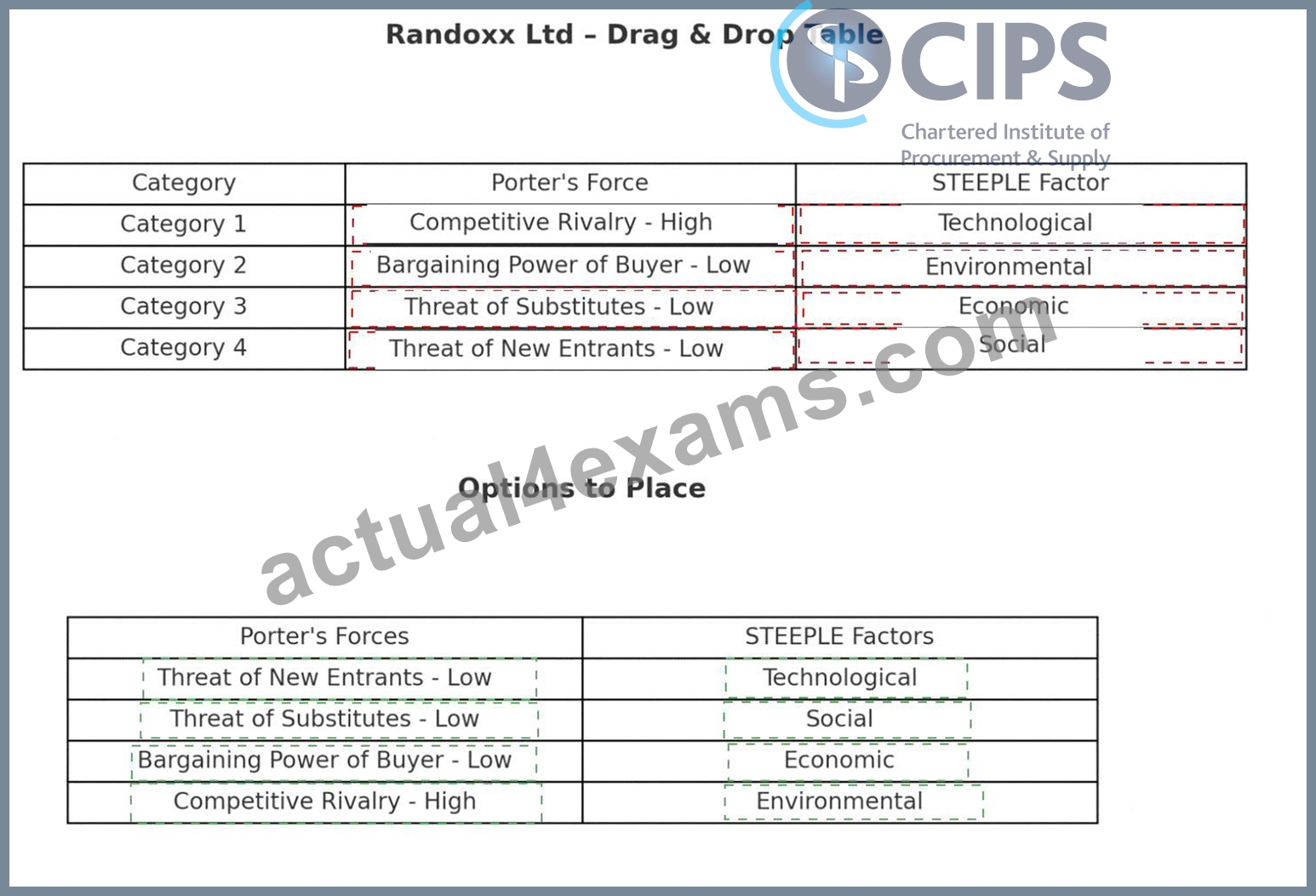
Explanation:
A close-up of a questionnaire AI-generated content may be incorrect.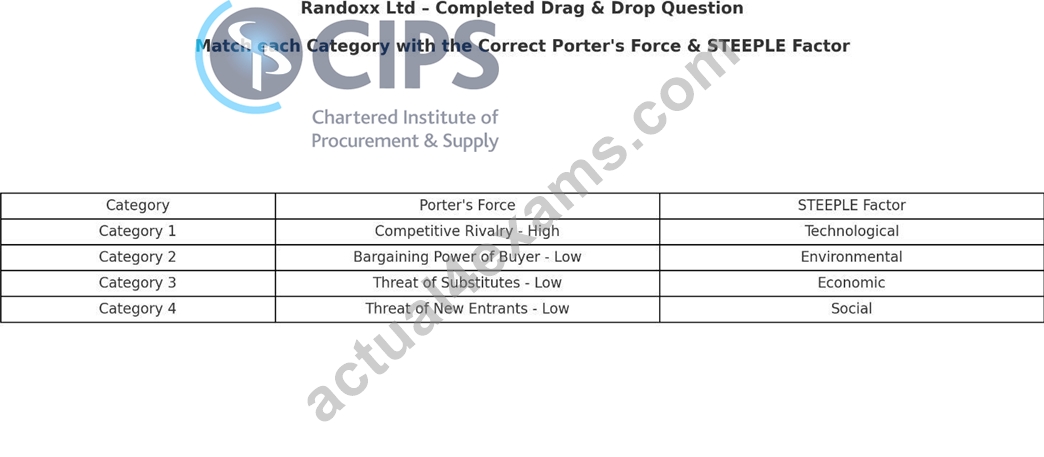
Category 1: Highly innovative, many suppliers with similar products at similar price points
* Porter's Force: Competitive Rivalry - High
* STEEPLE Factor: Technological
Explanation (150-200 words):
Category 1 operates in a market that is highly innovative and subject to rapid technological change.
Innovation means suppliers are constantly developing new features or solutions, making technology the primary STEEPLE factor. Additionally, because there are many suppliers offering similar products at similar price points, competitive rivalry is intense. Buyers can switch easily, and suppliers must compete aggressively on features, pricing, and differentiation.
This combination of high rivalry and technological change creates both opportunity and risk for Randoxx.
On one hand, innovation drives new solutions that can be leveraged; on the other hand, it increases pressure to manage supplier relationships strategically. Randoxx must monitor technological trends closely while maintaining competitive sourcing strategies to manage this highly dynamic category.
(Ref: CIPS L5M6 Study Guide - Porter's Five Forces, p.112-116; STEEPLED Analysis, p.109)
NEW QUESTION # 26
Derek is a Supply Chain Manager conducting a risk assessment. A supplier from 10,000 miles away could fail to deliver, and the risk is classified as major. Using a 1-5 scale for severity and likelihood, which score applies?
- A. 0
- B. 1
- C. 2
- D. 3
Answer: C
Explanation:
The correct score is 25, which is the highest possible risk score on a 1-5 scale. This reflects a major risk with both severity [5] and likelihood [5] rated as high. The risk assessment methodology multiplies these two factors [5 × 5 = 25] to produce a risk rating.
This scoring system enables supply chain managers to rank risks and prioritise mitigation strategies. A risk scored at 25 requires urgent attention, such as developing contingency plans, dual sourcing, increasing safety stock, or renegotiating terms with suppliers.
Lower scores such as 1, 5, or 10 indicate lower overall risk exposure, but in this case, the combination of long geographical distance, reliance on a low-cost country supplier, and criticality of the order elevates the risk to the maximum score.
Risk assessment tools like this are central to category management because they support proactive risk mitigation rather than reactive crisis management.
[Ref: CIPS L5M6 Study Guide, p.56 - Risk assessment scoring and protocols]
NEW QUESTION # 27
Total Cost of Ownership [TCO] is important in Category Management. Steve is sourcing machine parts and IT systems.
Which of the following should Steve consider as part of TCO?
- A. Supplier Relationship
- B. Training
- C. Purchase Price
- D. Maintenance and Downtime
- E. Location of the Items
Answer: B,C,D
Explanation:
Total Cost of Ownership [TCO] refers to the full cost of acquiring, operating, and maintaining an item over its entire lifecycle-not just the purchase price. For Steve, the relevant elements are:
* Purchase Price [A]: The initial acquisition cost.
* Maintenance and Downtime [D]: Costs of repairs, spare parts, and losses during equipment downtime.
* Training [E]: Expenses incurred in training staff to use new systems or equipment.
By contrast, Location and Supplier Relationship are important considerations but cannot be quantified as direct financial costs in the same way.
The TCO model is often illustrated as the Cost Iceberg, where the purchase price is only the visible tip, while hidden costs [e.g., energy use, repairs, obsolescence, disposal] represent the bulk. Understanding TCO enables procurement to make more informed decisions, ensuring long-term value rather than focusing narrowly on upfront cost.
[Ref: CIPS L5M6 Study Guide, p.9 - TCO and the Cost Iceberg]
NEW QUESTION # 28
According to Porter's Five Forces, supplier power is strong in industries where which of the following is true?
[Select THREE]
- A. Switching costs are low
- B. Supplier's customers are fragmented
- C. No substitutes are available
- D. Forward integration is possible
- E. The product is undifferentiated
Answer: B,C,D
Explanation:
Supplier power is strong when buyers have fewer choices and suppliers have leverage. This occurs where:
* No substitutes are available [A]: Buyers are locked into what suppliers provide, increasing supplier power.
* Supplier's customers are fragmented [B]: When customers are fragmented [many small buyers], they cannot collectively negotiate, so suppliers hold more power.
* Forward integration is possible [D]: Suppliers can bypass buyers and sell directly to the end customer, which gives them negotiating strength.
Options C and E relate more to buyer power:
* Switching costs are low [C]: This reduces supplier power as buyers can easily move.
* Undifferentiated products [E]: This strengthens buyer power since products are interchangeable.
[Ref: CIPS L5M6 Study Guide, p.116 - Porter's Five Forces model]
NEW QUESTION # 29
Teddy Ltd has created a virtual cross-functional procurement team across divisions. What could become a barrier to success?
- A. Geography
- B. Language and use of acronyms
- C. Cost
- D. Time
Answer: B
Explanation:
The key barrier is language and the use of acronyms. In cross-functional, international, or virtual teams, communication challenges can hinder collaboration. Procurement often uses specialised terminology and acronyms that other functions or non-native speakers may not fully understand. This can create confusion, misalignment, and inefficiency.
Geography is less of an issue in virtual teams, as digital platforms enable collaboration across locations. Time and cost can be challenges, but the study guide specifically identifies language and acronyms as barriers.
Effective category managers overcome this by using clear, simple communication and ensuring shared understanding of procurement terms. This reduces misunderstandings and ensures that all team members- finance, engineering, operations-can contribute effectively.
Cross-functional teamwork is central to category management success, but only if barriers to collaboration are proactively addressed.
[Ref: CIPS L5M6 Study Guide, p.64 - Cross-functional teams and barriers]
NEW QUESTION # 30
What is the purpose of a Category Board?
- A. To develop and implement a category strategy
- B. To select the Category Manager
- C. To approve spending over a certain amount
- D. To mitigate all risks
Answer: A
Explanation:
A Category Board [sometimes called a Category Council or Committee] is a cross-functional group of stakeholders responsible for overseeing the development and implementation of a category strategy. It brings together representatives from procurement, finance, operations, and other relevant departments to ensure that sourcing decisions align with overall business objectives.
While boards may also review spending or risk, their main role is strategic governance. They provide input into category planning, approve strategies, resolve conflicts, and ensure stakeholder buy-in. This collaboration is essential, as category management is a cross-functional discipline that cannot succeed if procurement operates in isolation.
Options A and B are too narrow, while option D is unrealistic-no body can "mitigate all risks." Instead, the board ensures risks are recognised and addressed within the strategy.
The study guide highlights the importance of such structures in embedding category management within an organisation's governance framework.
[Ref: CIPS L5M6 Study Guide, pp.614 - Category Boards and governance in category management]
NEW QUESTION # 31
Which of the following form part of Cialdini's 7 Principles of Persuasion? Select THREE.
- A. Liking
- B. Morality
- C. Power
- D. Commitment
- E. Social proof
Answer: A,D,E
Explanation:
Cialdini's 7 Principles of Persuasion are key behavioural insights relevant to procurement negotiations and stakeholder management. They are:
* Reciprocity
* Commitment/consistency
* Social proof/consent
* Authority
* Liking
* Scarcity
* Unity
Options social proof, commitment, and liking are directly part of this framework. These principles are used to influence supplier behaviour, build stakeholder alignment, and negotiate effectively. For example, demonstrating that other organisations have adopted a strategy (social proof) can increase acceptance, while establishing rapport (liking) improves cooperation. Procurement professionals who understand these principles can navigate complex stakeholder environments more effectively.
Reference: CIPS L5M6 Study Guide, p.66
NEW QUESTION # 32
Which of the following approaches to cost is the least transparent?
- A. Cost down
- B. Cost out
- C. Price acceptance
- D. Price management
Answer: C
Explanation:
Price acceptance is the least transparent approach because the buyer simply accepts the supplier's quoted price without investigating its basis or fairness. There is no visibility into the supplier's cost structure, margins, or pricing methodology.
By contrast:
* Price management involves actively managing pricing discussions.
* Cost down involves collaborative efforts to reduce costs after production.
* Cost out involves eliminating costs before production through design.
[Ref: CIPS L5M6 Study Guide, p.81 - Costing methods]
NEW QUESTION # 33
Polygon Ltd is a buyer of components. Jeff, a Category Manager at Polygon, is analysing buyer strength in this marketplace to determine his procurement strategy. Which of the following would increase buyer strength?
- A. Low levels of substitute
- B. Fewer suppliers in the marketplace
- C. High level of inflation
- D. Placing larger order quantities
Answer: D
Explanation:
Buyer strength increases when order volumes are large, as this gives leverage in negotiations and can improve pricing and terms. The other options do not necessarily strengthen buyer power.
Reference: CIPS L5M6 Study Guide, p.112
NEW QUESTION # 34
In a Sourcing Business Model, stakeholders must answer key questions to determine the right model.
Which are the most important?
- A. What is the most appropriate economic model?
- B. What factors form part of the total cost of ownership?
- C. How much risk does the company wish to take?
- D. What is the most appropriate contractual relationship?
Answer: A,D
Explanation:
In deciding the correct Sourcing Business Model, stakeholders must clarify two fundamental issues:
* The most appropriate contractual relationship [C]: This could be transactional [short-term, cost- focused], relational [long-term collaboration], or investment-based [joint ventures, alliances]. The choice defines how risks and rewards are shared with suppliers.
* The most appropriate economic model [D]: This determines the pricing and performance framework, e.g., transactional [pay-per-unit], output-based, or outcome-based [pay-for-results].
Options A and B are important but secondary considerations. Risk appetite and TCO factors are inputs to decision-making, but the contractual and economic models define the overall sourcing structure.
This reflects the study guide's emphasis that sourcing models should be tailored to category complexity and business objectives. Using the wrong model can undermine supplier relationships and value delivery.
[Ref: CIPS L5M6 Study Guide, p.32 - Key questions in Sourcing Business Models]
NEW QUESTION # 35
......
Updated Test Engine to Practice L5M6 Dumps & Practice Exam: https://latestdumps.actual4exams.com/L5M6-real-braindumps.html