


New 2026 Realistic Free Juniper JN0-664 Exam Dump Questions and Answer
JN0-664 Practice Test Engine: Try These 99 Exam Questions
To achieve the Juniper JN0-664 certification, candidates must demonstrate a thorough understanding of these topics and be able to apply their knowledge to real-world scenarios. Service Provider, Professional (JNCIP-SP) certification is ideal for network engineers who want to advance their careers in service provider networking and demonstrate their proficiency in Juniper Networks technologies. Service Provider, Professional (JNCIP-SP) certification is also valuable for organizations that employ Juniper Networks technologies and want to ensure that their network engineers have the necessary skills and knowledge to manage and operate their networks effectively.
Juniper JN0-664 certification exam is a computer-based test that consists of 65 multiple-choice questions. Candidates have 120 minutes to complete the exam, and they must achieve a passing score of 65% or higher to earn the certification. JN0-664 exam is administered by Pearson VUE, and it can be taken at any Pearson VUE testing center worldwide.
NEW QUESTION # 35
Which two EVPN route types are used to advertise a multihomed Ethernet segment? (Choose two )
- A. Type 2
- B. Type 1
- C. Type 3
- D. Type 4
Answer: B,D
Explanation:
Explanation
EVPN is a solution that provides Ethernet multipoint services over MPLS networks. EVPN uses BGP to distribute endpoint provisioning information and set up pseudowires between PE devices. EVPN uses different route types to convey different information in the control plane. The following are the main EVPN route types:
* Type 1 - Ethernet Auto-Discovery Route: This route type is used for network-wide messaging and discovery of other PE devices that are part of the same EVPN instance. It also carries information about the redundancy mode and load balancing algorithm of the PE devices.
* Type 2 - MAC/IP Advertisement Route: This route type is used for MAC and IP address learning and advertisement between PE devices. It also carries information about the Ethernet segment identifier (ESI) and the label for forwarding traffic to the MAC or IP address.
* Type 3 - Inclusive Multicast Ethernet Tag Route: This route type is used for broadcast, unknown unicast, and multicast (BUM) traffic forwarding. It also carries information about the multicast group and the label for forwarding BUM traffic.
* Type 4 - Ethernet Segment Route: This route type is used for multihoming scenarios, where a CE device is connected to more than one PE device. It also carries information about the ESI and the designated forwarder (DF) election process.
NEW QUESTION # 36
Exhibit.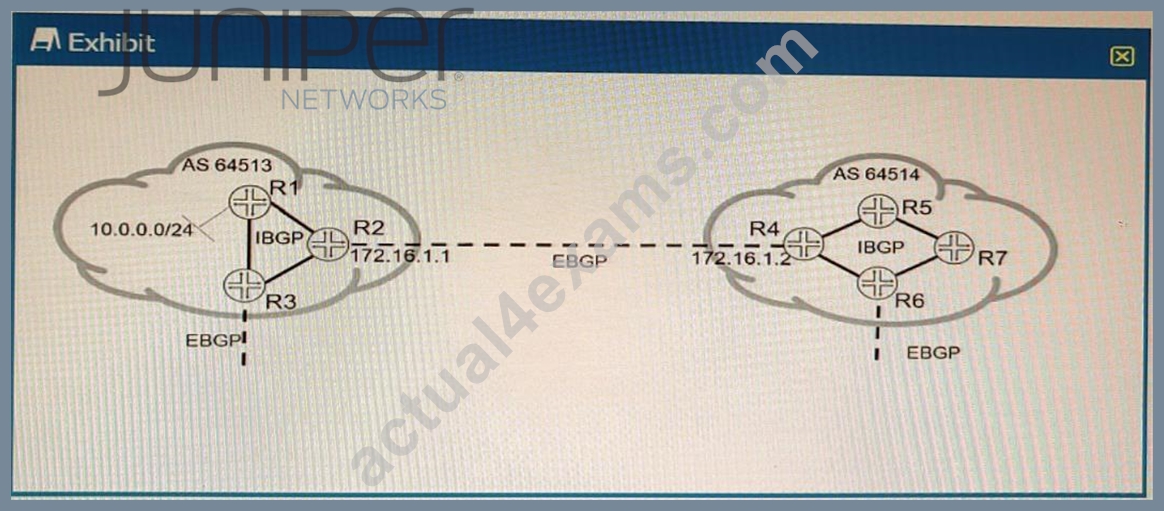
Referring to the exhibit; the 10.0.0.0/24 EBGP route is received on R5; however, the route is being hidden.
What are two solutions that will solve this problem? (Choose two.)
- A. On R4, create a policy to change the BGP next hop to itself and apply it to IBGP as an export policy.
- B. On R4, add the external EBGP interface's prefix to the IGP routing tables.
- C. On R4, add the internal IBGP interface prefixes to the BGP routing tables.
- D. On R4, create a policy to change the BGP next hop to 172.16.1.1 and apply it to IBGP as an export policy.
Answer: A,B
NEW QUESTION # 37
In IS-IS, which two statements are correct about the designated intermediate system (DIS) on a multi-access network segment? (Choose two)
- A. On the multi-access network, each router forms an adjacency to every other router on the segment
- B. A router with a priority of 1 wins the DIS election over a router with a priority of 10.
- C. A router with a priority of 10 wins the DIS election over a router with a priority of 1.
- D. On the multi-access network, each router only forms an adjacency to the DIS.
Answer: C,D
Explanation:
In IS-IS, a designated intermediate system (DIS) is a router that is elected on a multi-access network segment (such as Ethernet) to perform some functions on behalf of other routers on the same segment. A DIS is responsible for sending network link-state advertisements (LSPs), which describe all the routers attached to the network. These LSPs are flooded throughout a single area. A DIS also generates pseudonode LSPs, which represent the multi-access network as a single node in the link-state database. A DIS election is based on the priority value configured on each router's interface connected to the multi-access network. The priority value ranges from 0 to 127, with higher values indicating higher priority. The router with the highest priority becomes the DIS for the area (Level 1, Level 2, or both). If routers have the same priority, then the router with the highest MAC address is elected as the DIS. By default, routers have a priority value of 64. On a multi-access network, each router only forms an adjacency to the DIS, not to every other router on the segment. This reduces the amount of hello packets and LSP
NEW QUESTION # 38
You are configuring a BGP signaled Layer 2 VPN across your MPLS enabled core network. In this scenario, which statement is correct?
- A. This type of VPN requires the support of the inet-vpn NLRI on all core BGP devices
- B. This type of VPN only supports Ethernet interfaces when connecting to CE devices.
- C. You must assign a unique site number to each attached site's configuration.
- D. You must use the same route-distinguiaher value on both PE devices.
Answer: A
Explanation:
BGP signaled Layer 2 VPN is a type of VPN that uses BGP to distribute VPN labels and information for Layer 2 connectivity between sites over an MPLS network. BGP signaled Layer 2 VPN requires the support of the l2vpn NLRI on all core BGP devices1. The l2vpn NLRI is a new address family that carries Layer 2 VPN information such as the VPN identifier, the attachment circuit identifier, and the route distinguisher. The l2vpn NLRI is used for both auto-discovery and signaling of Layer 2 VPNs2. In this scenario, we are configuring a BGP signaled Layer 2 VPN across an MPLS enabled core network. Therefore, we need to ensure that all core BGP devices support the l2vpn NLRI.
References: 1:
https://www.juniper.net/documentation/us/en/software/junos/vpn-l2/topics/concept/vpn-layer-2-overview.html
2:
https://www.cisco.com/c/en/us/td/docs/ios-xml/ios/mp_l2_vpns/configuration/xe-16/mp-l2-vpns-xe-16-book/vpl
NEW QUESTION # 39
Exhibit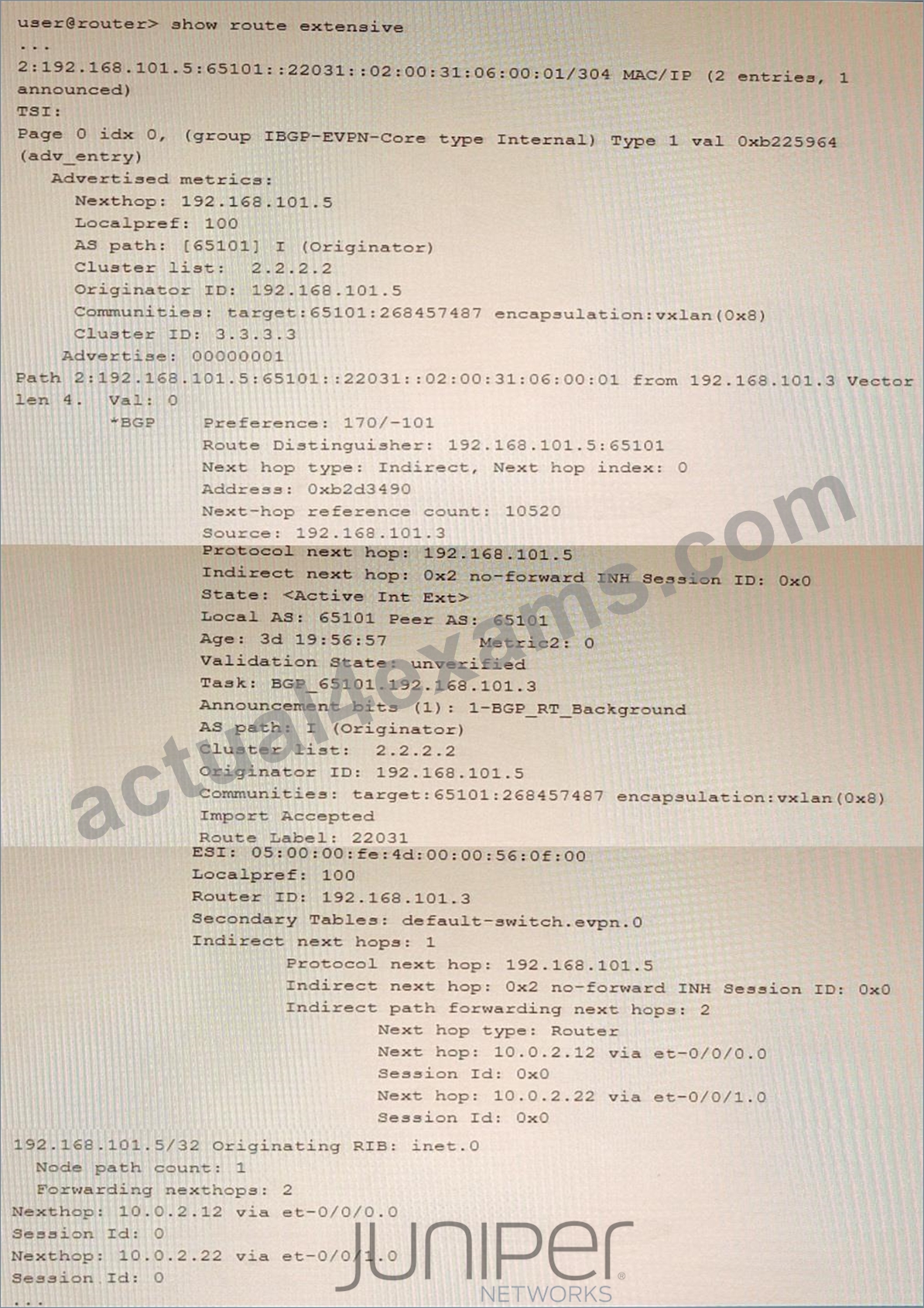
Referring to the exhibit, which two statements are true? (Choose two.)
- A. This is an EVPN Type-2 route.
- B. The device advertising this route into EVPN is 192.168.101.5.
- C. This route is learned through EBGP
- D. The devices advertising this route into EVPN are 10 0 2 12 and 10.0.2.22.
Answer: A,B
Explanation:
This is an EVPN Type-2 route, also called a MAC/IP advertisement route, that is used to advertise host IP and MAC address information to other VTEPs in an EVPN network. The route type field in the EVPN NLRI has a value of 2, indicating a Type-2 route. The device advertising this route into EVPN is 192.168.101.5, which is the IP address of the VTEP that learned the host information from the local CE device. This IP address is carried in the MPLS label field of the route as part of the VXLAN encapsulation.
NEW QUESTION # 40
By default, which statement is correct about OSPF summary LSAs?
- A. All Type 2 and Type 7 LSAs will be summanzed into a single Type 5 LSA
- B. Type 3 LSAs are advertised for routes in Type 1 LSAs.
- C. The area-range command must be installed on all routers.
- D. The metric associated with a summary route will be equal to the lowest metric associated with an individual contributing route
Answer: B
Explanation:
OSPF uses different types of LSAs to describe different aspects of the network topology. Type 1 LSAs are also known as router LSAs, and they describe the links and interfaces of a router within an area. Type 3 LSAs are also known as summary LSAs, and they describe routes to networks outside an area but within the same autonomous system (AS). By default, OSPF will summarize routes from Type 1 LSAs into Type 3 LSAs when advertising them across area boundaries .
NEW QUESTION # 41
Which two statements are correct about reflecting inet-vpn unicast prefixes in BGP route reflection? (Choose two.)
- A. A BGP peer does not require any configuration changes to become a route reflector client.
- B. Route reflectors add their cluster ID to the AS path when readvertising client routes.
- C. Clients add their originator ID when advertising routes to their route reflector
- D. Route reflectors do not change any existing BGP attributes by default when advertising routes.
Answer: A,D
Explanation:
Explanation
Route reflection is a BGP feature that allows a router to reflect routes learned from one IBGP peer to another IBGP peer, without requiring a full-mesh IBGP topology. Route reflectors do not change any existing BGP attributes by default when advertising routes, unless explicitly configured to do so. A BGP peer does not require any configuration changes to become a route reflector client, only the route reflector needs to be configured with the client parameter under [edit protocols bgp group group-name neighbor neighbor-address] hierarchy level.
NEW QUESTION # 42
Which two statements are correct regarding the PIM DR in a PIM-SM domain? (Choose two.)
- A. The source DR sends PIM register messages from the source network to the RP.
- B. By default. PIM DR election is performed on point-to-point links.
- C. The receiver DR sends PIM join and PIM prune messages from the receiver network toward the RP.
- D. If the DR priorities match, the router with the lowest IP address is selected as the DR.
Answer: A,C
NEW QUESTION # 43
Exhibit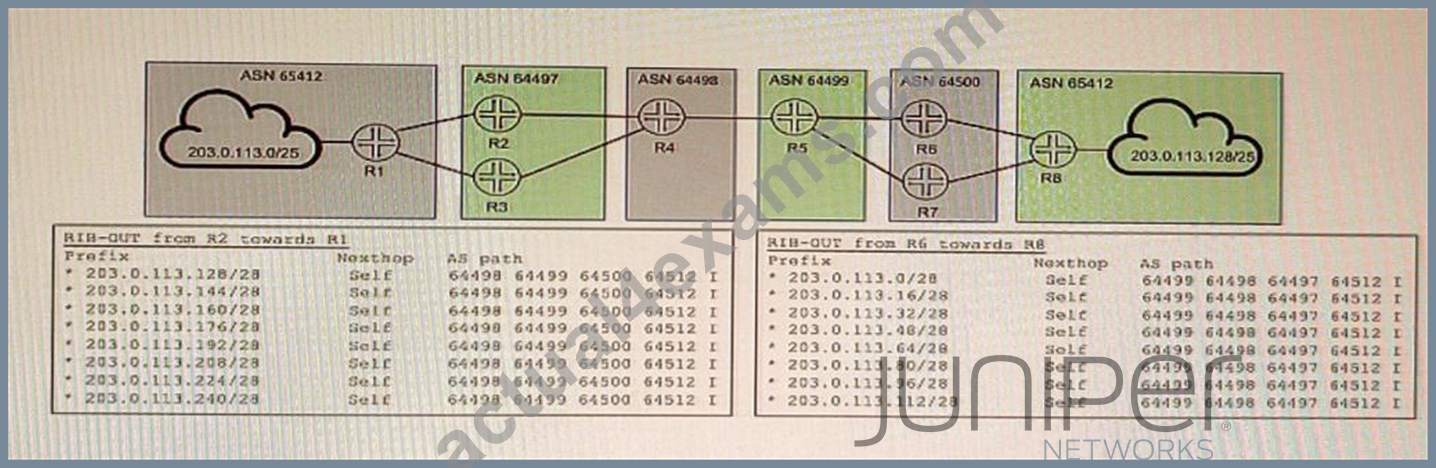
R1 and R8 are not receiving each other's routes
Referring to the exhibit, what are three configuration commands that would solve this problem? (Choose three.)
- A. Configure as-override on advertisement from AS 64500 toward AS 64512.
- B. Configure remove-private on advertisements from AS 64497 toward AS 64498
- C. Configure remove-private on advertisements from AS 64500 toward AS 64499
- D. Configure loops and advertise-peer-as on routers in AS 64497 and AS 64450.
- E. Configure loops on routers in AS 65412 and advertise-peer-as on routers in AS 64498.
Answer: B,C,E
Explanation:
Explanation
The problem in this scenario is that R1 and R8 are not receiving each other's routes because of private AS numbers in the AS path. Private AS numbers are not globally unique and are not advertised to external BGP peers. To solve this problem, you need to do the following:
* Configure loops on routers in AS 65412 and advertise-peer-as on routers in AS 64498. This allows R5 and R6 to advertise their own AS number (65412) instead of their peer's AS number (64498) when sending updates to R7 and R8. This prevents a loop detection issue that would cause R7 and R8 to reject the routes from R5 and R62.
* Configure remove-private on advertisements from AS 64497 toward AS 64498 and from AS 64500 toward AS 64499. This removes any private AS numbers from the AS path before sending updates to external BGP peers. This allows R2 and R3 to receive the routes from R1 and R4, respectively3.
NEW QUESTION # 44
Exhibit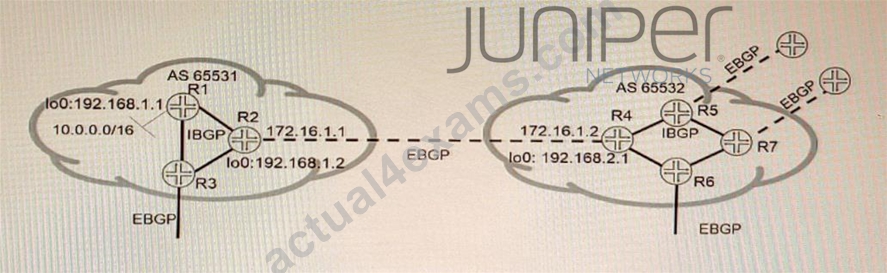
Referring to the exhibit, which three statements are correct about route 10 0 0.0/16 when using the default BGP advertisement rules'? (Choose three.)
- A. R2 will advertise 10.0.0.0/16 to R3 with 192.168.1 1 as the next hop
- B. R2 will advertise 10.0.0.0/16 to R4 with 172.16.1.1 as the next hop
- C. R1 will advertise 10.0.0.0/16 to R2 with 192 168 1 1 as the next hop.
- D. R4 will advertise 10 0.0 0/16 to R6 with 172.16 1 1 as the next hop
- E. R1 will prepend AS 65531 when advertising 10 0.0 0/16 to R2.
Answer: A,B,E
NEW QUESTION # 45
Your network is receiving the 203.0.113.0/24 network using EBGP from AS 64500 and AS 64501. Both of these advertisements have identical local-preference values, AS-path lengths, and BGP origin codes. You want to influence the way your AS sends traffic to the 203.0.113.0/24 network.
In this scenario, which attribute would you consider next when selecting the best path?
- A. MED value
- B. peer IP address
- C. IGP metric
- D. router ID
Answer: A
Explanation:
To determine the correct answer, let's analyze the BGP path selection process and identify which attribute would be considered next in this scenario.
Background on BGP Path Selection
When multiple paths to the same destination are received via BGP, the router uses a step-by-step process to select the best path. The order of attributes considered is as follows (simplified for this scenario):
* Highest Local Preference : The path with the highest local preference is preferred.
* Shortest AS Path : The path with the shortest AS path length is preferred.
* Lowest Origin Code : Paths with an origin code of IGP are preferred over EGP, and EGP is preferred over Incomplete.
* Lowest MED (Multi-Exit Discriminator) : If the first three attributes are identical, the path with the lowest MED value is preferred.
* eBGP over iBGP : eBGP paths are preferred over iBGP paths.
* IGP Metric to Next Hop : The path with the lowest IGP metric to the next-hop router is preferred.
* Router ID : If all else is equal, the path from the router with the lowest Router ID is preferred.
* Peer IP Address : As a last tiebreaker, the path from the peer with the lowest IP address is preferred.
Scenario Analysis
In this scenario:
* You are receiving the 203.0.113.0/24 network via EBGP from two different autonomous systems (AS
64500 and AS 64501).
* Both advertisements have identical local-preference values , AS-path lengths , and BGP origin codes .
Given that the first three attributes in the BGP path selection process are identical, the next attribute to consider is the MED (Multi-Exit Discriminator) value.
Analysis of the Options
Option A: Router ID
* Incorrect : The Router ID is considered much later in the BGP path selection process, only after other attributes like MED and IGP metric have been evaluated. Since MED is still relevant here, Router ID is not the next attribute to consider.
Option B: MED value
* Correct : The MED value is used to influence inbound traffic from neighboring ASes. When local preference, AS path length, and origin code are identical, the path with the lowest MED value is preferred. This makes MED the next attribute to consider in this scenario.
Option C: Peer IP Address
* Incorrect : The peer IP address is a tiebreaker used only at the very end of the BGP path selection process, after all other attributes have been evaluated. It is not relevant here because MED has not yet been considered.
Option D: IGP Metric
* Incorrect : The IGP metric to the next-hop router is considered after MED. Since MED is still relevant in this scenario, IGP metric is not the next attribute to evaluate.
Final Answer
The correct answer is:
B: MED value
Summary
* When local preference, AS path length, and origin code are identical, the MED value is the next attribute considered in the BGP path selection process.
* MED is used to influence how traffic enters your AS from neighboring ASes.
NEW QUESTION # 46
Exhibit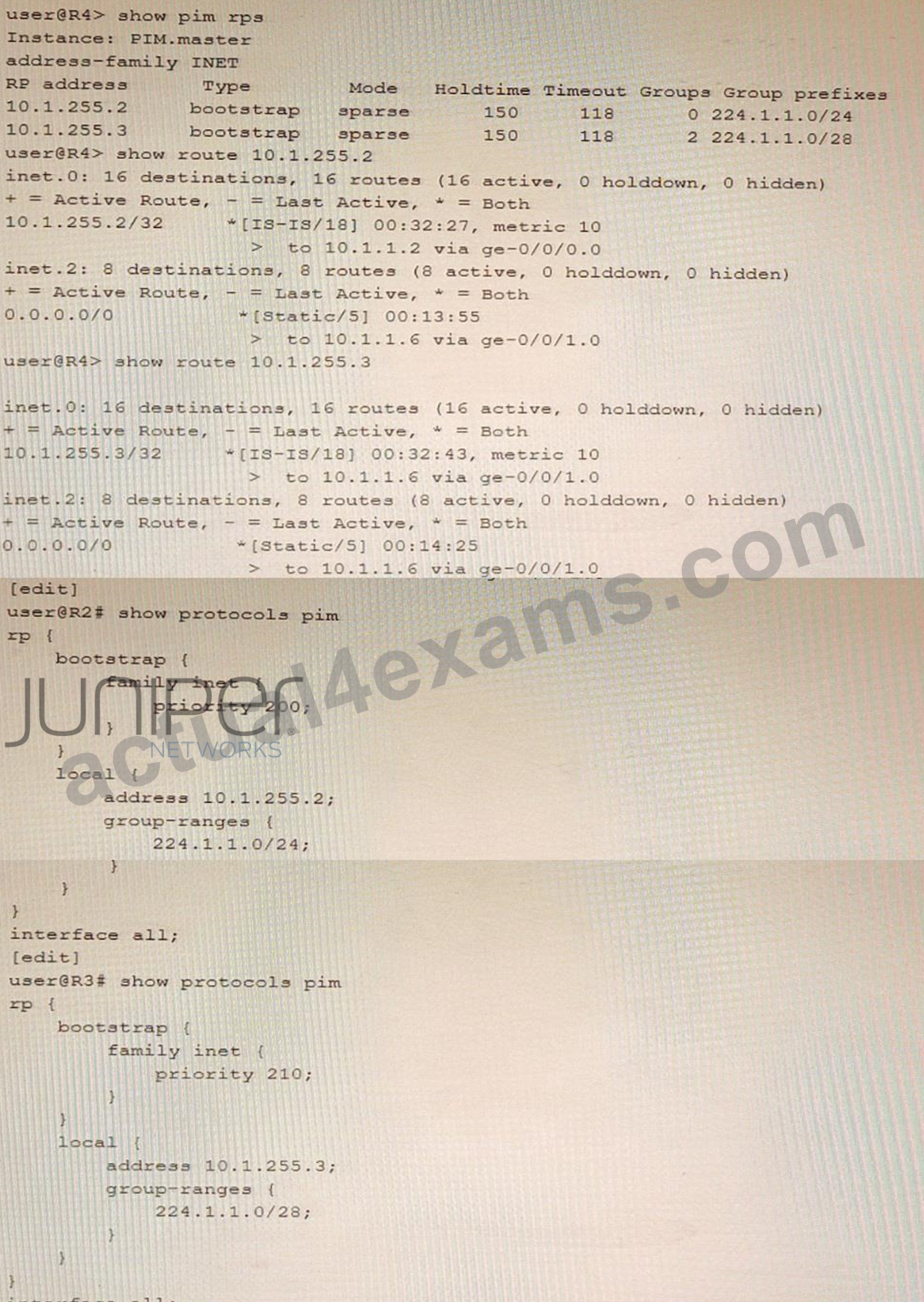
R4 is directly connected to both RPs (R2 and R3) R4 is currently sending all ,o,ns upstream to R3 but you want all joins to go to R2 instead Referring to the exhibit, which configuration change will solve this issue?
- A. Change the local address on R2 to be higher than R3.
- B. Change the group-range to be more specific on R2 than R3.
- C. Change the default route in inet.2 on R4 from R3 as the next hop to R2
- D. Change the bootstrap priority on R2 to be higher than R3
Answer: D
Explanation:
Explanation
PIM Bootstrap Router (BSR) is a mechanism that allows PIM routers to discover and announce rendezvous point (RP) information for multicast groups. BSR uses two roles: candidate BSR and candidate RP. Candidate BSR is the router that collects information from all available RPs in the network and advertises it throughout the network. Candidate RP is the router that wants to become the RP and registers itself with the BSR. There can be only one active BSR in the network, which is elected based on the highest priority or highest IP address if the priority is the same. The BSR priority can be configured manually or assigned automatically. The default priority is 0 and the highest priority is 2551. In this question, R4 is directly connected to both RPs (R2 and R3) and is currently sending all joins upstream to R3 but we want all joins to go to R2 instead. To achieve this, we need to change the BSR priority on R2 to be higher than R3 so that R2 becomes the active BSR and advertises its RP information to R4.
NEW QUESTION # 47
Refer to the exhibit.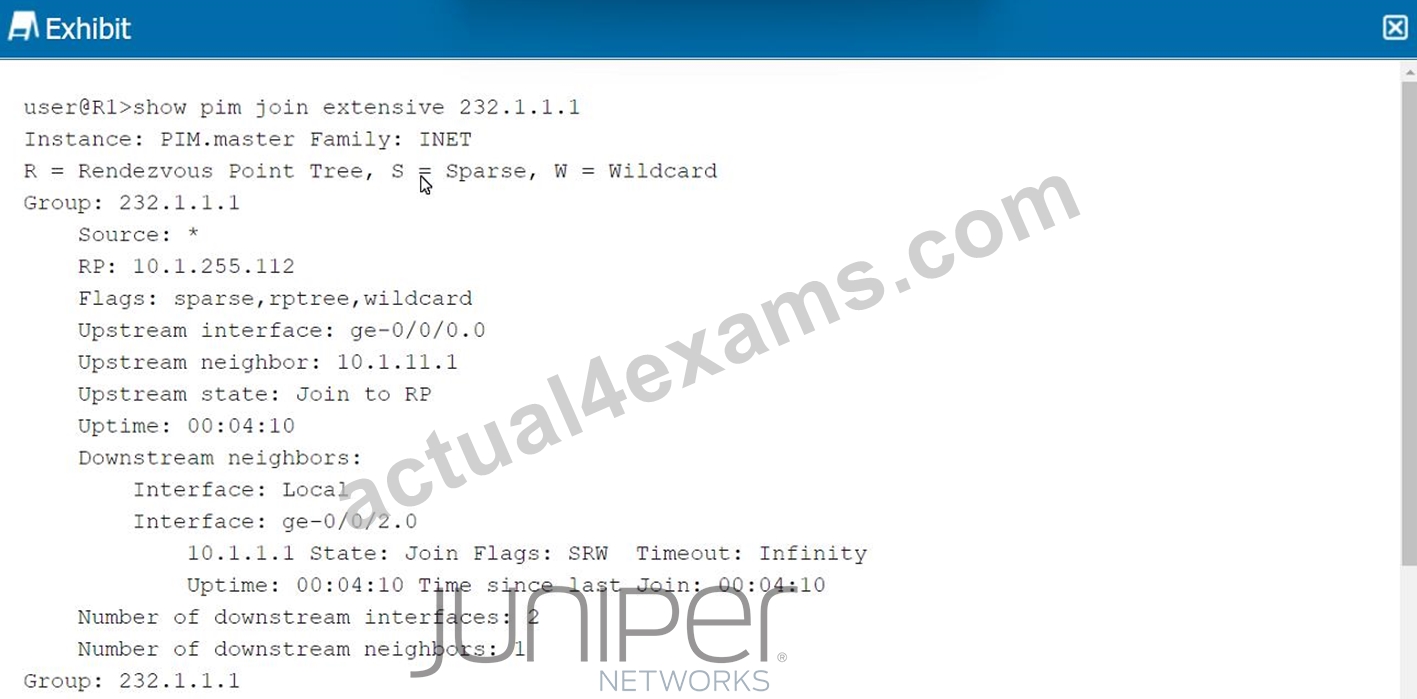
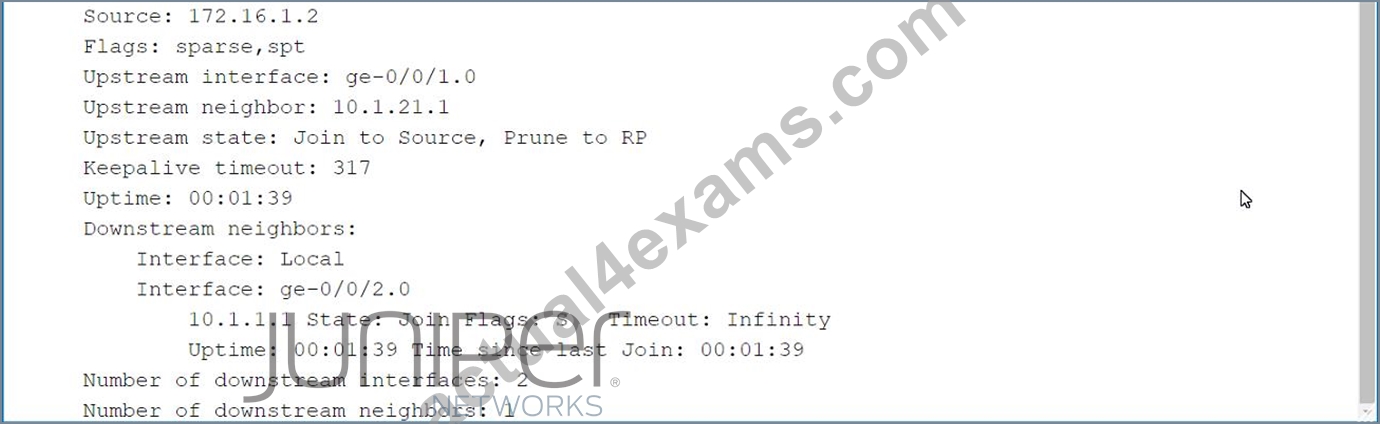
Click the Exhibit button.
Referring to the exhibit, which two statements are correct regarding the output shown in the exhibit? (Choose two.)
- A. The multicast traffic is using the SPT.
- B. The multicast traffic is using the RPT.
- C. The multicast group is an SSM group.
- D. The multicast group is an ASM group.
Answer: A,D
Explanation:
In the provided exhibit, the output of the `show pim join extensive 232.1.1.1` command is shown. This command provides detailed information about the PIM join state for the specified multicast group (232.1.1.1) on the router R1. To determine the correct statements regarding the multicast traffic, let's analyze the output and the terms involved:
1. **ASM vs. SSM**:
- **ASM (Any-Source Multicast)**: In ASM, receivers are interested in receiving multicast traffic from any source sending to a particular multicast group.
- **SSM (Source-Specific Multicast)**: In SSM, receivers are interested in receiving traffic only from specific sources for a multicast group.
- **Group Address Range**:
- ASM uses the range 224.0.0.0 to 239.255.255.255.
- SSM uses the range 232.0.0.0 to 232.255.255.255.
Since the group address 232.1.1.1 falls within the SSM range (232.0.0.0/8), there might be confusion. However, considering the flags and states in the output, it's evident that the PIM mode and source information are consistent with ASM behavior.
2. **Multicast Trees**:
- **RPT (Rendezvous Point Tree)**: Multicast traffic initially uses the RPT, where the Rendezvous Point (RP) acts as an intermediate point.
- **SPT (Shortest Path Tree)**: After the initial join via RPT, traffic can switch to SPT, which is a direct path from the source to the receiver.
3. **Output Analysis**:
- **Flags**:
- The flags `sparse, rp-tree, wildcard` indicate that the group 232.1.1.1 is currently using RPT. This is typical for ASM, where traffic initially goes through the RP.
- The flags `sparse, spt` indicate that for the source 172.16.1.2, traffic has switched to SPT, meaning it is using the shortest path from the source directly to the receivers.
**Conclusion**:
Based on the analysis:
- **A. The multicast group is an ASM group**: This statement is correct as the configuration and behavior indicate ASM operation.
- **B. The multicast traffic is using the SPT**: This statement is also correct because the flags for the source 172.16.1.2 indicate that the traffic is using the SPT.
Thus, the correct answers are:
**A. The multicast group is an ASM group.**
**B. The multicast traffic is using the SPT.**
**Reference**:
- Juniper Networks PIM Documentation: [PIM Overview](https://www.juniper.net/documentation/en_US/junos/topics/concept/pim-overview.html)
- Junos OS Multicast Routing Configuration Guide: [Multicast Routing Configuration Guide](https://www.juniper.net/documentation/en_US/junos/topics/topic-map/multicast-routing.html)
NEW QUESTION # 48
Exhibit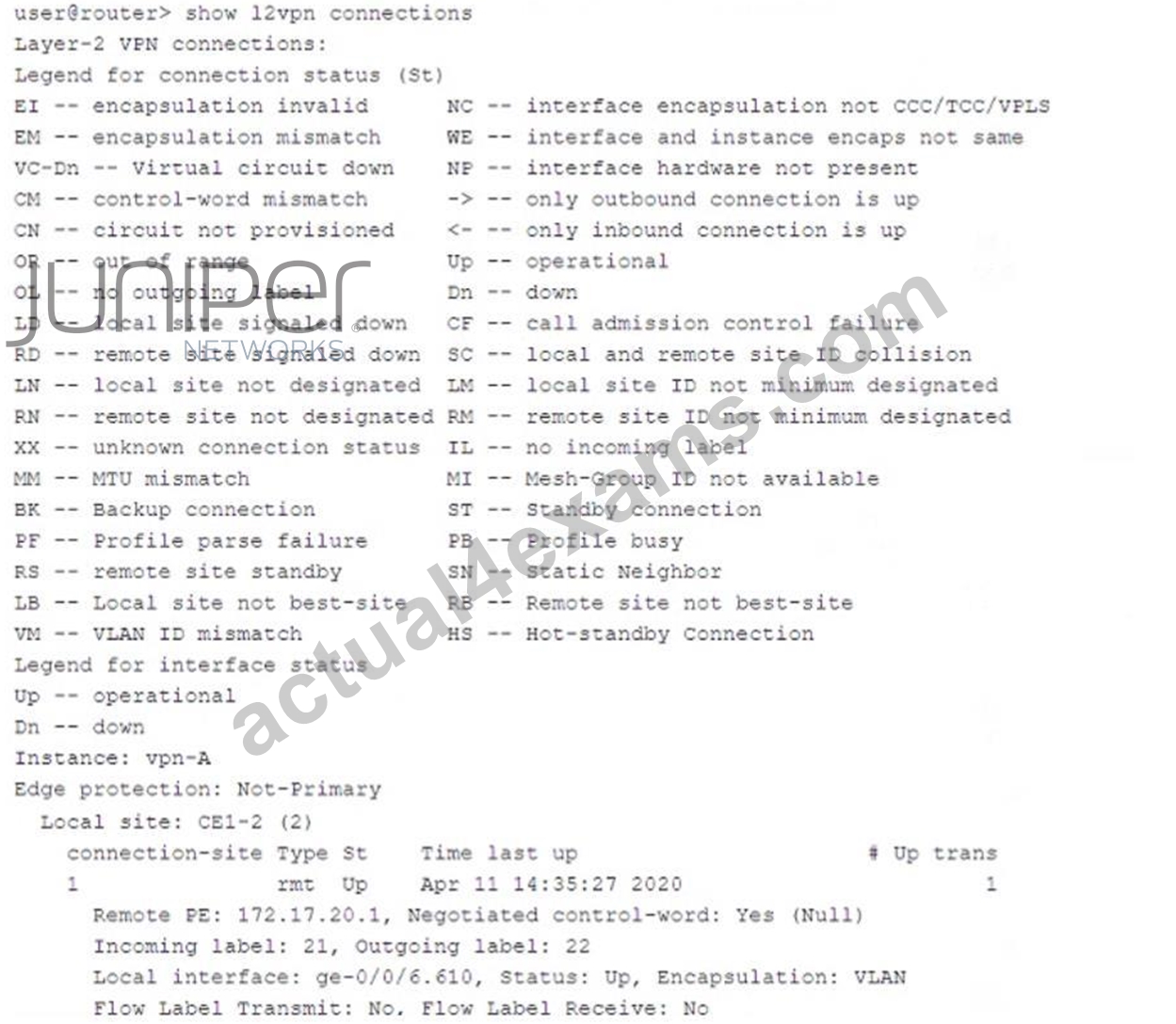
Which two statements about the output shown in the exhibit are correct? (Choose two.)
- A. The PE router has the capability to pop flow labels
- B. The PE is attached to a single local site.
- C. The connection has not flapped since it was initiated.
- D. There has been a VLAN ID mismatch.
Answer: B,C
Explanation:
The output is from the show l2vpn connections command on a Juniper router. This command is used to verify the status of Layer 2 VPN (L2VPN) pseudowires between Provider Edge (PE) routers.
Breakdown of Key Information:
* Instance: vpn-A
* This is the L2VPN instance being monitored.
* Connection Status (St)
* The connection status is "Up", meaning the pseudowire is operational.
* Local Site: CE1-2 (2)
* The PE router is attached to a single local site (CE1-2).
* Uptime & Connection Flaps
* The output shows the last time the connection was up:
Time last up: Apr 11 14:35:27 2020
* The "# Up trans" value is 1, meaning this connection has been established once and has not flapped since it was initiated.
* VLAN ID Mismatch Check
* The legend includes "VM - VLAN ID mismatch", but this status is not present in the connection output.
* This means there is NO VLAN ID mismatch.
* Flow Labels
* The Flow Label Transmit is No, and the Flow Label Receive is No.
* This means the PE router does NOT have the capability to pop flow labels.
NEW QUESTION # 49
By default, which statement is correct about OSPF summary LSAs?
- A. Type 3 LSAs are advertised for routes in Type 1 LSAs.
- B. The area-range command must be installed on all routers.
- C. The metric associated with a summary route will be equal to the lowest metric associated with an individual contributing route.
- D. All Type 2 and Type 7 LSAs will be summarized into a single Type 5 LSA.
Answer: A
NEW QUESTION # 50
Referring to the exhibit, which two statements are correct about BGP routes on R3 that are learned from the ISP-A neighbor? (Choose two.)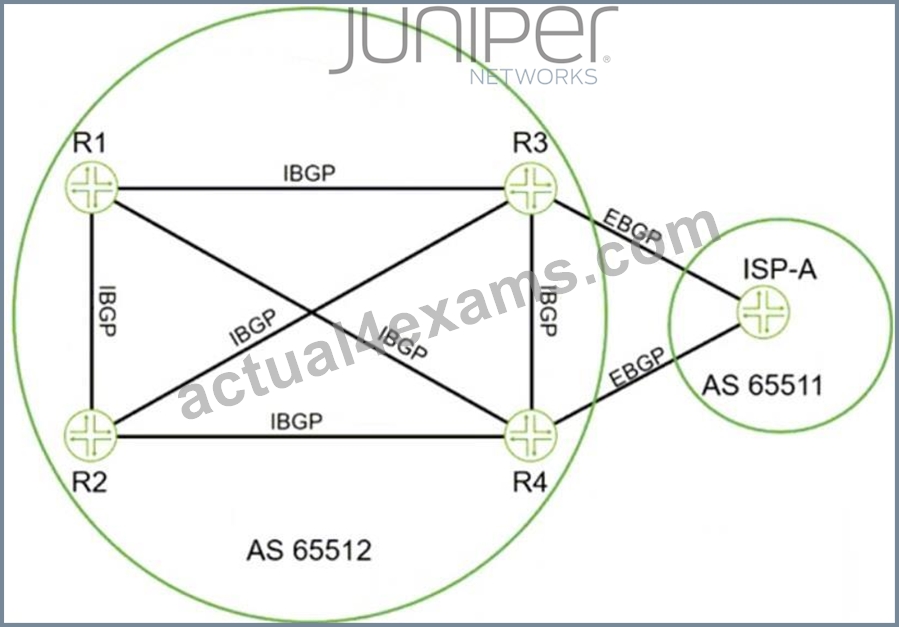
- A. By default, the next-hop value for these routes is not changed by ISP-A before being sent to R3.
- B. The BGP local-preference value that is used by ISP-A is not advertised to R3.
- C. All BGP attribute values must be removed before receiving the routes.
- D. The next-hop value for these routes Is changed by ISP-A before being sent to R3.
Answer: A,B
NEW QUESTION # 51
You are configuring a Layer 3 VPN between two sites. You are configuring the vrf-target target : 65100:100 statement in your routing instance.
In this scenario, which two statements describe the vrf-target configuration? (Choose two.)
- A. This value is used to add a target community to BGP routes advertised to the remote PE device.
- B. This value is used to add a target community to BGP routes advertised to the local CE device.
- C. This value is used to identify BGP routes learned from the remote PE device.
- D. This value is used to identify BGP routes learned from the local CE device.
Answer: A,C
Explanation:
The `vrf-target` statement in a Layer 3 VPN configuration is used to control the import and export of VPN routes by attaching a target community to the routes. This helps in defining which VPN routes should be imported into or exported from a particular VRF (Virtual Routing and Forwarding) instance.
1. **Understanding VRF Target**:
- The `vrf-target` statement specifies the extended community attributes (route targets) that are used to control the import and export of routes in a VRF.
- These attributes help in identifying which routes should be shared between different VRFs, particularly across different PE (Provider Edge) devices.
2. **Statements Analysis**:
- **A. This value is used to identify BGP routes learned from the local CE device.**
- Incorrect. The `vrf-target` attribute is not used to identify routes learned from the local CE device. It is used to manage routes between PE devices and within the provider's MPLS network.
- **B. This value is used to identify BGP routes learned from the remote PE device.**
- Correct. The `vrf-target` value helps in identifying which routes from remote PE devices should be imported into the local VRF. It essentially acts as a filter for importing BGP routes with matching target communities.
- **C. This value is used to add a target community to BGP routes advertised to the local CE device.**
- Incorrect. Routes advertised to the local CE device do not use the `vrf-target` attribute. Instead, these routes are typically managed within the local VRF routing table.
- **D. This value is used to add a target community to BGP routes advertised to the remote PE device.**
- Correct. When advertising routes from the local PE to remote PE devices, the `vrf-target` value is added to these routes. This target community ensures that the correct routes are shared across the VPN.
**Conclusion**:
The correct statements about the `vrf-target` configuration in a Layer 3 VPN scenario are:
**B. This value is used to identify BGP routes learned from the remote PE device.**
**D. This value is used to add a target community to BGP routes advertised to the remote PE device.**
**Reference**:
- Juniper Networks Documentation on VRF Target: [VRF Target Configuration](https://www.juniper.net/documentation/en_US/junos/topics/topic-map/layer-3-vpns.html)
- MPLS and VPN Architectures by Ivan Pepelnjak and Jim Guichard
NEW QUESTION # 52
You are configuring a BGP signaled Layer 2 VPN across your MPLS enabled core network. Your PE-2 device connects to two sites within the s VPN In this scenario, which statement is correct?
- A. You must create a unique Layer 2 VPN routing instance for each site on the PE-2 device.
- B. You must use separate physical interfaces to connect PE-2 to each site.
- C. By default on PE-2, the site's local ID is automatically assigned a value of 0 and must be configured to match the total number of attached sites.
- D. By default on PE-2, the remote site IDs are automatically assigned based on the order that you add the interfaces to the site configuration.
Answer: D
Explanation:
Explanation
BGP Layer 2 VPNs use BGP to distribute endpoint provisioning information and set up pseudowires between PE devices. BGP uses the Layer 2 VPN (L2VPN) Routing Information Base (RIB) to store endpoint provisioning information, which is updated each time any Layer 2 virtual forwarding instance (VFI) is configured. The prefix and path information is stored in the L2VPN database, which allows BGP to make decisions about the best path.
In BGP Layer 2 VPNs, each site has a unique site ID that identifies it within a VFI. The site ID can be manually configured or automatically assigned by the PE device. By default, the site ID is automatically assigned based on the order that you add the interfaces to the site configuration. The first interface added to a site configuration has a site ID of 1, the second interface added has a site ID of 2, and so on.
Option D is correct because by default on PE-2, the remote site IDs are automatically assigned based on the order that you add the interfaces to the site configuration. Option A is not correct because by default on PE-2, the site's local ID is automatically assigned a value of 0 and does not need to be configured to match the total number of attached sites. Option B is not correct because you do not need to create a unique Layer 2 VPN routing instance for each site on the PE-2 device. You can create one routing instance for all sites within a VFI. Option C is not correct because you do not need to use separate physical interfaces to connect PE-2 to each site. You can use subinterfaces or service instances on a single physical interface.
NEW QUESTION # 53
You must alter class-of-service values in packets on the outbound interface of an edge router.
In this scenario, which CoS component allows you to accomplish this task?
- A. output policer
- B. rewrite rules
- C. forwarding classes
- D. scheduler
Answer: B
NEW QUESTION # 54
Exhibit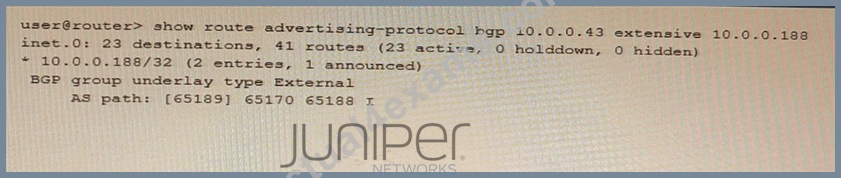
Referring to the exhibit, what do the brackets [ ] in the AS path identify?
- A. They identify the local AS number associated with the AS path if configured on the router, or if AS path prepending is configured
- B. They identify that a BGP confederation is being used to ensure that there are no routing loops.
- C. They identify that the autonomous system number is incomplete and awaiting more information from the BGP protocol.
- D. They identify an AS set, which are groups of AS numbers in which the order does not matter
Answer: A
Explanation:
https://www.juniper.net/documentation/us/en/software/junos/cli-reference/topics/ref/command/show-route- advertising-protocol.html
NEW QUESTION # 55
Exhibit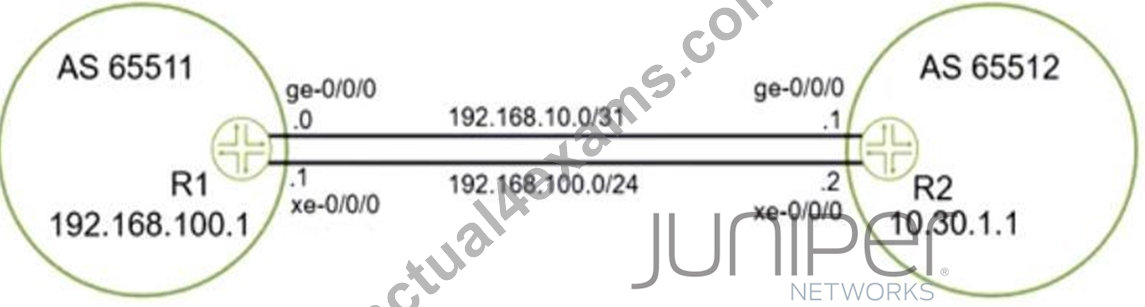
You want to use both links between R1 and R2 Because of the bandwidth difference between the two links, you must ensure that the links are used as much as possible.
Which action will accomplish this goal?
- A. Ensure that the metric-out parameter on the Gigabit Ethernet interface is higher than the 10 Gigibit Ethernet interface.
- B. Define a policy to tag routes with the appropriate bandwidth community.
- C. Enable per-prefix load balancing.
- D. Disable multipath.
Answer: B
Explanation:
https://www.juniper.net/documentation/us/en/software/junos/sampling-forwarding-monitoring/bgp/topics/concep
NEW QUESTION # 56
......
Juniper JN0-664 exam is aimed at professionals who are responsible for designing, implementing, and supporting service provider networks. JN0-664 exam is designed to test the candidate's knowledge and skills in the areas of routing, switching, and service provider technologies. The JN0-664 exam is a rigorous test that requires candidates to demonstrate their knowledge of networking technologies and their ability to apply that knowledge in real-world scenarios.
Guaranteed Success in JNCIP-SP JN0-664 Exam Dumps: https://latestdumps.actual4exams.com/JN0-664-real-braindumps.html