


PF1 Questions PDF [2026] Use Valid New dump to Clear Exam
Passing National Payroll Institute PF1 Exam Using 2026 Practice Tests
NEW QUESTION # 18
The capital cost of an employer-owned vehicle includes:
- A. The cost of the vehicle, vehicle options, accessories, sales tax and additions that add to depreciation value
- B. The cost of the vehicle, sales tax, customized heavy-duty suspension and power winches to meet requirement of employment uses
- C. The cost of the vehicle, vehicle options, specialized equipment to meet requirements of employment
- D. The cost of the vehicle excluding sales tax
Answer: A
Explanation:
For CRA automobile benefit purposes (standby charge on an employer-owned automobile), the "cost" used is the capital cost, which includes more than just the sticker price. CRA guidance states the cost includes the trade-in amount (if applicable), additions, and GST/HST and PST as part of the cost base used in the standby charge calculation.
Option D is the best match because it includes vehicle options/accessories, sales taxes, and additions that add to depreciation value. Importantly, CRA also notes that certain specialized equipment added to meet the requirements of a disabled person or employment (examples include heavy-duty suspension and power winches) is not considered part of the automobile's cost for standby charge purposes. This directly rules out options A and C, since they treat specialized equipment as part of capital cost. Option B is incorrect because CRA includes sales taxes (GST/HST and PST) in the cost base.
NEW QUESTION # 19
Vacation pay on termination would be recorded in which Block(s) on the Record of Employment?
- A. It would not be recorded
- B. Block 15B only
- C. Block 17A only
- D. Blocks 15B, 15C P.P. 1 and 17A
Answer: D
Explanation:
Service Canada's ROE Guide is clear that vacation pay paid because of separation (termination/layoff) must be reported in Block 17A - Vacation pay.
But it doesn't stop there. Vacation pay is generally insurable earnings, so when you enter insurable earnings in Block 17A, you must also add those amounts into Block 15B (Total insurable earnings) and into Block
15C, Pay Period 1 (P.P. 1) as applicable. The ROE Guide explicitly states: when you enter insurable earnings in Blocks 17A/17B/17C, you must also add them to the totals in Blocks 15B and 15C (P.P. 1 field)-and it gives the example that vacation pay paid on separation must be added to 15B and 15C because it is insurable.
Therefore, vacation pay on termination is recorded in Blocks 15B, 15C P.P. 1, and 17A (option C).
NEW QUESTION # 20
The Canada Revenue Agency form that is completed to allow a commissioned employee to claim non- reimbursed expenses at source is a:
- A. TD1X
- B. T777
- C. TP-1015.R.13.1-V
- D. TD1
Answer: A
Explanation:
The CRA form used to adjust payroll income tax withholdings at source for employees who earn commission income and have commission expenses is Form TD1X - Statement of Commission Income and Expenses for Payroll Tax Deductions. The CRA explains that an employee completes TD1X if they receive commission income (or salary plus commission) and want the employer to adjust tax deductions to take commission expenses into account.
This is different from:
TD1, which is the Personal Tax Credits Return used to claim basic/personal credits and determine standard withholding (not commission-expense adjustments).
T777, which is used to claim employment expenses on the employee's personal tax return (not to reduce payroll withholding at source).
TP-1015.R.13.1-V, which is a Quebec form used to request a reduction of Quebec income tax withholding in specific situations (not the CRA commission-expense at-source form).
Operationally, payroll should keep the TD1X on file and apply it to income tax withholding calculations until the employee updates or replaces it.
NEW QUESTION # 21
Charmaine's employment was terminated by her employer on April 13 of the current year. Charmaine had worked for her employer for 3 years and was paid 3 weeks of legislated wages in lieu of notice and two weeks' vacation pay with her final pay. What date should be recorded in Block 11 on Charmaine's Record of Employment?
- A. None of the above
- B. Block 11 would not be completed
- C. April 13 of the current year
- D. May 4 of the current year
Answer: C
Explanation:
Block 11 on the ROE is the "Last day for which paid," meaning the last day the employee received insurable earnings. In most terminations, this is the employee's last day of work. Service Canada notes Block 11 only moves beyond the last day worked when the employee continues to receive insurable earnings after the last day of work due to paid leave (such as vacation leave or sick leave) or salary continuance.
In this question, Charmaine's employment ended April 13, and she received a lump-sum final pay that included wages in lieu of notice and vacation pay. These amounts are typically reported as special payments (for example, pay in lieu of notice is reported as such), but they do not automatically change Block 11 unless they are paid as an actual paid-leave period or as salary continuance (where regular pay continues and the ROE is not issued until the continuance ends).
NEW QUESTION # 22
Which of the following deductions would be the last payroll withholding in order of priority?
- A. Requirement to Pay
- B. Third Party Demand
- C. Voluntary insurance coverage
- D. The organization's pension plan
Answer: C
Explanation:
In payroll, deductions are applied in a priority order so employers satisfy mandatory legal obligations first.
CRA collection tools such as a Requirement to Pay (RTP) and a Demand on a Third Party (DTP) are legal
/garnishment-type deductions. CRA explains that a Requirement to Pay directs a third party (often the employer) to send amounts otherwise payable to the employee to the CRA, and the employer must comply.
Company pension contributions (where participation is required as a condition of employment or under a plan
/collective agreement) are generally company-compulsory deductions-important, but they come after statutory and legal deductions. Voluntary insurance coverage is a classic voluntary deduction (the employee chooses it; it is not legally required). Voluntary deductions are normally taken last because they must not interfere with statutory/legal withholding obligations.
So among the options, voluntary insurance coverage is the one that would be withheld last in the order of priority.
NEW QUESTION # 23
What information is required to calculate thestandby charge, thereduced standby charge, and theoperating cost benefitfor a company-owned automobile?
- A. Capital cost, total kilometres, personal kilometres, and business kilometres
- B. Capital cost, availability, business kilometres
- C. Capital cost, sales taxes, availability
- D. Capital cost, sales tax, availability, total kilometres, business kilometres, and personal kilometres
Answer: D
Explanation:
CRA's automobile benefit calculations require multiple data points because there are usuallytwo components thestandby charge(vehicle availability) and theoperating expense benefit(personal driving where the employer pays operating costs). CRA's guidance on employer-provided automobiles explains that standby charge calculations use the automobile'scost (capital cost) including applicable taxesand the time the vehicle wasavailableto the employee, while the reduced standby charge and operating benefit depend on kilometres drivenand the split betweenbusiness and personal use.
To determine whether areduced standby chargeapplies, you need availability plusbusiness-use requirements(which are evidenced through total/business kilometres). To calculate the operating expense benefit, you needpersonal kilometres(often derived from total kilometres minus business kilometres) or detailed personal km directly.
Therefore, the complete and correct set of required inputs is:capital cost (with sales tax), availability, total kilometres, business kilometres, and personal kilometres-which is optionD.
NEW QUESTION # 24
The amount of notice the employer must give an employee depends on:
- A. The size of the employer's payroll
- B. The employee's length of service and the jurisdiction in which they live
- C. The industry in which the employer operates
- D. The employee's length of service and the jurisdiction in which they work
Answer: D
Explanation:
Termination notice requirements come from the employment standards legislation that applies to the workplace, which is tied to the jurisdiction where the employee works (province/territory), unless the workplace is federally regulated. The Government of Canada explicitly directs employers and employees to consult the employment standards for the province or territory of work if they are not in a federally regulated industry.
Within a given jurisdiction, the minimum notice (or pay in lieu) is typically based on the employee's length of continuous employment/service. For example, under the Canada Labour Code (federally regulated workplaces), required notice increases with service (and can be replaced with wages in lieu), showing service length is a core driver of notice entitlements.
That's why "where they live" is not the deciding factor for notice rules: the governing employment standards are based on the jurisdiction of employment (where the work is performed / the employment is regulated), and the employee's length of service under that jurisdiction's rules.
NEW QUESTION # 25
Select the correct order of priority for withholding payroll deductions from an employee's earnings.
- A. Statutory deductions, union deductions, legal deductions, company-compulsory deductions, voluntary deductions
- B. Statutory deductions, legal deductions, union deductions, company-compulsory deductions, voluntary deductions
- C. Company-compulsory deductions, union deductions, statutory deductions, legal deductions, voluntary deductions
- D. Union deductions, statutory deductions, legal deductions, company-compulsory deductions, voluntary deductions
Answer: B
Explanation:
Payroll deductions are typically applied in a priority order to ensure the employer meets mandatory legal obligations first and avoids creating liability. Standard Canadian payroll training materials commonly present five categories withheld in this order: (1) statutory deductions, (2) legal deductions, (3) union deductions, (4) company-compulsory deductions, and (5) voluntary deductions.
Statutory deductions (CPP/QPP, EI, income tax, and where applicable NWT/Nunavut payroll tax) have top priority because employers are legally required to deduct and remit them.
Legal deductions (such as CRA requirements to pay/garnishments) are next because they are enforced by law and can create employer liability if not followed.
Union deductions follow where required by a collective agreement.
Company-compulsory deductions (for example, required benefit premiums) come after those.
Voluntary deductions (charity, savings plans, etc.) are last and only taken if funds remain.
Therefore, option D is the correct order.
NEW QUESTION # 26
In Block 6 of the Record of Employment, what pay period type is entered for employees who are paid salary plus regularly paid commission?
- A. Depends on the pay period frequency
- B. Weekly
- C. Irregular
- D. Monthly
Answer: A
Explanation:
In Block 6 (Pay period type), Service Canada instructs employers to enter the employee's actual pay period type-one of the standard types such as weekly, biweekly, semi-monthly, monthly, or 13 pay periods a year.
Service Canada identifies a special rule only for employees "paid solely on commission or on salary plus irregularly paid commission": in those cases, the employer must use a weekly pay period and average earnings using the weekly averaging formula.
Because this question specifies salary plus regularly paid commission (not irregularly paid commission), the
"special situation" rule does not apply. Therefore, you enter the pay period type that matches the employer's normal payroll cycle for that employee (for example, weekly, biweekly, semi-monthly, monthly, etc.).
NEW QUESTION # 27
National Hardware, an Ontario organization, will be terminating the employment of Emilie St. Germain on October 28, 2019, the last day of the pay period. Emilie started with National Hardware on September 19,
2007. Complete the paper Record of Employment (ROE) for Emilie based on the information provided in the following chart.
Note: Vacationable earnings already include the pay in lieu of notice.
All dates must be entered in the format DDMMYYYY.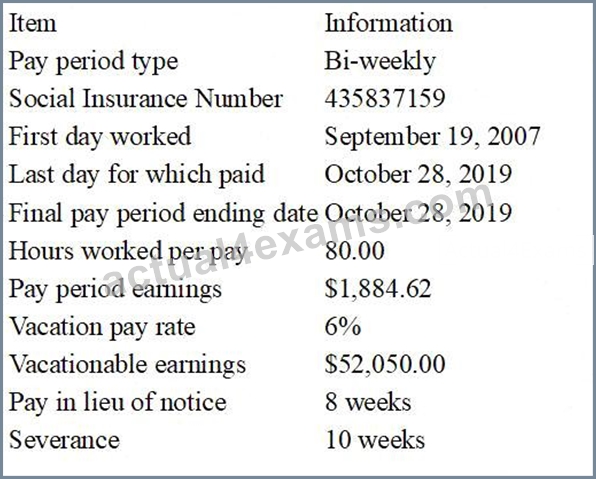
Paper ROE (Form Reference)
Complete the following paper ROE blocks for Emilie:
Block 6 - Pay period type
Block 8 - Social Insurance Number
Block 10 - First day worked
Block 11 - Last day for which paid
Block 12 - Final pay period ending date
Block 15A - Total insurable hours
Block 15B - Total insurable earnings
Block 17A - Vacation pay
Block 17C - Other monies (Pay in lieu of notice)
Block 17C - Other monies (Severance)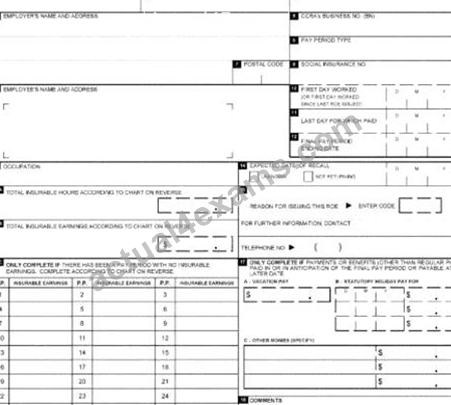
Step 1 - Complete Block 6
Enter the pay period type for Emilie.
Step 2 - Complete Block 8
Enter Emilie's Social Insurance Number.
Step 3 - Complete Block 10
Enter Emilie's first day worked in DDMMYYYY format.
Step 4 - Complete Block 11
Enter Emilie's last day for which paid in DDMMYYYY format.
Step 5 - Complete Block 12
Enter the final pay period ending date in DDMMYYYY format.
Step 6 - Complete Block 15A
Calculate and enter total insurable hours.
Given:
Hours worked per pay period = 80.00
Bi-weekly ROE pay period chart captures 27 pay periods
Step 7 - Complete Block 15B
Calculate and enter total insurable earnings.
Given:
Pay period earnings = $1,884.62
Bi-weekly ROE pay period chart captures 27 pay periods
Step 8 - Complete Block 17A
Calculate and enter vacation pay.
Given:
Vacation pay rate = 6%
Vacationable earnings = $52,050.00
(already includes pay in lieu of notice)
Step 9 - Complete Block 17C
Enter the correct amount in 17C for "Other monies" specified as Pay in lieu of notice.
Given:
Pay in lieu of notice = 8 weeks
Use weekly earnings derived from the bi-weekly pay period earnings.
Step 10 - Complete Block 17C
Enter the correct amount in 17C for "Other monies" specified as Severance.
Given:
Severance = 10 weeks
Use the same weekly earnings used in Step 9.
Answer:
Explanation:
See the Below Explanation for complete Solution.
Explanation:
Step 1 - Block 6
Bi-weekly
Step 2 - Block 8
435837159
Step 3 - Block 10
September 19, 2007 # 19092007
Step 4 - Block 11
October 28, 2019 # 28102019
Step 5 - Block 12
October 28, 2019 # 28102019
Step 6 - Block 15A (Total insurable hours)
80.00 × 27 = 2160
Block 15A = 2160
Step 7 - Block 15B (Total insurable earnings)
$1,884.62 × 27 = $50,884.74
Block 15B = 50,884.74
Step 8 - Block 17A (Vacation pay)
$52,050.00 × 6% = $3,123.00
Block 17A = 3,123.00
Step 9 - Block 17C (Pay in lieu of notice)
Weekly earnings = $1,884.62 ÷ 2 = $942.31
Pay in lieu = $942.31 × 8 = $7,538.48
Block 17C (Pay in lieu of notice) = 7,538.48
Step 10 - Block 17C (Severance)
Severance = $942.31 × 10 = $9,423.10
Block 17C (Severance) = 9,423.10
NEW QUESTION # 28
Alyssa is a member of her employer's Defined Contribution Pension Plan. The plan defines the contribution as 3% of the employee's pensionable earnings, with the employer matching the employee's contribution.
Alyssa's pensionable earnings are $3,400.00 per month. Calculate the total payment to be remitted to Alyssa's Defined Contribution Pension Plan each month.
Answer:
Explanation:
$204.00 per month
Explanation:
In a Defined Contribution (DC) pension plan, contributions are calculated as a set percentage of the employee' s pensionable earnings, and the total remittance is usually the sum of the employee deduction plus the employer's matching contribution, based on the plan text. Here, the plan states the employee contributes 3% of pensionable earnings, and the employer matches the employee contribution.
Step 1: Calculate the employee's pension contribution:
3% × $3,400.00 = 0.03 × 3,400.00 = $102.00.
Step 2: Calculate the employer match:
Because the employer matches the employee contribution, the employer contributes $102.00 as well.
Step 3: Total remittance to the plan:
$102.00 (employee) + $102.00 (employer) = $204.00 each month.
From a payroll processing perspective, the employee amount is withheld from gross pay as a payroll deduction according to plan rules, while the employer match is recorded as an employer expense. Payroll remits both amounts to the plan administrator following the plan's remittance schedule, and should reconcile pensionable earnings and contributions to ensure accuracy and compliance with plan terms.
NEW QUESTION # 29
A retiring allowance includes:
- A. Payments in recognition of long service
- B. Bonus or incentive pay
- C. Vacation pay
- D. Accumulated overtime
Answer: A
Explanation:
The CRA defines a retiring allowance (also called severance pay) as an amount paid to an employee when or after they retire or lose their job, in recognition of long service or for the loss of office or employment. This matches option A.
The other options are specifically not retiring allowances under CRA guidance. The CRA states a retiring allowance does not include salary, wages, bonuses, or overtime, which rules out bonus or incentive pay and accumulated overtime. The CRA also states it does not include payments for accumulated vacation leave not taken before retirement, which rules out vacation pay.
This classification matters in payroll because retiring allowances have distinct rules: for example, they are not subject to CPP or EI deductions, and part of a retiring allowance may be eligible for direct transfer to an RRSP
/RPP under special rules (based on pre-1996 service).
NEW QUESTION # 30
Raminder was hired in January 1997. He was fully vested in the organization's pension plan at the time he received the retiring allowance. His employment was terminated on May 1, 2006 and he was paid a
$10,000.00 retiring allowance. Calculate the eligible portion of the retiring allowance.
- A. $2,000.00
- B. $7,500.00
- C. $10,000.00
- D. None of the retiring allowance is eligible
Answer: D
Explanation:
The "eligible portion" of a retiring allowance (the part that may be transferred directly to an RRSP/RPP on a tax-deferred basis without using regular RRSP room) is based on years of service before 1996 (and potentially an additional amount for certain pre-1989 years). CRA explains that the eligible part is: $2,000 for each year or part-year of service before 1996, plus an additional $1,500 for each year or part-year of service before 1989 only if no employer-funded pension/DPSP benefits for those years were vested (or previously paid out).
Raminder was hired in January 1997, so he has zero years (or part-years) of service before 1996, and therefore he has no base eligible amount under the $2,000-per-year rule. Because he also has no pre-1989 service, the additional $1,500-per-year rule does not apply either.
So, the eligible portion is $0, meaning none of the $10,000 retiring allowance is eligible (option D).
NEW QUESTION # 31
Paula is granted a pay increase. The paperwork informing the payroll department of the pay increase is two pay periods late. What method would be used to calculate income taxes on the separate retroactive payment?
- A. Bonus tax method
- B. Tax table method
- C. Retroactive tax method
- D. Lump-sum tax method
Answer: C
Explanation:
A payment made to "catch up" wages because a pay increase was processed late is a retroactive payment. The CRA provides different income tax calculation approaches depending on the payment type and specifically lists "Retroactive payments" as its own category, separate from regular tax-table calculations, lump-sum, and bonus/irregular methods.
For bonuses and retroactive pay increases, the CRA also points employers to the Payroll Deductions Online Calculator (PDOC) to calculate CPP, EI, and income tax correctly, which aligns with using the appropriate CRA method for retroactive amounts.
Because this situation is explicitly a retroactive adjustment (two pay periods late), the correct choice is the Retroactive tax method (option C), not the bonus/irregular method, not the lump-sum method, and not the regular tax tables.
NEW QUESTION # 32
When would a Record of Employment be issued for an employee paid mainly by commission?
- A. When the employee has not earned any commission after six months
- B. An employee mainly paid by commission is not entitled to receive a Record of Employment
- C. When the employee has had seven consecutive calendar days without both work and insurable earnings
- D. When the employment relationship has been severed
Answer: D
Explanation:
Commission employees have a specific ROE rule. Service Canada's ROE Guide explains that for employees whose earnings consist mainly of commissions, an interruption of earnings occurs only when the employment contract is terminated-unless the employee stops working due to specified EI-related reasons such as illness
/injury/quarantine, maternity/pregnancy, parental leave, or compassionate care/family caregiver leaves.
This means the usual 7-day rule (7 consecutive days with no work and no insurable earnings) generally does not trigger an interruption of earnings for mainly-commission employees as long as the contract continues. In other words, if the employee stops working for reasons like vacation or a leave of absence but remains under contract, Service Canada indicates there is no interruption of earnings and therefore no ROE is issued just because of time without commissions/work.
So the correct choice is when the employment relationship/contract is terminated (option C).
NEW QUESTION # 33
......
PF1 Study Guide Brilliant PF1 Exam Dumps PDF: https://latestdumps.actual4exams.com/PF1-real-braindumps.html