


Practice on 2025 LATEST 5V0-22.23 Exam Updated 75 Questions
Download Latest 5V0-22.23 Dumps with Authentic Real Exam QA's
To prepare for the VMware 5V0-22.23 certification exam, candidates can take advantage of various resources offered by VMware, including instructor-led training, online courses, practice exams, and study guides. VMware also recommends that candidates have a minimum of six months of experience working with vSAN technology in a production environment before taking the exam. Additionally, candidates should have a good understanding of VMware vSphere, networking, and storage concepts.
VMware 5V0-22.23 certification exam is designed for professionals seeking to validate their ability to implement and manage VMware vSAN solutions. VMware vSAN Specialist (v2) certification exam is the second version of the VMware vSAN Specialist certification, and it focuses on the latest version of the VMware vSAN software.
VMware vSAN Specialist (v2) certification emphasizes the importance of software-defined storage in modern data centers and validates the skills required to design, implement, and manage vSAN solutions. VMware vSAN Specialist (v2) certification exam covers a wide range of topics, including vSAN architecture and components, storage policies and profiles, fault tolerance and availability, data protection and recovery, and vSAN monitoring and troubleshooting. Passing the VMware 5V0-22.23 exam demonstrates your proficiency in vSAN technology and opens up a world of opportunities in virtualization and cloud computing.
NEW QUESTION # 35
An administrator has 24 physical servers that need to be configured with vSAN. The administrator needs to ensure that a single rack failure is not going to affect the data availability. The number of racks used should be minimized.
What has to be done and configured to achieve this goal?
- A. Distribute servers across at least three different racks and configure three fault domains
- B. Distribute servers across at least two different racks and configure two fault domains
- C. Enable deduplication and compression
- D. Configure disk groups with a minimum of four capacity disks in each server and distribute them across four racks
Answer: A
Explanation:
Explanation
To ensure that a single rack failure is not going to affect the data availability, while minimizing the number of racks used, the administrator has to do the following:
Distribute servers across at least three different racks. This is because vSAN supports up to three fault domains per cluster, which can be used to tolerate one or two failures. If only two racks are used, then only one failure can be tolerated4 Configure three fault domains. A fault domain is a logical grouping of hosts that share a common failure point, such as a rack or a power supply. By configuring fault domains, vSAN can place replicas of an object across different fault domains, so that a failure within one fault domain does not result in data loss orunavailability4 References: 4: VMware vSAN Specialist v2 Exam Preparation Guide, page 13
NEW QUESTION # 36
A vSAN administrator is planning to deploy a new vSAN cluster with these requirements:
* Physical adapters share capacity among several traffic types
* Guaranteed bandwidth for vSAN during bandwidth contention
* Enhanced security
Which two actions should be taken to configure the new vSAN cluster to meet these requirements? (Choose two.)
- A. Utilize Network I/O Control
- B. Isolate vSAN traffic in a VLAN
- C. Enable jumbo frames
- D. Create static routes between the vSAN hosts
- E. Use IOPS Limit rules in storaqe policies
Answer: A,B
Explanation:
Explanation
Utilizing Network I/O Control and isolating vSAN traffic in a VLAN are the two actions that should be taken to configure the new vSAN cluster to meet the requirements. Network I/O Control allows the vSAN administrator to create network resource poolsand assign bandwidth shares or reservations to different traffic types, such as vSAN, vMotion, or management. This ensures that vSAN traffic has guaranteed bandwidth during contention and can achieve better performance and availability. Isolating vSAN traffic in a VLAN enhances the security of the cluster by preventing unauthorized access or interference from other network segments. It also simplifies the network configuration and management by reducing the broadcast domain and avoiding IP address conflicts. Creating static routes between the vSAN hosts, using IOPS Limit rules in storage policies, and enabling jumbo frames are not necessary or recommended actions for this scenario. Static routes are not required for vSAN communication, as vSAN uses multicast or unicast depending on the version and configuration. IOPS Limit rules are used to limit the IOPS allocated to an object, which can degrade the performance and latency of the application. Jumbo frames can improve the network efficiency and throughput, but they are not mandatory for vSAN and require consistent configuration across all network devices.
References:
Network I/O Control
vSAN Network Design Guide
NEW QUESTION # 37
A vSAN administrator needs to build a vSAN ESA cluster with RAID-5/FTT 1 adaptive storage policy.
What is the absolute minimum number of hosts that need to be part of that vSAN ESA cluster?
- A. 6 hosts
- B. 5 hosts
- C. 3 hosts
- D. 4 hosts
Answer: C
Explanation:
Explanation
To build a vSAN ESA cluster with RAID-5/FTT 1 adaptive storage policy, the absolute minimum number of hosts that need to be part of that vSAN ESA cluster is 3. This is because the vSAN ESA supports a new RAID-5 erasure coding scheme in a 2+1 configuration, which writes the data in a VM as a stripe consisting of
2 data bits and 1 parity bit, across a minimum of 3 hosts. This scheme can tolerate a single host failure (FTT=1) while consuming 1.5x the capacity of the primary data. This scheme is suitable for smaller vSAN clusters that want to reduce capacity usage without compromising performance12 References: 1: VMware vSAN Specialist v2 ExamPreparation Guide, page 15 2: Adaptive RAID-5 Erasure Coding with the Express Storage Architecture in vSAN 8 3
NEW QUESTION # 38
A customer wishes to host a new range of applications with high-performance requirements, specifically, low latency. The current vSAN platform is based on ReadyNode hardware and uses a vSAN 7.0 U2 hybrid topology configuration.
Which would satisfy the customer's requirement?
- A. Perform an in-place upgrade from vSAN 7.0 U2 OSA to vSAN 8.0 ESA
- B. Deploy the application on a new cluster with vSAN 8.0 ESA using a new hardware design
- C. Deploy the application on a new cluster with vSAN 8.0 OSA using the existing hybrid configuration
- D. Deploy the new applications on the existing cluster with a RAID-6 VM storage policy and an additional stripe width of 4
Answer: B
Explanation:
Explanation
Deploying the application on a new cluster with vSAN 8.0 ESA using a new hardware design is the correct answer because it will satisfy the customer's requirement for low latency. vSAN 8.0 ESA is a new architecture that uses a storage pool configuration where all disks are treated as capacity disks and use a new algorithm to distribute data across them. This improves the I/O flow, reduces the write amplification, and eliminates the cache tier bottleneck. Using a new hardware design with all-flash disks or NVMe disks will further enhance the performance and latency of the application, as these disks have faster read and write speeds than hybrid disks. Deploying the new applications on the existing cluster with a RAID-6 VM storage policy and an additionalstripe width of 4, deploying the application on a new cluster with vSAN 8.0 OSA using the existing hybrid configuration, and performing an in-place upgrade from vSAN 7.0 U2 OSA to vSAN 8.0 ESA are not valid or optimal solutions for this scenario. Deploying the new applications on the existing cluster with a RAID-6 VM storage policy and an additional stripe width of 4 will increase the resiliency and availability of the data, but it will also increase the network traffic, disk space consumption, and parity calculation overhead, which will negatively affect the latency and performance of the application. Deploying the application on a new cluster with vSAN 8.0 OSA using the existing hybrid configuration will not improve the latency significantly, as vSAN 8.0 OSA still uses the same disk group configuration as vSAN 7.0 U2 OSA, where one disk is designated as a cache disk and the rest are capacity disks. The cache disk can still become a bottleneck for high-performance applications, especially if it is not an SSD or NVMe disk. Performing an in-place upgrade from vSAN 7.0 U2 OSA to vSAN 8.0 ESA is not possible, as vSAN ESA requires a different hardware design than vSAN OSA. The existing disk groups need to be deleted and all disks need to be erased before switching to vSAN ESA. References:
[VMware vSAN Specialist v2 Exam Preparation Guide], page 6
What's New in VMware vSAN 8.0
NEW QUESTION # 39
A vSAN administrator has a cluster configured with a Storage Pool that was moved to a new physical DC.
Upon checking on the vSAN cluster health status, one of the ESXi hosts has two storage devices in a degraded state and must be replaced.
What must the vSAN administrator do to restore the health of the vSAN cluster with minimum risk?
- A. Remove the devices from the storage pool, replace the storage devices, claim the new devices in vSAN
- B. Remove the host from the cluster, replace the faulty disks, re-add the host to the cluster
- C. Remove the host from ySAN configuration, replace the faulty disks, re-create the storage pool
- D. Remove the entire storage pool, install the new devices, re-create the storage pool
Answer: A
Explanation:
Explanation
To restore the health of the vSAN cluster with minimum risk, the vSAN administrator must remove the devices from the storage pool, replace the storage devices, and claim the new devices in vSAN. This is because removing and replacing devices in a storage pool does not affect the availability or performance of the objects stored in that pool. The storage pool automatically rebalances the objects across the remaining devices in the pool when a device is removed, and distributes the objects across the new devices when they are added. This process is faster and safer than removing and re-adding a host to the cluster, which requires resynchronization of all objects on that host4 References: 4: VMware vSphere Storage Guide, page 133 :
VMware vSAN Design and Sizing Guide, page 38
NEW QUESTION # 40
An administrator is upgrading multiple vSAN Witness nodes with vLCM (single image management) that are used for vSAN Stretched and two-node Clusters.
What two witness node types can the administrator upgrade? (Choose two.)
- A. Shared witness node
- B. Dedicated witness node
- C. Appliance witness node
- D. Nested witness node
- E. Physical witness node
Answer: C,D
Explanation:
Explanation
To upgrade multiple vSAN Witness nodes with vLCM (single image management) that are used for vSAN Stretched and two-node Clusters, the administrator can upgrade two witness node types: appliance witness node and nested witness node. An appliance witness node is a virtual ESXi host that runs on a physical ESXi host and contains the witness components of VM objects stored in the vSAN cluster. A nested witness node is a virtual ESXi host that runs on another virtual ESXi host and contains the witness components of VM objects stored in the vSAN cluster. Both types of witness nodes can be managed by vLCM as independent nodes since vSphere 7.0 Update 3, as long as they are version 7.0 Update 2 or later. The other options are not correct. A shared witness node is a witness node that serves multiple vSAN clusters, which is not supported by vLCM. A dedicated witness node is a witness node that serves only one vSAN cluster, which is not a specific type of witness node. A physical witness node is aphysical ESXi host that contains the witness components of VM objects stored in the vSAN cluster, which cannot be upgraded by vLCM. References: vSphere Lifecycle Manager and the vSAN Witness Hosts; Shared Witness for 2-Node vSAN Deployments
NEW QUESTION # 41
Due to a planned power outage, an administrator decides to shut down the vSAN cluster using the Shutdown Cluster Wizard. The administrator starts by checking the vSAN health service to confirm the cluster is healthy and then powers off all virtual machines (VMs) including vCLS VMs.
Which step needs to be taken before starting the Shutdown Cluster Wizard?
- A. Turn off High Availability
- B. Shutdown vCenter
- C. Place all ESXi hosts into maintenance mode
- D. Disable cluster member updates from vCenter Server
Answer: A
Explanation:
Explanation
To shut down the vSAN cluster using the Shutdown Cluster Wizard, the administrator needs to turn off High Availability (HA) before starting the wizard. This is because HA monitors the cluster for host failures and attempts to restart the affected VMs on other hosts. If HA is not turned off, the cluster might register host shutdowns as failures and trigger unnecessary VM restarts, which can interfere with the graceful shutdown process. Therefore, the administrator should disable HA from the Configure tab of the cluster before using the Shutdown Cluster Wizard12 References: 1: Shut Down the vSAN Cluster Using the Shutdown Cluster Wizard 3 2: Manually Shut Down and Restart the vSAN Cluster 4
NEW QUESTION # 42
A customer has deployed a new vSAN cluster with the following configuration:
5 x vSAN ReadyNodes
All Flash
12 TB Raw Storage
vSAN 8 is deployed with ESA.
New VMs are configured with a RAID-5 VM policy.
Which statement is accurate?
- A. RAID 5 will provide an FTT=2 level of protection in this case
- B. vSAN will use a 4+1 RAID-5 data placement scheme with parity will be used
- C. vSAN will use a 2+1 RAID-5 data placement scheme with parity will be used
- D. vSAN will spread the components across all of the disk groups
Answer: B
Explanation:
Explanation
vSAN will use a 4+1 RAID-5 data placement scheme with parity will be used is the correct answer because vSAN 8 ESA uses adaptive RAID-5 erasure coding that depends on the number of hosts in the cluster. If the cluster has 6 or more hosts, vSAN will use a 4+1 RAID-5 scheme, where the data is written as a stripe of 4 data bits and 1 parity bit across 5 hosts. This provides a failure tolerance of 1 (FTT=1) and a space efficiency of 1.25x. If the cluster has less than 6 hosts (3 to 5), vSAN will use a 2+1 RAID-5 scheme, where the data is written as a stripe of 2 data bits and 1 parity bit across 3 hosts. This also provides a failure tolerance of 1 (FTT=1) but a space efficiency of 1.5x. In this case, the cluster has 5 hosts, so vSAN will use the 4+1 RAID-5 scheme.
The other options are incorrect for the following reasons:
A, vSAN will use a 2+1 RAID-5 data placement scheme with parity will be used, is incorrect because vSAN will only use this scheme if the cluster has less than 6 hosts but more than 2 hosts. In this case, the cluster has 5 hosts, so vSAN will use the 4+1 RAID-5 scheme.
B, RAID 5 will provide an FTT=2 level of protection in this case, is incorrect because RAID 5 can only provide an FTT=1 level of protection, regardless of the number of hosts or the data placement scheme.
To achieve an FTT=2 level of protection, vSAN would need to use RAID 6 erasure coding, which requires at least 6 hosts in the cluster.
D, vSAN will spread the components across all of the disk groups, is incorrect because vSAN will not necessarily spread the components across all of the disk groups in the cluster. vSAN will only spread the components across as many disk groups as needed to meet the storage policy requirements and to balance the load and capacity. In this case, vSAN will only need to spread the components across 5 disk groups for each stripe of RAID-5 data. References:
VMware vSAN Specialist v2 Exam Preparation Guide, page 11
Adaptive RAID-5 Erasure Coding with the Express Storage Architecture in vSAN 8
NEW QUESTION # 43
A vSAN administrator notices that the VMware Skyline Health: Network Latency Check reports indicate that three hosts are noncompliant.
Which action should the vSAN administrator take?
- A. Immediately reboot the non-compliant hosts
- B. Place the non-compliant hosts into an isolated network partition
- C. Rerun the VMware Skyline Health: vSAN Cluster Partition report
- D. Check VMKNICs, uplinks, physical switches, and associated settings
Answer: D
Explanation:
Explanation
The correct answer is B, check VMKNICs, uplinks, physical switches, and associated settings. This is because the VMware Skyline Health: Network Latency Check reports the network latency between vSAN hosts and displays the network latency in real time. Failure indicates that the network latency is above the normal threshold, which can affect the performance and availability of vSAN. The network latency can be caused by various factors, such as misconfiguration, congestion, or errors in the network components. The vSAN administrator should check the VMKNICs, uplinks, physical switches, and associated settings for any issues and resolve them accordingly. The vSAN administrator can also use tools such as vmkping or esxtop to test the network connectivity and performance between hosts. The other options are incorrect for the following reasons:
A, immediately reboot the non-compliant hosts, is incorrect because rebooting the non-compliant hosts is not a recommended action and can cause more disruption and data loss than resolving the network issue. Rebooting the hosts will also trigger a resynchronization of data across the cluster, which can affect the performance and availability of vSAN.
C, rerun the VMware Skyline Health: vSAN Cluster Partition report, is incorrect because rerunning the VMware Skyline Health: vSAN Cluster Partition report will not help to resolve the network latency issue. The vSAN Cluster Partition report checks if there are any network partitions in the cluster that prevent communication between hosts. The network partition can be caused by network latency, but it is not the same as network latency. The vSAN administrator should first fix the network latency issue before checking for any network partitions.
D, place the non-compliant hosts into an isolated network partition, is incorrect because placing the non-compliant hosts into an isolated network partition will not help to resolve the network latency issue.
It will also cause more problemsfor vSAN, such as data inconsistency, reduced redundancy, and degraded performance. The vSAN administrator should avoid creating any network partitions in the cluster and ensure that all hosts can communicate with each other. References:
VMware vSAN Specialist v2 Exam Preparation Guide, page 9
Network Health - Network Latency Check (2149511)
NEW QUESTION # 44
The DevOps team of an organization wants to deploy with persistent storage on a dedicated vSAN cluster. The storage administrator is tasked to configure the vSAN cluster and leverage the vSAN Direct feature.
Which two requirements must the administrator meet to complete this task? (Choose two.)
- A. An integration with vSAN File Services
- B. Unclaimed disks in the hosts forvSAN Direct
- C. A valid vSAN license for the vSAN cluster
- D. A dedicated network for vSAN Direct
- E. HA enabled on the vSAN cluster
Answer: B,C
Explanation:
Explanation
To configure vSAN Direct, the administrator must meet two requirements: a valid vSAN license for the vSAN cluster and unclaimed disks in the hosts for vSAN Direct. A vSAN license is required to enable vSAN features and services, including vSAN Direct. Unclaimed disks are local storage devices that are not used by vSAN or any other service, and can be claimed by vSAN Direct to create datastores for persistent storage. The other options are not requirements for vSAN Direct. HA is an optional feature that can be enabled on any cluster, but is not specific to vSAN Direct. A dedicated network for vSAN Direct is not necessary, as vSAN Direct uses the same network as vSAN. An integration with vSAN File Services is not required, as vSAN Direct does not provide file shares, but block storage. References: Set Up vSAN Direct for vSphere with Tanzu; vSAN Licensing Guide
NEW QUESTION # 45
Which two considerations should an architect assess when designing a HCI Mesh solution with VMware vSAN and VMware vSphere High Availability (HA)? (Choose two.)
- A. A server vSAN cluster can serve its local datastore up to five client vSAN clusters.
- B. If vSphere HA is to work with HCI Mesh, Datastore with Permanent Device Loss (PDL) must be confiqured to Power off and restart VMs.
- C. A client cluster can mount up to ten remote datastores from one or more vSAN server clusters.
- D. A minimum of three nodes are required within the client cluster for vSphere HA to work
- E. If vSphere HA is to work with HCI Mesh, Datastore with AllPaths Down (APD) must be configured to Power off and restart VMs.
Answer: D,E
Explanation:
Explanation
To design a HCI Mesh solution with VMware vSAN and VMware vSphere High Availability (HA), two considerations that the architect should assess are: A minimum of three nodes are required within the client cluster for vSphere HA to work. This is because vSphere HA needs at least three nodes in a cluster to form a quorum and elect a master host that monitors the availability of other hosts and VMs. If there are less than three nodes in a cluster, vSphere HA cannot function properly and might fail to detect or respond to host or VM failures. If vSphere HA is to work with HCI Mesh, Datastore with All Paths Down (APD) must be configured to Power off and restart VMs. This is because APD is a condition that occurs when a storage device becomes inaccessible due to loss of physical connectivity, resulting in I/O errors or timeouts for VMs that use that device. When using HCI Mesh, APD can happen if the network connection between the client cluster and the server cluster is lost or disrupted, causing the remote datastore to become unavailable. To ensure that vSphere HA can restart the affected VMs on another host that has access to their storage, Datastore with APD must be set to Power off and restart VMs in the vSphere HA settings. The other options are not correct. A server vSAN cluster can serve its local datastore up to 15 client vSAN clusters, not five. This is the maximum number of client clusters that can mount a remote datastore from a server cluster using HCI Mesh.
A client cluster can mount up to five remote datastores from one or more vSAN server clusters, not ten. This is the maximum number of remote datastores that can be mounted by a client cluster using HCI Mesh.
References: VMware vSAN HCI Mesh; vSphere Availability; Handling All Paths Down (APD) Conditions
NEW QUESTION # 46
vSAN requires that the virtual machines deployed on the vSAN datastores are assigned at least one storage policy, but the administrator did not explicitly assign a storage policy when provisioning the new VM.
What is the result of this situation?
- A. No data protection will be applied to the VM objects.
- B. The vSphere Web Client will choose the last vSAN Storage Policy used.
- C. The VM objects will be protected based on the vSAN Default Storage Policy configurations.
- D. The VM provisioning will fail.
Answer: C
Explanation:
Explanation
If the administrator did not explicitly assign a storage policy when provisioning a new VM on a vSAN datastore, the result is that the VM objects will be protected based on the vSAN Default Storage Policy configurations. The vSAN Default Storage Policy is assigned to all VM objects if no other vSAN policy is assigned when provisioning a VM. The default policy contains vSAN rule sets and a set of basic storage capabilities, such as Failures to tolerate set to 1, Number of disk stripes per object set to 1, and Thin provisioning. The other options are not correct. The VM provisioning will not fail, as vSAN requires that every VM has at least one storage policy. The vSphere Web Client will not choose the last vSAN Storage Policy used, as it will always apply the default policy if no other policy is selected. No data protection will not be applied to the VM objects, as they will have at least one replica based on the default policy.
References: About the vSAN Default Storage Policy; Using vSAN Policies
NEW QUESTION # 47
The vSphere Client reports that the state of some components stored on the vSAN datastore are in the reconfiguring state.
Which situation causes components to enter this state?
- A. The cluster is recovering from a vSAN failure.
- B. A host in the cluster enters maintenance mode.
- C. Additional storage capacity is added to the cluster.
- D. The applied storage policy is modified.
Answer: D
Explanation:
Explanation
The reconfiguring state indicates that some components stored on the vSAN datastore are being moved or resized to meet a new storage policy requirement. This state can occur when the applied storage policy is modified, such as changing the number of failures to tolerate, stripe width, or object space reservation. The other situations will not cause components to enter this state. References: [VMware vSAN Specialist v2 EXAM 5V0-22.23], page 31
NEW QUESTION # 48
A customer wishes to host a new range of applications with high-performance needs, specifically, low latency.
The applications are required to be hosted at company-owned edge locations, each with minimal rack space (three host slots per edge location for this project).
Which deployment options would satisfy the customer's needs, while maximizing the amount of capacity available per deployment?
- A. A new three-node vSAN 8.0 All-Flash Cluster with OSA in each edge location Each application VM configured with a RAID-5 VM storage policy
- B. A new three-node vSAN 8.0 All-Flash Cluster with ESA in each edge location Each application VM configured with a RAID-1 VM storage policy
- C. A new three-node vSAN 8.0 All-Flash Cluster with OSA in each edge location Each application VM configured with a RAID-1 VM storage policy
- D. A new three-node vSAN 8.0 All-Flash Cluster with ESA in each edge location Each application VM configured with a RAID-5 VM storage policy
Answer: C
Explanation:
Explanation
To satisfy the customer's needs for high-performance, low-latency applications at edge locations, the best deployment option is to use a new three-node vSAN 8.0 All-Flash Cluster with OSA in each edge location and configure each application VM with a RAID-1 VM storage policy. This option will provide the following benefits:
All-flash clusters offer the highest performance and lowest latency for vSAN, as they use flash devices for both cache and capacity tiers. Flash devices have faster read and write operations than magnetic disks, and they also support advanced features such as deduplication, compression, and encryption.
OSA stands for One Socket Architecture, which means that each host has only one CPU socket with multiple cores. This reduces the licensing cost and complexity of vSphere and vSAN, as well as the power consumption and cooling requirements of the hosts. OSA also improves the performance of vSAN by eliminating the NUMA effect, which is the latency caused by accessing memory or devices across different CPU sockets.
RAID-1 is a mirroring technique that creates two copies of each data component and places them on different hosts. This provides high availability and fault tolerance for the application VMs, as they can survive the failure of one host or disk. RAID-1 also offers better performance than RAID-5 or RAID-6, as it does not incur any parity overhead or additional write operations.
The other options are not optimal for the customer's needs, as they either sacrifice performance or capacity.
Option A uses RAID-5, which is an erasure coding technique that splits each data component into three data segments and one parity segment, and distributes them across four hosts. This reduces the capacity consumption by 25%, but it also increases the write latency and network traffic, as each write operation requires four hosts to participate. Option C uses ESA, which stands for Enterprise Storage Architecture, which means that each host has two CPU sockets with multiple cores. This increases the licensing cost and complexity of vSphere and vSAN, as well as the power consumption and cooling requirements of the hosts.
ESA also introduces the NUMA effect, which can degrade the performance of vSAN by adding latency to access memory or devices across different CPU sockets. Option D uses RAID-5 with ESA, which combines the disadvantages of both options A and C.
NEW QUESTION # 49
An organization plans to implement a new vSAN 8.0 cluster to take advantage of the new features around improved I/O flow, better resiliency, and more efficient disk usage. The vSAN ReadyNodes available for the cluster consist of eight NVMe disks.
How should the organization configure the disk layout?
- A. Use vSAN OSA and create two disk groups with one cache disk and three capacity disks each
- B. Use vSAN ESA and create two disk groups with one cache disk and three capacity disks each
- C. Use vSAN OSA and thenew Storage pool configuration where all disks contribute to capacity
- D. Use vSAN ESA and the new Storage pool configuration where all disks contribute to capacity
Answer: D
Explanation:
Explanation
Using vSAN ESA and the new Storage pool configuration where all disks contribute to capacity is the correct answer because it allows the organization to take advantage of the new features in vSAN 8.0, such as improved I/O flow, better resiliency, and more efficient disk usage. With vSAN ESA, there is no need to create disk groups or designate cache disks, as all disks are treated as capacity disks and use a new algorithm to distribute data across them. This also simplifies the disk management and reduces the overhead of cache management. References:
VMware vSAN Specialist v2 Exam Preparation Guide, page 6
What's New in VMware vSAN 8.0
NEW QUESTION # 50
All of the virtual machines running on a hybrid vSAN datastore have this storage policy assigned:
Failures to Tolerate (FTT) rule is set to "2 Failures - RAID-1 (Mirroring)" The vSAN administrator needs to reduce the amount of vSAN datastore capacity the virtual machines will consume.
Which action should the vSAN administrator take to meet this goal?
- A. Modify the FTT rule to "2 Failures - RAID-5 (Erasure Coding)"
- B. Change the FTT rule to "1 Failure - RAID-1 (Mirroring)", and select "Now" for Reapply to VMs
- C. Disable Operations reserve and Host rebuild reserve and click "Apply"
- D. Add the "Flash read cache reservation" rule to the storage policy, and set to 0%
Answer: B
Explanation:
Explanation
To reduce the amount of vSAN datastore capacity the virtual machines will consume, the vSAN administrator should change the FTT rule to "1 Failure - RAID-1 (Mirroring)", and select "Now" for Reapply to VMs. This action will reduce the number of replicas for each object from three to two, and thus free up some space on the vSAN datastore. The other options are not correct, as they will not reduce the capacity consumption.
Modifying the FTT rule to "2 Failures - RAID-5 (Erasure Coding)" will not work for a hybrid vSAN cluster, as erasure coding is only supported for all-flash clusters. Adding the "Flash read cache reservation" rule to the storage policy, and setting to 0% will not affect the capacity layer, as it only controls the amount of flash cache reserved for each object. Disabling Operations reserve and Host rebuild reserve and clicking "Apply" will not change the actual space used by the objects, as these reserves are only logicalsettings that affect how much free space is reported by vSAN. References: 1, page 9; , section 4.3
NEW QUESTION # 51
After reviewing various performance charts at a cluster level, an administrator found an individual VM impacting overall performance of the vSAN cluster.
What feature should be used to introspect multiple performance metrics of a single virtual machine?
- A. llOlnsiqht
- B. esxci
- C. I/O Trip Analyzer
- D. Skyline Health
Answer: C
Explanation:
Explanation
To introspect multiple performance metrics of a single virtual machine, such as latency, throughput, IOPS, and congestion, the feature that should be used is I/O Trip Analyzer. This feature allows the administrator to diagnose the virtual machine I/O latency issues by providing a breakdown of the latencies at each layer of the vSAN stack, such as VM, host, network, and disk group. The other options are not correct, as they do not provide multiple performance metrics of a single virtual machine. esxcli is a command-line tool that can be used to manage various aspects of ESXi hosts, but it does not provide detailed performance analysis of virtual machines. Skyline Health is a feature that provides proactive notifications and recommendations for software and hardware issues based on VMware Analytics Cloud, but it does not provide granular performance metrics of virtual machines. llOlnsiqht is not a valid feature name in vSAN. References: Use I/O Trip Analyzer; Monitoring vSAN Performance
NEW QUESTION # 52
Refer to the exhibit.
An administrator uses SSH to log into a vSAN ESA host and runs theesxcli vsan debug object overview command.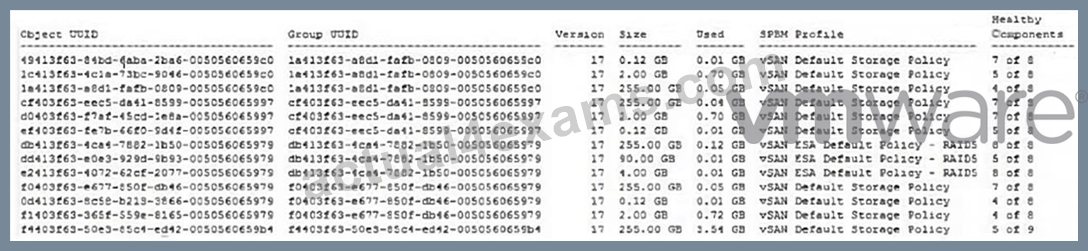
The administrator notices the Healthy Components column, the last column, is reporting some components are not in a fully healthy state.
What could cause this behavior?
- A. New VMDKs have been added to multiple VMs, but the storage policy has not finished applying.
- B. The applied Storage policy has been updated.
- C. One host is in maintenance mode with ensure accessibility.
- D. New physical disks have been claimed and a rebalance operation is underway.
Answer: C
Explanation:
Explanation
The most likely cause for some components to be not in a fully healthy state is that one host is in maintenance mode with the ensure accessibility option. This option creates temporary durability components on other hosts to maintain the required number of failures to tolerate (FTT) until the original components are restored or rebuilt. These durability components are not considered fully healthy because they do not have full redundancy and might not be compliant with the storage policy. The other options do not explain why some components are not fully healthy, as they do not affect the FTT or the compliance state of the objects.
References: Durability Components; esxcli vsan debug object overview
NEW QUESTION # 53
An administrator wishes to prevent vCenter notifications of vSAN Health status during a scheduled maintenance window.
Which action can be taken to achieve this goal?
- A. Disable SNMP service
- B. Disable the performance service
- C. Disable the alarm from the HTML client
- D. Run performance diagnostics prior to scheduled maintenance
Answer: C
Explanation:
Explanation
To prevent vCenter notifications of vSAN Health status during a scheduled maintenance window, the administrator can disable the alarm from the HTML client. This will suppress the alerts for a specified duration or until the alarm is re-enabled. Disabling the performance service, running performance diagnostics, or disabling SNMP service will not affect the vSAN Health status notifications. References: [VMware vSAN Specialist v2 EXAM 5V0-22.23], page 25
NEW QUESTION # 54
A vSAN administrator needs to enable vSAN ESA.
Which two requirements need to be met? (Choose two.)
- A. vSAN Advanced license
- B. vSAN Witness Appliance
- C. vSAN Build Your Own configuration
- D. vSAN Standard license
- E. vSAN ReadyNodes configuration
Answer: D,E
Explanation:
Explanation
To enable vSAN ESA, two requirements that need to be met are: vSAN Standard license or higher, and vSAN ReadyNodes configuration. vSAN Standard license or higher is required to use vSAN ESA, as it is a feature that is only available in vSAN 8.0 or later versions. vSAN ESA is an optional, alternative architecture to vSAN OSA that is designed to process and store data with higher efficiency, scalability, and performance.
vSAN ReadyNodes configuration is required to use vSAN ESA, as it is a hardware configuration that is pre-configured, tested, and certified for VMware Hyper-Converged Infrastructure Software. Each vSAN ReadyNode is optimally configured for vSAN ESA with the required amount of CPU, memory, network, and storage NVMe devices. The other options are not correct. vSAN Build Your Own configuration is not supported for vSAN ESA, as it might not meet the hardware requirements or compatibility for vSAN ESA.
vSAN Witness Appliance is not required to use vSAN ESA, as it is only needed for stretched cluster or two-node cluster configurations. References: vSAN Express Storage Architecture; vSAN ReadyNode Hardware Guidance
NEW QUESTION # 55
Which VMware solution requires vSAN usage?
- A. VMware Cloud Foundation
- B. VMware Horizon
- C. VMware Aria Automation
- D. VMware Telco Cloud Automation
Answer: A
Explanation:
Explanation
The VMware solution that requires vSAN usage is VMware Cloud Foundation. VMware Cloud Foundation is an integrated software stack that bundles compute virtualization (VMware vSphere), storage virtualization (VMware vSAN), network virtualization (VMware NSX), and cloud management and monitoring (VMware vRealize Suite) into a single platform that can be deployed on premises or as a service within a public cloud.
VMware Cloud Foundation relies on vSAN as the primary storage solution for its workload domains, which are logical pools of resources that can be used to run different types of workloads. The other options are not correct. VMware Horizon, VMware Telco Cloud Automation, and VMware Aria Automation are VMware solutions that do not require vSAN usage, although they can benefit from it. VMware Horizon is a platform that delivers virtual desktops and applications across a variety of devices and locations, and it can use any supported storage solution, including vSAN. VMware Telco Cloud Automation is a cloud-native orchestration and automation platform that enables communication service providers to accelerate the deployment and lifecycle management of network functions and services across any network and cloud. It can use any supported storage solution, including vSAN. VMware Aria Automation is not a valid VMware solution name.
References: VMware Cloud Foundation Overview; VMware Horizon Overview; VMware Telco Cloud Automation Overview
NEW QUESTION # 56
An administrator is tasked to create a Kerberos secured NFS v4.1 file share.
Which information is minimally required during the configuration of the File Service?
- A. Organizational Unit, User Account, Password
- B. Active Directory Domain. Organizational Unit, User Account. Password
- C. Active Directory Domain, User Account, Password
- D. Kerberos Server, User Account, Password
Answer: C
Explanation:
Explanation
To create a Kerberos secured NFS v4.1 file share, the administrator needs to provide the following information during the configuration of the File Service:
Active Directory Domain: The domain name of the Active Directory server that provides Kerberos authentication service for the NFS server and clients. For example, example.com.
User Account: The user name of the Active Directory account that has permissions to join the NFS server to the domain and create service principal names (SPNs) for the NFS server. For example, [email protected].
Password: The password of the Active Directory account that is used for authentication. For example, P@ssw0rd.
These information are required to enable Kerberos security for NFS 4.1 and allow the NFS server to obtain a Kerberos ticket from the Active Directory server. The administrator also needs to specify the NFS share name, path, and access permissions1 References: 1: VMware vSphere Storage Guide, page 118
NEW QUESTION # 57
A vSAN administrator has recently upgraded a vSAN cluster to 8.0 OSA and has enabled Capacity Reserve features to reduce the amount of capacity reserved for transient and rebuild operations.
Which scenario would prevent this feature from operating properly?
- A. The used space on vSAN datastore exceeds the suggested slack rebuild threshold.
- B. Underutilized space is above 25-30% of the total capacity threshold.
- C. The physical disk has reached an 80% full reactive rebalance threshold.
- D. The used space on vSAN datastore exceeds the suggested host rebuild threshold.
Answer: A
Explanation:
Explanation
The Capacity Reserve feature in vSAN 8.0 OSA reduces the amount of capacity reserved for transient and rebuild operations by using a slack space threshold. This threshold is calculated based on the size of the largest component in the cluster and the number of failures to tolerate. If the used space on vSAN datastore exceeds the suggested slack space threshold, the feature will not operate properly and vSAN will revert to using the host rebuild reserve threshold. The other scenarios will not affect the Capacity Reserve feature. References:
[VMware vSAN Specialist v2 EXAM 5V0-22.23], page 28
NEW QUESTION # 58
......
Authentic 5V0-22.23 Exam Dumps PDF - Oct-2025 Updated: https://latestdumps.actual4exams.com/5V0-22.23-real-braindumps.html