


New 2024 Realistic Free Microsoft AZ-104 Exam Dump Questions and Answer
AZ-104 Practice Test Engine: Try These 361 Exam Questions
Microsoft AZ-104 certification exam consists of 40-60 multiple-choice questions, and you will have 180 minutes to complete it. AZ-104 exam is available in English, Japanese, Chinese (Simplified), and Korean. AZ-104 exam fee is $165 USD, but prices may vary depending on your location. If you do not pass the exam on your first attempt, you can retake it after 24 hours.
Knowing the Exam Profile
Microsoft AZ-104 follows the same pattern as all Microsoft’s intermediate-level exams. Therefore, it contains nearly 40-60 questions and the total time duration given to answer them is 180 minutes. While the general passing score of about 70%, a certain number is not disclosed, and it is likely to get changed as per the total number of questions. The tasks are provided in the multiple-choice format but be ready to face the items of other types as well.
The results that you will gain come with lifetime validity. However, the vendor proposes various enhancement options for those who want to pump up their career. Interested candidates can choose to earn the higher-level accreditation of their liking. Also, other than bringing you the Azure Administrator Associate certificate, the exam score will lead to earning some ACE college credits.
When it comes to the cost, candidates will have to pay $165 as an exam fee. One must comprehend the amount is subject to change as per different countries. AZ-104 test can be taken in English, Simplified Chinese, Korean, and Japanese from anywhere in the world via a testing center and online proctored facility.
NEW QUESTION # 155
Note: This question is part of a series of questions that present the same scenario. Each question in the series contains a unique solution that might meet the stated goals. Some question sets might have more than one correct solution, while others might not have a correct solution.
After you answer a question in this section, you will NOT be able to return to it. As a result, these questions will not appear in the review screen.
You have an Azure subscription that contains the following users in an Azure Active Directory tenant named contoso.onmicrosoft.com:
User1 creates a new Azure Active Directory tenant named external.contoso.onmicrosoft.com.
You need to create new user accounts in external.contoso.onmicrosoft.com.
Solution: You instruct User4 to create the user accounts.
Does that meet the goal?
- A. yes
- B. No
Answer: B
Explanation:
Explanation
Only a global administrator can add users to this tenant.
Reference:
https://docs.microsoft.com/en-us/azure/devops/organizations/accounts/add-users-to-azure-ad
NEW QUESTION # 156
You have an Azure subscription.
You deploy a virtual machine scale set that is configured as shown in the following exhibit.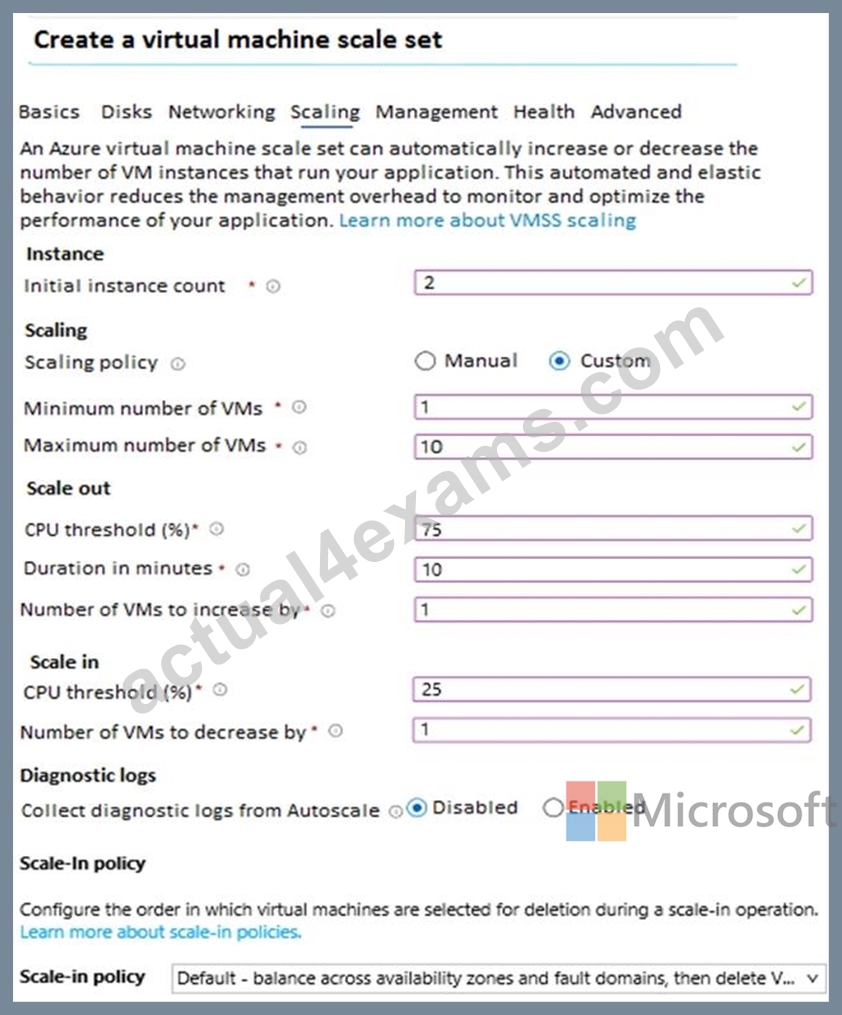
Use the drop-down menus to select the answer choice that answers each question based on the information presented in the graphic NOTE: Each correct selection is worth one point.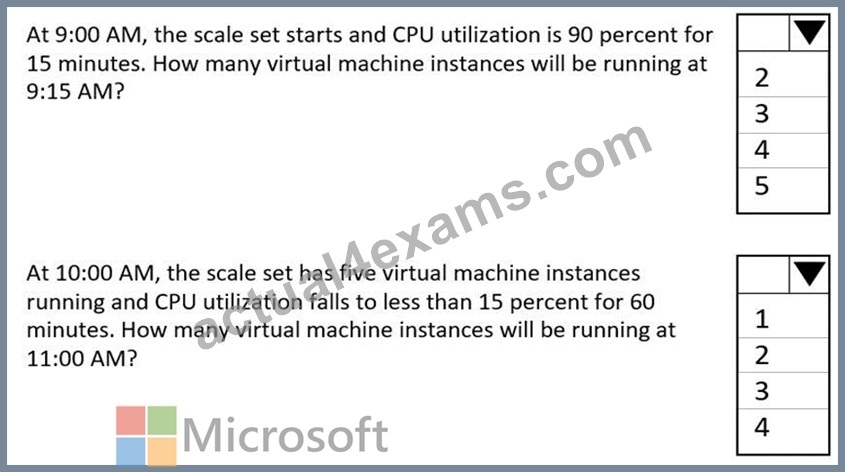
Answer:
Explanation: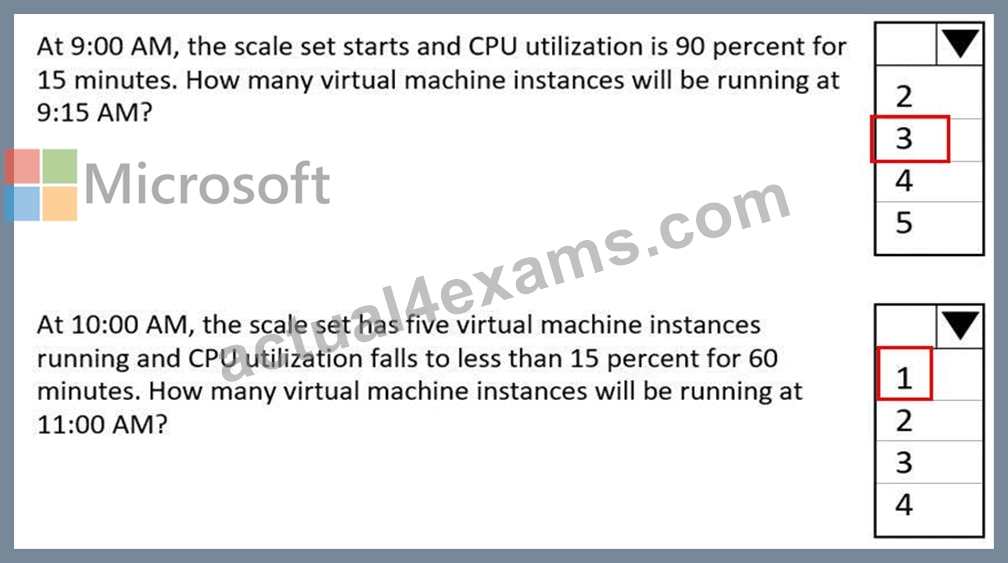
Reference:
https://docs.microsoft.com/en-us/azure/virtual-machine-scale-sets/virtual-machine-scale-sets-autoscale-portal
NEW QUESTION # 157
You have an on premises data center and an Azure subscription. The data center contains two VPN devices. The subscription contains an Azure virtual network named VNet1. VNet1 contains a gateway subnet.
You need to create a site-to-site VPN. The solution must ensure that if a single instance of an Azure VPN gateway fails, or a single on-premises VPN device fails, the failure will not cause an interruption that is longer than two minutes.
What is the minimum number of public IP addresses, virtual network gateways, and local network gateways required in Azure? To answer, select the appropriate options in the answer area.
NOTE: Each correct selection is worth one point.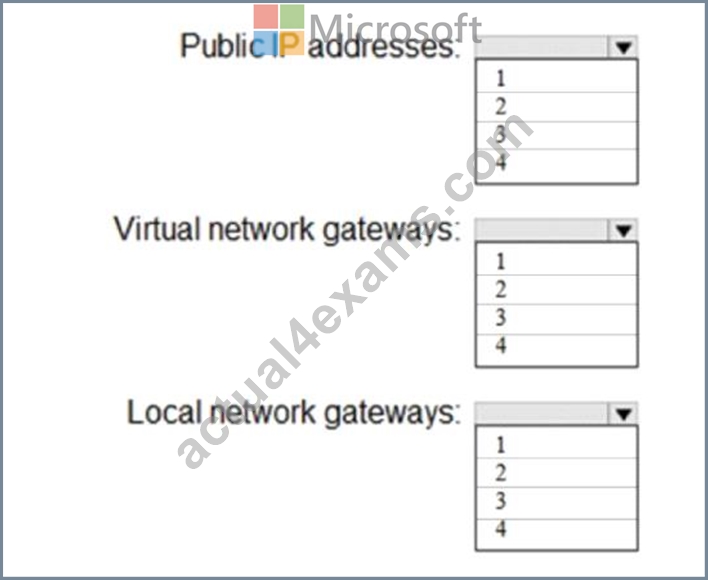
Answer:
Explanation: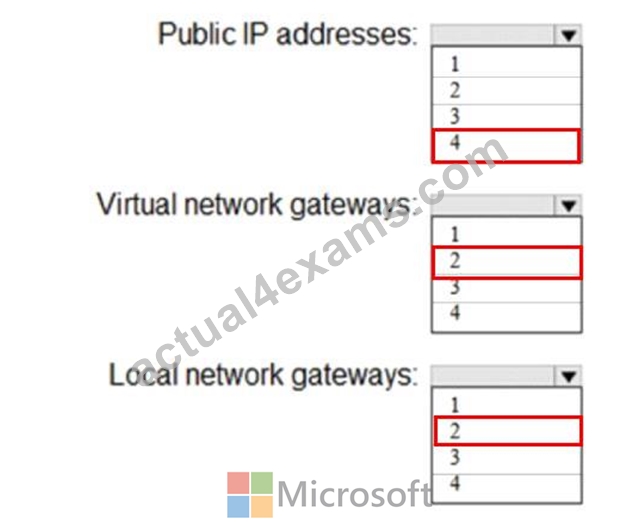
Box 1: 4
Two public IP addresses in the on-premises data center, and two public IP addresses in the VNET.
The most reliable option is to combine the active-active gateways on both your network and Azure, as shown in the diagram below.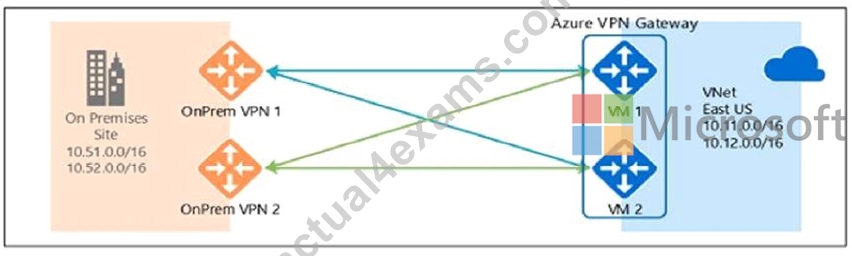
Box 2: 2
Every Azure VPN gateway consists of two instances in an active-standby configuration. For any planned maintenance or unplanned disruption that happens to the active instance, the standby instance would take over (failover) automatically, and resume the S2S VPN or VNet-to-VNet connections.
Box 3: 2
Dual-redundancy: active-active VPN gateways for both Azure and on-premises networks
Reference:
https://docs.microsoft.com/en-us/azure/vpn-gateway/vpn-gateway-highlyavailable
NEW QUESTION # 158
You have an Azure Storage account named storage1.
You have an Azure App Service app named app1 and an app named App2 that runs in an Azure container instance. Each app uses a managed identity.
You need to ensure that App1 and App2 can read blobs from storage1 for the next 30 days.
What should you configure in storage1 for each app?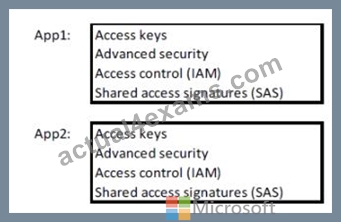
Answer:
Explanation: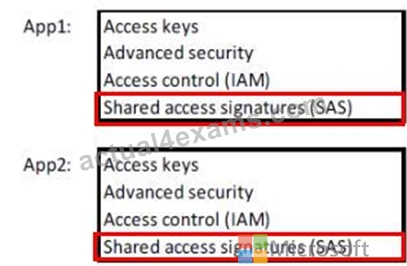
Explanation:
With Shared access signature you can limit the resources for access and at the same time can control the duration of the access.
A shared access signature (SAS) provides secure delegated access to resources in your storage account without compromising the security of your data. With a SAS, you have granular control over how a client can access your data. You can control what resources the client may access, what permissions they have on those resources, and how long the SAS is valid, among other parameters.
Reference:
https://docs.microsoft.com/en-us/azure/storage/common/storage-sas-overview
NEW QUESTION # 159
You are evaluating the connectivity between the virtual machines after the planned implementation of the Azure networking infrastructure.
For each of the following statements, select Yes if the statement is true. Otherwise, select No.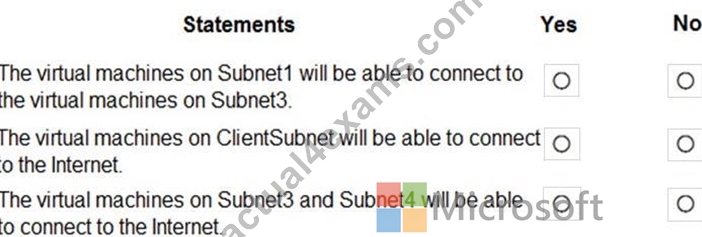
Answer:
Explanation: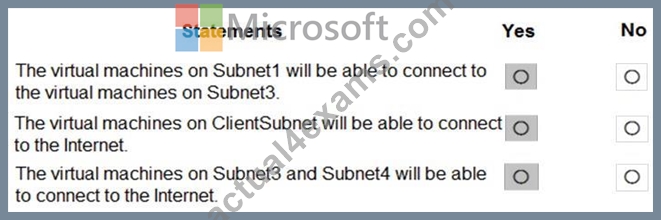
Once the VNets are peered, all resources on one VNet can communicate with resources on the other peered VNets. You plan to enable peering between Paris-VNet and AllOffices-VNet. Therefore VMs on Subnet1, which is on Paris-VNet and VMs on Subnet3, which is on AllOffices-VNet will be able to connect to each other.
All Azure resources connected to a VNet have outbound connectivity to the Internet by default. Therefore VMs on ClientSubnet, which is on ClientResources-VNet will have access to the Internet; and VMs on Subnet3 and Subnet4, which are on AllOffices-VNet will have access to the Internet.
Reference:
https://docs.microsoft.com/en-us/azure/virtual-network/virtual-network-peering-overview
https://docs.microsoft.com/en-us/azure/networking/networking-overview#internet-connectivity
NEW QUESTION # 160
You have an Azure web app named App1. App1 has the deployment slots shown in the following table: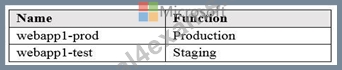
In webapp1-test, you test several changes to App1.
You back up App1.
You swap webapp1-test for webapp1-prod and discover that App1 is experiencing performance issues.
You need to revert to the previous version of App1 as quickly as possible.
What should you do?
- A. Swap the slots
- B. Redeploy App1
- C. Clone App1
- D. Restore the backup of App1
Answer: A
Explanation:
Explanation
When you swap deployment slots, Azure swaps the Virtual IP addresses of the source and destination slots, thereby swapping the URLs of the slots. We can easily revert the deployment by swapping back.
You can validate app changes in a staging deployment slot before swapping it with the production slot.
Deploying an app to a slot first and swapping it into production makes sure that all instances of the slot are warmed up before being swapped into production. This eliminates downtime when you deploy your app. The traffic redirection is seamless, and no requests are dropped because of swap operations. You can automate this entire workflow by configuring auto swap when pre-swap validation isn't needed.
After a swap, the slot with previously staged app now has the previous production app. If the changes swapped into the production slot aren't as you expect, you can perform the same swap immediately to get your "last known good site" back.
Reference:
https://docs.microsoft.com/en-us/azure/app-service/deploy-staging-slots
NEW QUESTION # 161
Note: This question is part of a series of questions that present the same scenario. Each question in the series contains a unique solution that might meet the stated goals. Some question sets might have more than one correct solution, while others might not have a correct solution.
After you answer a question in this section, you will NOT be able to return to it. As a result, these questions will not appear in the review screen.
You need to ensure that an Azure Active Directory (Azure AD) user named Admin1 is assigned the required role to enable Traffic Analytics for an Azure subscription.
Solution: You assign the Reader role at the subscription level to Admin1.
Does this meet the goal?
- A. No
- B. Yes
Answer: B
Explanation:
Explanation
Your account must meet one of the following to enable traffic analytics:
Your account must have any one of the following Azure roles at the subscription scope: owner, contributor, reader, or network contributor.
Reference:
https://docs.microsoft.com/en-us/azure/network-watcher/traffic-analytics-faq
NEW QUESTION # 162
Note: This question is part of a series of questions that present the same scenario. Each question in the series contains a unique solution that might meet the stated goals. Some question sets might have more than one correct solution, while others might not have a correct solution.
After you answer a question in this section, you will NOT be able to return to it. As a result, these questions will not appear in the review screen.
You have an Azure virtual machine named VM1 that runs Windows Server 2016.
You need to create an alert in Azure when more than two error events are logged to the System event log on VM1 within an hour.
Solution: You create an Azure Log Analytics workspace and configure the data settings. You install the Microsoft Monitoring Agent on VM1. You create an alert in Azure Monitor and specify the Log Analytics workspace as the source.
Does this meet the goal?
- A. No
- B. Yes
Answer: B
Explanation:
Section: [none]
Explanation:
Alerts in Azure Monitor can identify important information in your Log Analytics repository. They are created by alert rules that automatically run log searches at regular intervals, and if results of the log search match particular criteria, then an alert record is created and it can be configured to perform an automated response.
The Log Analytics agent collects monitoring data from the guest operating system and workloads of virtual machines in Azure, other cloud providers, and on-premises. It collects data into a Log Analytics workspace.
Reference:
https://docs.microsoft.com/en-us/azure/azure-monitor/learn/tutorial-response
https://docs.microsoft.com/en-us/azure/azure-monitor/platform/agents-overview
NEW QUESTION # 163
You plan to use Azure Network Watcher to perform the following tasks:
Task1: Identify a security rule that prevents a network packet from reaching an Azure virtual machine Task2: Validate outbound connectivity from an Azure virtual machine to an external host Which feature should you use for each task? To answer, select the appropriate options in the answer area.
NOTE: Each correct selection is worth one point.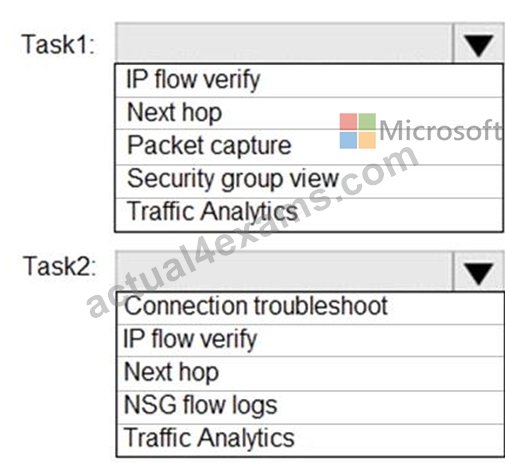
Answer:
Explanation: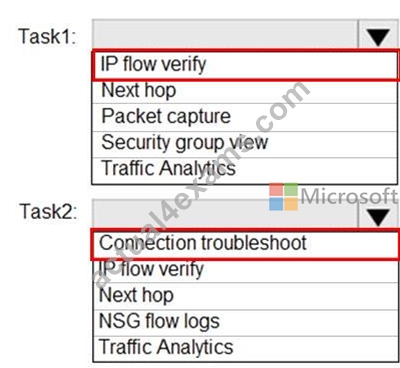
Task 1: IP flow verify
The IP flow verify capability enables you to specify a source and destination IPv4 address, port, protocol (TCP or UDP), and traffic direction (inbound or outbound). IP flow verify then tests the communication and informs you if the connection succeeds or fails. If the connection fails, IP flow verify tells you which security rule allowed or denied the communication, so that you can resolve the problem.
Task 2: Connection troubleshoot
The connection troubleshoot capability enables you to test a connection between a VM and another VM, an FQDN, a URI, or an IPv4 address. The test returns similar information returned when using the connection monitor capability, but tests the connection at a point in time, rather than monitoring it over time.
Reference:
https://docs.microsoft.com/en-us/azure/network-watcher/network-watcher-monitoring-overview
https://docs.microsoft.com/en-us/azure/network-watcher/network-watcher-ip-flow-verify-overview
https://docs.microsoft.com/en-us/azure/network-watcher/network-watcher-connectivity-overview
NEW QUESTION # 164
You have Azure subscriptions named Subscription1 and Subscription2.
Subscription1 has following resource groups:
RG1 includes a web app named App1 in the West Europe location.
Subscription2 contains the following resource groups:
For each of the following statements, select Yes if the statement is true. Otherwise, select No.
NOTE: Each correct selection is worth one point.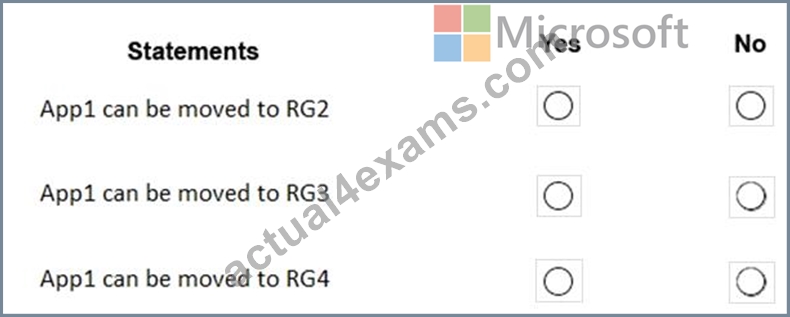
Answer:
Explanation: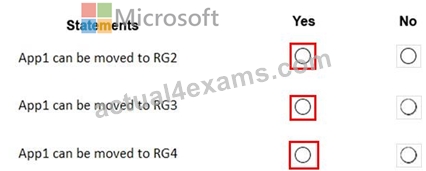
App1 present in RG1 and in RG1 there is no lock available. So you can move App1 to other resource groups, RG2, RG3, RG4.
Note:
App Service resources can only be moved from the resource group in which they were originally created. If an App Service resource is no longer in its original resource group, move it back to its original resource group.
Reference:
https://docs.microsoft.com/en-us/azure/azure-resource-manager/management/move-limitations/app-service-move-limitations
NEW QUESTION # 165
You have an on premises data center and an Azure subscription. The data center contains two VPN devices. The subscription contains an Azure virtual network named VNet1. VNet1 contains a gateway subnet.
You need to create a site-to-site VPN. The solution must ensure that if a single instance of an Azure VPN gateway fails, or a single on-premises VPN device fails, the failure will not cause an interruption that is longer than two minutes.
What is the minimum number of public IP addresses, virtual network gateways, and local network gateways required in Azure? To answer, select the appropriate options in the answer area.
NOTE: Each correct selection is worth one point.
Answer:
Explanation: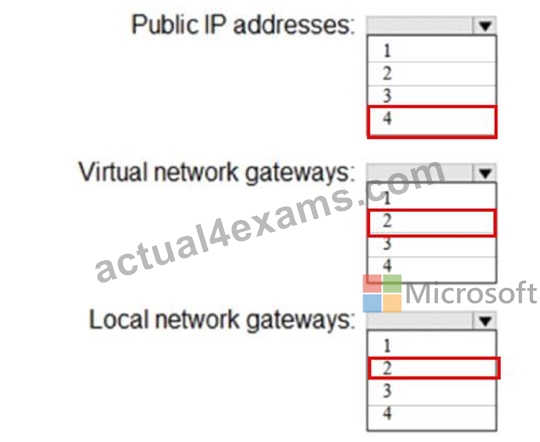
Reference:
https://docs.microsoft.com/en-us/azure/vpn-gateway/vpn-gateway-highlyavailable
NEW QUESTION # 166
You plan to use Azure Network Watcher to perform the following tasks:
* Task1: Identify a security rule that prevents a network packet from reaching an Azure virtual machine
* Task2: Validate outbound connectivity from an Azure virtual machine to an external host Which feature should you use for each task? To answer, select the appropriate options in the answer area.
NOTE: Each correct selection is worth one point.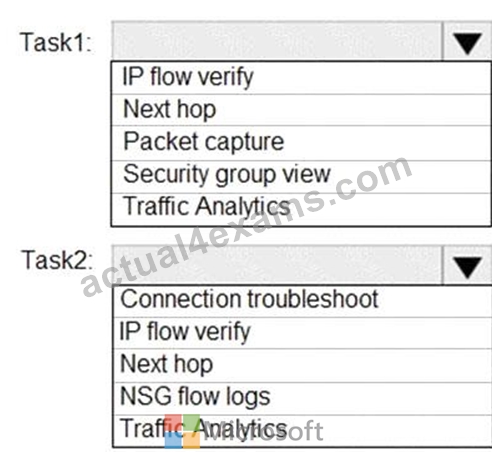
Answer:
Explanation: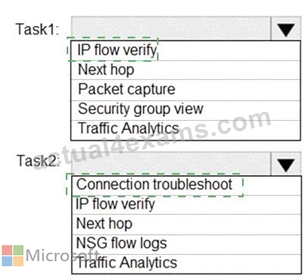
Explanation
1: IP Flow verify
2: Connection troubleshoot
https://docs.microsoft.com/en-us/azure/network-watcher/network-watcher-monitoring-overview
NEW QUESTION # 167
Note: This question is part of a series of questions that present the same scenario. Each question in the series contains a unique solution that might meet the stated goals. Some question sets might have more than one correct solution, while others might not have a correct solution.
After you answer a question in this section, you will NOT be able to return to it. As a result, these questions will not appear in the review screen.
You have an Azure virtual machine named VM1 that runs Windows Server 2016.
You need to create an alert in Azure when more than two error events are logged to the System log on VM1 within an hour.
Solution: You create an event subscription on VM1. You create an alert in Azure Monitor and specify VM1 as the source.
Does this meet the goal?
- A. Yes
- B. No
Answer: B
Explanation:
Instead: You create an Azure Log Analytics workspace and configure the data settings. You install the Microsoft Monitoring Agent on VM1. You create an alert in Azure Monitor and specify the Log Analytics workspace as the source.
Reference:
https://docs.microsoft.com/en-us/azure/azure-monitor/platform/agents-overview
NEW QUESTION # 168
You have an Azure Storage accounts as shown in the following exhibit.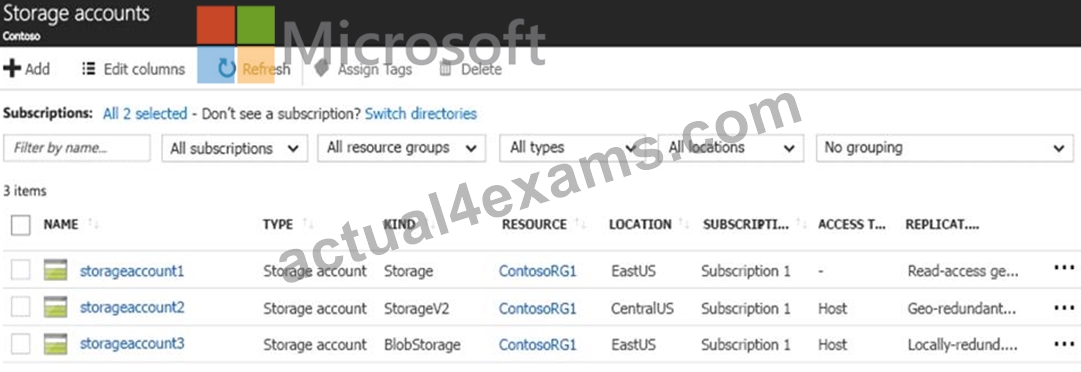
Use the drop-down menus to select the answer choice that completes each statement based on the information presented in the graphic.
NOTE: Each correct selection is worth one point.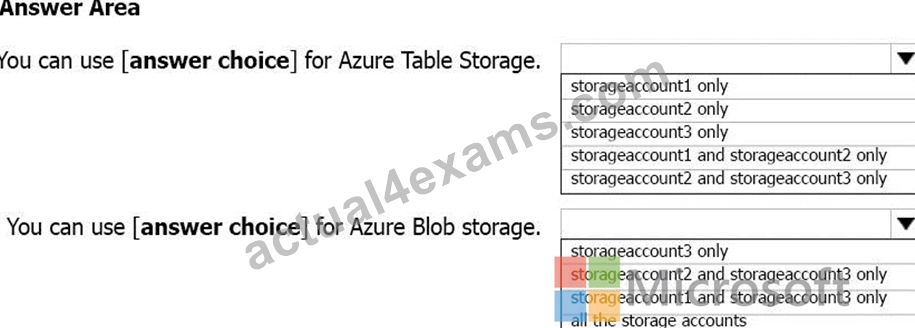
Answer:
Explanation: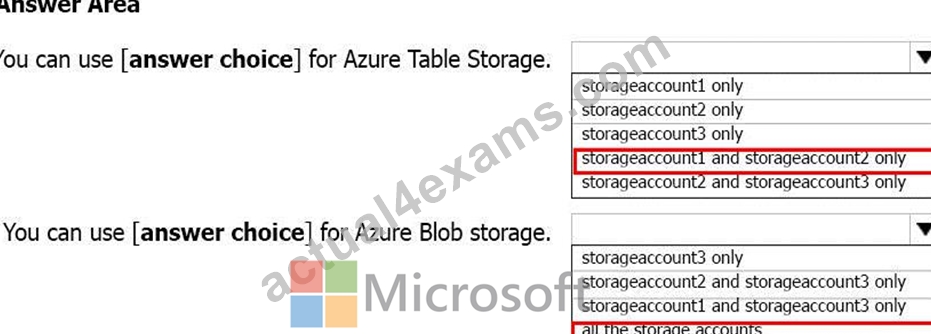
NEW QUESTION # 169
You have an Azure subscription.
You need to implement a custom policy that meet the following requirements:
*Ensures that each new resource group in the subscription has a tag named organization set to a value of Contoso.
*Ensures that resource group can be created from the Azure portal.
*Ensures that compliance reports in the Azure portal are accurate.
How should you complete the policy? To answer, select the appropriate options in the answers area.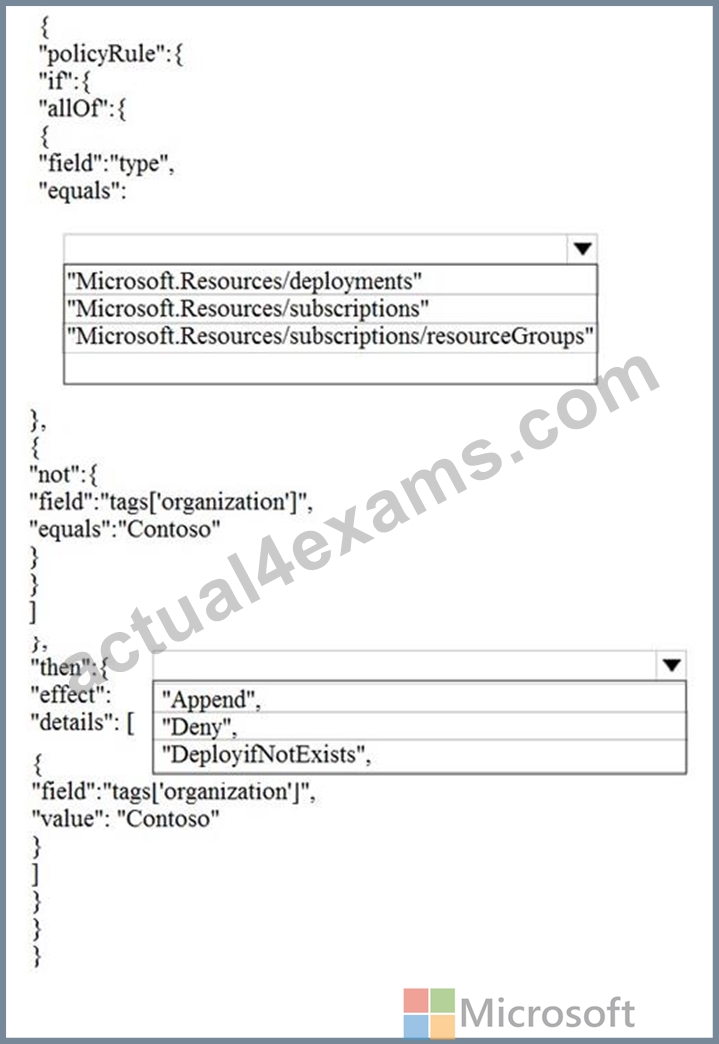
Answer:
Explanation: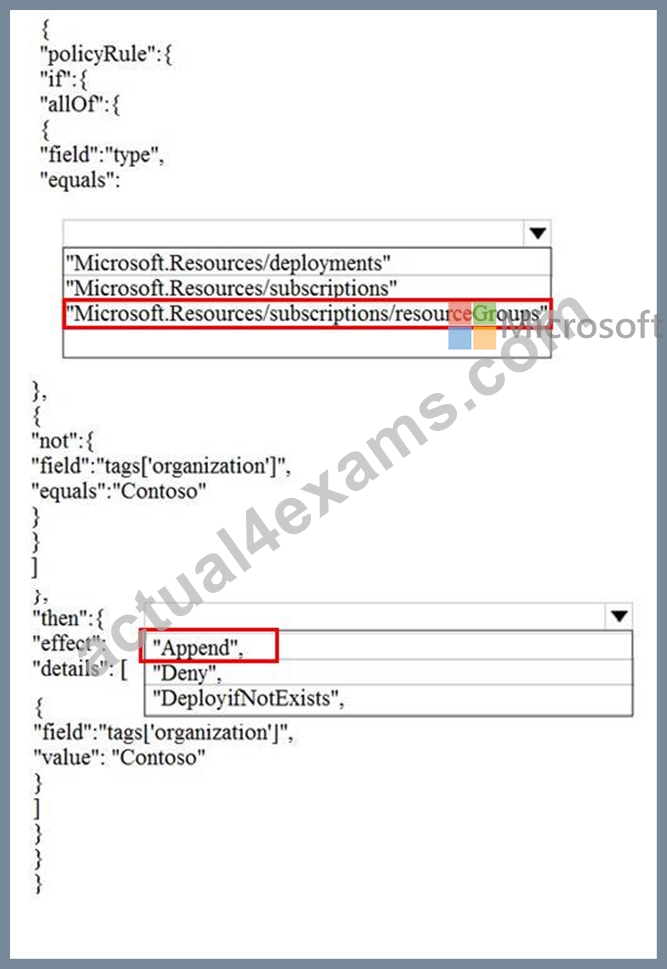
Reference:
https://docs.microsoft.com/en-us/azure/governance/policy/concepts/definition-structure
https://docs.microsoft.com/en-us/azure/role-based-access-control/custom-roles
https://docs.microsoft.com/en-us/azure/governance/policy/concepts/effects
NEW QUESTION # 170
You create a Recovery Services vault backup policy named Policy1 as shown in the following exhibit.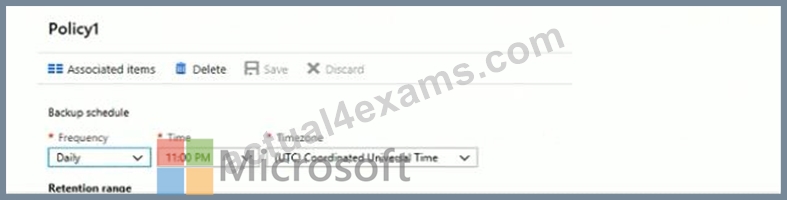
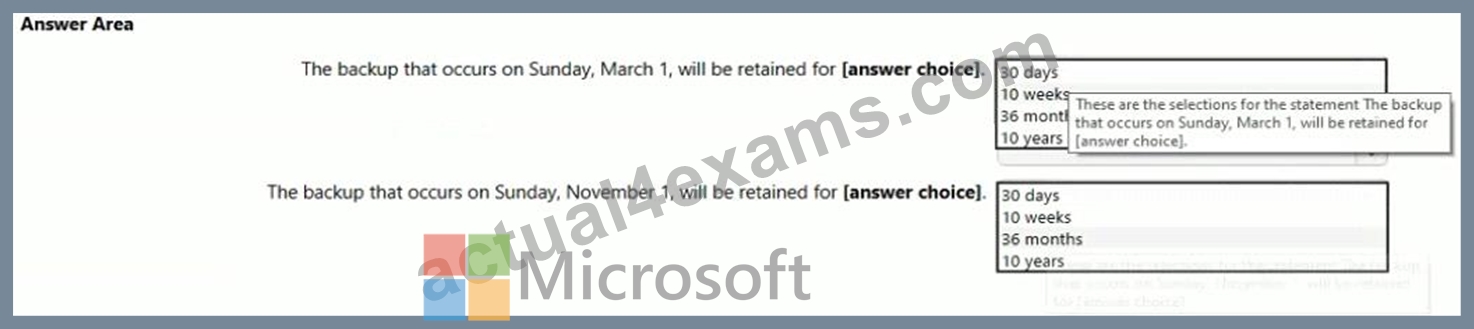
Answer:
Explanation: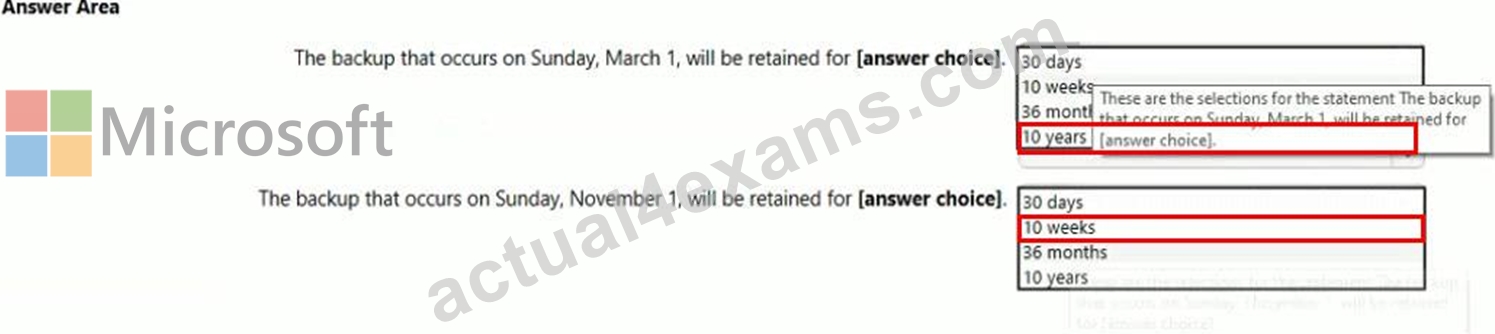
NEW QUESTION # 171
You have an Azure subscription named Subscription1 that contains the quotas shown in the following table.
You deploy virtual machines to Subscription1 as shown in the following table.
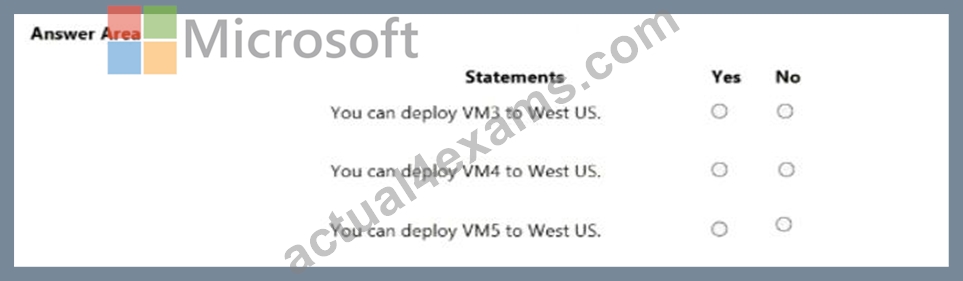
Answer:
Explanation: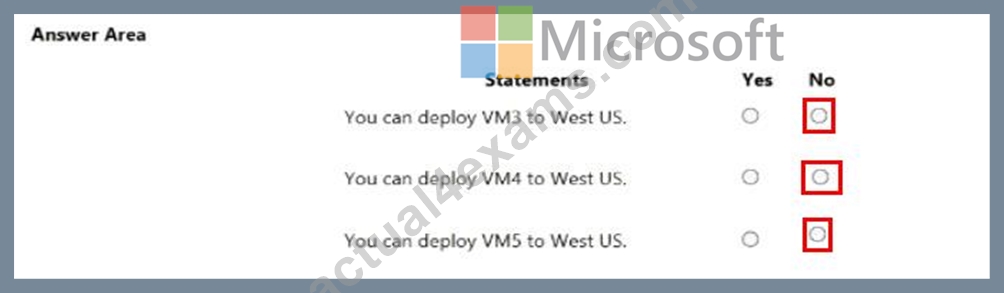
NEW QUESTION # 172
Your company has a main office in London that contains 100 client computers.
Three years ago, you migrated to Azure Active Directory (Azure AD).
The company's security policy states that all personal devices and corporate-owned devices must be registered or joined to Azure AD.
A remote user named User1 is unable to join a personal device to Azure AD from a home network.
You verify that other users can join their devices to Azure AD.
You need to ensure that User1 can join the device to Azure AD.
What should you do?
- A. Create a point-to-site VPN from the home network of User1 to Azure.
- B. From the Device settings blade, modify the Users may join devices to Azure AD setting.
- C. From the Device settings blade, modify the Maximum number of devices per user setting.
- D. Assign the User administrator role to User1.
Answer: C
Explanation:
The Maximum number of devices setting enables you to select the maximum number of devices that a user can have in Azure AD. If a user reaches this quota, they will not be able to add additional devices until one or more of the existing devices are removed.
Incorrect Answers:
A: The Users may join devices to Azure AD setting enables you to select the users who can join devices to Azure AD. Options are All, Selected and None. The default is All.
C: Azure AD Join enables users to join their devices to Active Directory from anywhere as long as they have connectivity with the Internet.
References:
https://docs.microsoft.com/en-us/azure/active-directory/devices/device-management-azure-portal
http://techgenix.com/pros-and-cons-azure-ad-join/
NEW QUESTION # 173
You have an Azure subscription that contains a virtual network named VNET1 in the East US 2 region. You have the following resources in an Azure Resource Manager template.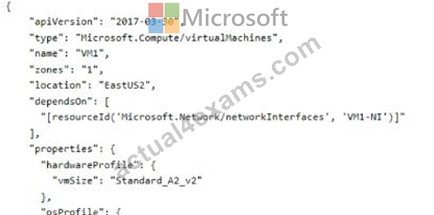
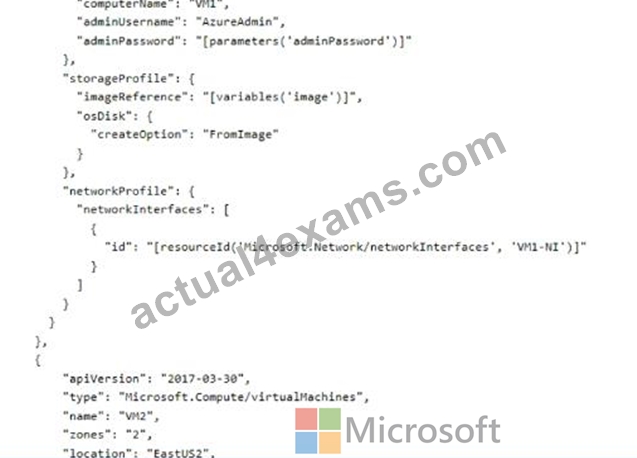
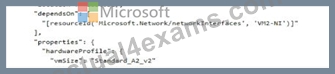
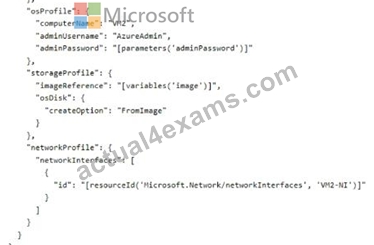
For each of the following statements, select Yes if the statement is true. Otherwise, select No.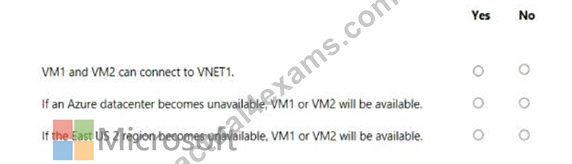
Answer:
Explanation: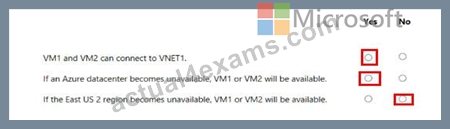
Reference:
https://docs.microsoft.com/en-us/azure/architecture/resiliency/recovery-loss-azure-region
NEW QUESTION # 174
......
Introduction of Microsoft Azure Administrator Exam
Microsoft Certified Solutions Associate (MCSA): Microsoft Azure Administrator is an exam that is used to test your knowledge of designing solutions with Microsoft Azure. Your understanding of the various Azure services and how they work is important if you want to pass this exam. Proficiency with all the Azure services is required. Assessment, App Service, API Management, and Blob Storage are all important for this exam. Proficiency with all of the Azure services is required. The Microsoft az-104 test will measure your knowledge of implementing these different solutions. Microsoft AZ-104 exam dumps are an important part of obtaining your certification. Mastery of Azure is important in order to achieve the Microsoft AZ-104 certification. Exampreparation is an important part of the test. Rewarding career opportunities and an increase in pay are only a few of the benefits of achieving this certification.
Paths and Domains and Solution and Subscription and Usage and Virtual Machines and Websites all require you to know each of the Azure services. Additionally, Node Manager, Key Vault, Log Analytics, Machine Learning Studio, Network Watcher Replication, OMS Workspace Portal, and Operations Management Suite Workload are all included in this practice exam. Head to head Azure exam prep with these free materials is still the best option. Reach your goal with the certification exam. Workers with this certification are more likely to receive high-paying jobs. Applicants with a Microsoft AZ-104 certification stand out from the crowd. Incredible career opportunities await applicants with the Microsoft AZ-104 certification.
Guaranteed Success in Microsoft Azure Administrator Associate AZ-104 Exam Dumps: https://latestdumps.actual4exams.com/AZ-104-real-braindumps.html